

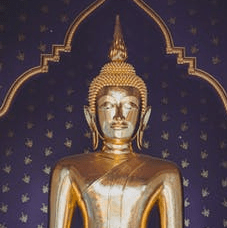
In the traditional Theravadan Buddhist tradition, it is commonly told that every moment can potentially be a moment for practice, for training. This practice is fostered by a mindfulness into the content of conscious experience, and, as every moment we hold the potential for being conscious of the content that arises, we can continually push our attention towards that content, and in doing so gain insights and cultivate a character of a certain nature, that follows from the practice. The essential characteristics that are developed in pursuing a mindful awareness of the conscious content within the present moment, are those of equanimity, and of understanding the nature of consciousness. If we better understand the mind, and the experience with which we are emerged in every moment, and its essential characteristics, we are better able to deal with that experience, for we recognize from which it arises, how it fades away, and understand the method of dealing with it which produces the most wholesome response to novel situations. This necessarily is included under wisdom, as we gain in experience in recognizing and differentiating phenomena that arises in consciousness, we gain the experiential knowledge of how best to respond to situations, and the set of all situations, and the path towards a mind that is calm, content, and free of desire (mostly), marked by equanimity, virtuosity in conduct, and thus providing a better experience of life for ourselves, and for those in our expanding circle of influence.
The Buddha pointed out key contributors to this nature of our conscious awareness, for which we are urged to discover ourselves. These key points are namely of threefold nature, and are categorized as the three marks of existence, from which we can extrapolate coinciding foundational truths which describe the nature of all sentient systems. The three marks which permeate the substratum for our psychological experience, are those of suffering or unsatisfactory nature, impermanence, and non-self.
This unsatisfactory nature is necessarily underlying all experience, as we constantly desire for things to be different, we desire something more than what we are, whether it be material or external gain such as career success, relationship optimization, health, youth, fame, or the desire for immaterial, or internal change, whether it be a better mode of being, a better experience of the present moment, if we are sad we desire to be happy, if we experience an unpleasant sensation we crave a pleasant one, if we are happy, and things apparently are going good, we desire for them to continue doing so. This desire, and lack of the object of desire, necessarily is conditioned by the unsatisfactoriness we contain in the present moment. If we were content, we wouldn’t desire, if we wouldn’t desire we wouldn’t suffer. Now on a practical note, the urge we contain to desire is necessary for survival, and is altogether inescapable. But the content of what is desired, and the ranging degree of wholesome or unwholesome desires which drive us, can be altered through training and practice, and more importantly, our response to the arising of all desires is what we can work to optimize. We must learn to distinguish which things are worthy of pursuing, which things aren’t, what is beneficial and useful to us and others, and what is merely the product societal or cultural influence that could be detrimental to our wellbeing. While our desires are spontaneously produced by the neural network that drives our nervous system in ways in which it believes are optimal for the organism, many times these urges are contradictory to our consciously conceived values, and in such cases, we must direct our gaze towards the things that are consciously considered as meaningful to us, and react to unwholesome desires, states of mind, and in general, those things which do not promote the wellbeing of us and of the sentient beings in our expanding circle of influence. While we cannot escape desire, we can recognize its place in creating the suffering which marks our existence. In its recognition, we can work to optimize the desire system, to make our desires range of interest less, and point in directions which we wisely intuit as being more meaningful to us. It is in the practice of present moment awareness that we can recognize our desires arising, the content and object they wish to pursue, and in being aware of the desire, discriminate whether or not it would be in our best interest to pursue such content. In remaining equanimous, and not spontaneously reacting to the content that arises, we can better direct our lives and our mental state to a place which we potentially contain, that marked by wellbeing, virtue, or whatever value you have uncovered as being important to you.
The insight of impermanence is recognized through the Buddhist practice as pervading all conditioned phenomena. It doesn’t take much looking to realize that all phenomena are conditioned, or determined on prior causes, that due to certain conditions, every phenomena arises, and if those conditions were not present, then that phenomena wouldn’t ever manifest itself. That being said, all phenomena in the present moment, necessarily is the cause or condition for further phenomena. Nothing stays the same, no matter how much the illusion of permanence appears to us to be real. The flux of existence, and of our mental content, is easily recognized if we pay sufficient attention to the content of our experience. The next moment holds new content, and the previous moment’s content slips way. Anything that appears to be, is merely arising now, and fading away now. Nothing ever lasts. As time moves, our consciousness moves, and the content within it, changes. The recognition of this fundamental mark of existence has implications that are vast, a few of which I’ll name here. For one, once we recognize that all phenomena are impermanent, we simultaneously realize that not only is no mode of being, or state of consciousness, is worth attempting to hold on to, but that it is impossible to hold on to. As in mental formations, so too in material. Modern physics clearly demonstrates this to us, that matter is always undergoing constant transformation, and as we necessarily are that matter, which appears to us as being that experience of Being which is consciousness, “we” too are constantly undergoing change. If we see that experience is transient by its inherent nature, in the same way that the natural world is, we not only can recognize there is no inherent difference between the two, that they are one in the same, but we can extrapolate this insight into practical matters in how our lives are conducted. When we enter into a negative, unwholesome, or undesired state of mind that we are naturally averse to, we must not complain, be averse to it, or falsely believe it will last forever. It is not permanent, it will change, and the conditions for its change are available to us dependent on the amount of experience we have in dealing with the causal nature that conditions experience. If we are in a positive state of mind, we too need to accept with pure equanimity that it too will not last, so when it fades, and it will, we will not be disheartened by the change in the mode of being, and the experience that it produces. If we are able to see all states of mind, all emotions, all thoughts, experiences in this manner, through the lens of impermanence, we better are able to remain equanimous, and undisturbed in peace of mind regardless of the content of our experience. This doesn’t mean we don’t care, or don’t experience emotions, or don’t have a full experience of life, to the contrary, not only are we better able to experience life (through greater ability to be mindful) but we are better able to deal with both the ups and down of temporal life, we are better able to navigate the psychological landscape, as we can recognize its transient nature, and respond in better ways which produce more wholesome, beneficial, and useful experiences, through greater penetration into the insight of what is causing change, and the effect of such content.
The third mark of existence is that of non-self, which can be tied causally and into the same world view, as the previous two. The three naturally exist within the same world, and like the other two, the truth of non-self supports their existence, as well as is available to us to experientially realize ourselves. The non-self doctrine is a bit tricky to intuit without sufficient practice in mindfulness, as we all act under the presupposition that we are “this being” which we use language to distinguish as ourselves, and which we point out others, all as being individuals. Our language and intuitions in this regard are useful in a conventional and practical sense, but they do ultimately hinder us in understanding the nature of our own mind. When Buddha taught non-self, it directly contradicted the Hindu notion of Self, and what he meant by it isn’t that there aren’t people, it isn’t a doctrine of non-personhood. There are beings, with which we mentally categorize as individuals, and that doesn’t change. What he points to is the feeling that there is a concrete, unchanging, controller of our own conscious experience. The intuition that “we” or “I’m” the driving force of my own experience, that “I” as an entity, command the next content of consciousness into existence, is the illusion which the Buddha rightly points out is an illusion, to which we all can realize. I hope this language is intuitable for the content it represents! As pointed out before, the content of experience is merely arising in consciousness, “we”, or, who we think we are – a self – is not directing the next content of experience to arise, nor are we directing the next thought to arise, or the next words which come out of our mouth, or the next actions we undertake. These things merely are happening. This doesn’t mean that as an organism we don’t have choices, and it doesn’t mean that the experience of consciousness doesn’t exist, it just means that there is no center to this Being commanding it. The Buddha points out that what we really are is the aggregation of five principle classificatory groups, which can be used to further distinguish who we actually are. When I say we, or you, or I, it isn’t meant in this ultimate, fundamental sense, but in a practical sense in which language as we know it differentiates people. The five aggregates are those of perception, name and form, feeling, mental formations, and consciousness. All experience is differentiated into these categories by the Buddha, and none of them, by themselves, constitues who we are. In other words, “we” are not our thoughts, nor our perceptions, nor the concepts and identifications we give to objects, nor are we the habits our survival organism acquires, nor are we the awareness that is able to witness the content of experience, and it seems to make sense that people don’t necessarily identify with any of these phenomena. Any search into a single factor of defining “who we are” will result in us deciding that, “no I am not that”, on all accounts, and a generalization of the Self residing within all experience, or the source form which all experience originates, also points to a lack of control and permanence, as we don’t choose the content “supposedly” stemming from this “Self”, leading us to believe that we too, “are not that”. As we don’t choose the content to arise, and there is a multitude of content and type of content arising into consciousness, we cannot pin the self down to any one of them, nor to the totality of them. There is nothing concrete, that is permanent, carrying over from moment to moment, as we initially intuited before introspection. What we are, is our experience, made up of the aggregations of very different content, and it is constantly changing, meaning we are constantly changing, and therefore, there is no permanent self carried over from moment to moment. There is no controller, there is no Being – which we think we are – directing the show, there merely is the show, and it is marked by these three fundamental truths, that experience is driven by desire and the unsatisfactory nature which underlies all content, that the content is impermanent and constantly subject to change, and that it arises from subsystems, it arises in the present moment, and is not directed to arise.
That being said, our thoughts can and frequently do proceed actions, and the conscious recognition of wholesome values does influence our actions, this makes us able to make choices and decisions, and to form better or worse responses to novel situations in which we find ourselves in. The non-self doctrine doesn’t bar us from making choices, it just helps us notice that on an ultimate level, these choices are not made by ourselves, that they are conditioned and thus determined by prior causes. This recognition and insight allows us to better pursue the things we value, as we better come to understand the preconditions for the arising of phenomena that we desire to arise, and with more experience, and greater knowledge, we become better able to navigate life.
 Seek Truth