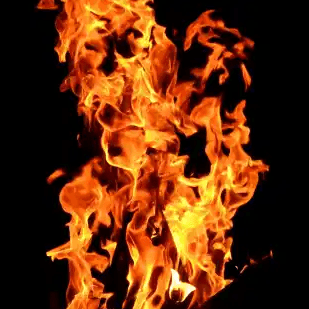
Fire is a good metaphorical representation for reality, as well as for all the phenomena occurring in human consciousness. Fire gives a clear visual in the present moment of being in an impermanent and constantly changing state, that is conditioned by external factors, and contains a fixed end to its manifestation that is as simple to see as the running out of wood. A close introspective look at our own subjective consciousness and its contents describes the same findings, and tells us a lot about our neurophysiology which makes up the ground level of our experience, yet is more difficult to clearly see. With fire we can see clearly from each present moment to the next that of changing nature, constantly present energy, moving, and never remaining the same, but with our own subjective identity, or “self”, we may be tricked into seeing something stable, and carried along from one moment to the next, as being the core defining aspect of who we are, or the CEO in charge that is carried over from one day to be next.
Who we are cannot follow different physical laws than fire does, and in fact it doesn’t, we both are part of the same reality, and we can observe that this self that we once thought to be permanent, unchanging, and moving through time without change or without being conditioned, is an illusion in which we were wrong about. Anything in this world that is conditioned, and is dependent on properties for it’s arising, like fire, is subject to change, impermanent, and is liable to end the moment its dependent substances are removed. Consciousness and its contents, in fact everything in reality that we can know, must be understood as it actual is, not as we wish it to be. Wishful thinking is a delusion that hinders an honest search for the truth, while for many it can be beneficial, for him who vows to adhere to the truth, regardless of the cost, it must be eradicated. Like the fire, our subjective experience of consciousness and its contents are in a constantly fluctuating state from moment to moment, also explicitly dependent on conditions. This isn’t only true for the totality of our experience, but for each aspect within it, such as feelings, sensory awareness, or thoughts. Every aspect is explicitly dependent on prior causes, and are able to be changed. The internal state that is best desirable for us would be also dependent on external causes, but I see the highest spiritual goal as something not only to strive to define and understand, but to work towards in a methodical way.
The highest spiritual goal is twofold yet intertwined; that of achieving an understanding of the truth of reality, and that of manifesting perfect wisdom and virtue in any circumstance. Both are impossible, but defining enlightenment in this way is useful, and not deceiving, as any progress on the path to these two things is undoubtedly a good thing. It must be clearly acknowledged that the completion of the task is impossible due to a number as factors such as the very nature of the goals in question are those that can continually be pushed to higher limits. It’s worth noting possible dangers in such spiritual goals that must be avoided in a mindful way, such as the suffering inherit in all craving, even for improvement, or becoming attached to any beneficial ideal, as well as the danger in arrogance and pride once achieving spiritual progress, the wise would do well to keep a mindful awareness that these factors do not manifest themselves as they will hinder any spiritual journey. This ultimate spiritual journey of self improvement both in terms of understanding reality, as well as transcending the historically appropriate Darwinian evolutionary ties, calls for the actualization of potential for an updated version of ourselves which we all have the ability to pursue. This is characterized by becoming compassionate, content, wise and virtuous within every present moment, and should be the ultimate goal of every human not only for their own self interest but for the interest of benefiting all sentient beings. Intention is important. A metaphor for the journey is like crossing a river, a journey to the summit, from the bottom of the sea to the surface, from sleep to becoming awake, as the change that is possible can completely redefine what you see around you, all present within your consciousness and displayed in its contents.
It’s wise to learn from people that have dedicated their whole lives to similar attainments, and to learn the knowledge produced from collective groups of humans in the areas of which are of use in the subject which you are interested in. Knowledge can be acquired through empirical observation and critical thinking, and through the help of others. Once you have knowledge of something in one way or another you have the basest level of wisdom. The next level in the hierarchy of wisdom would be to take this knowledge, such as in the domains of philosophy, psychology, meditation or morality, contemplation or even everyday thought, and to experience the truth or falsehood of the matter in practice. This practice, and training, is the second level of wisdom. It is taking conceptualized ideas and applying them to your life, and through experience, learning of their efficacy. The findings revealed through active testing will give you what I am defining as the next level of wisdom, that of practical wisdom. The third level of wisdom is attained after receiving knowledge, from whatever source, whether subjectively found, or from outside sources, experiencing life and finding the truth-hood or falsehood of claims, and then finding the insight of the nature that underlies the phenomena, penetrating into the source and reason as to why such things are the way they are. This ultimate realization is more useful, more applicable, and easier to call upon in all circumstances, as well as universal in its description. The wisdom of realization is what we are aiming at here, so that we find the truth we’re searching for, prove it to be true, implement it in our lives, and become more virtuous. All in all, the first step in the spiritual journey is acquiring knowledge, whether internally found, or externally, the second step would be that of experientially using the knowledge in your life to find out what’s beneficial or useful, and what’s not, and then realizing the truth of the truth itself, and how and why it works. We can train our minds to better understand reality, to be more virtuous, and to reduce suffering. This training can take place in every moment of our life, through mindfulness, meditation, knowledge passed down through others, and practicing virtuousness in order to train ourselves to be a better person unconsciously. The present moment is available to us at all times, and this is where mindfulness is useful in bringing our awareness to the present moment in order to observe and learn what it can teach us about reality, as well as our own psychology. This present moment is where everything in human experience takes place, and is where training and practice must be carried out.
Magic. Turn evil to good. Turn an impure life into a pure one. Turn animal into god. Create change in accordance with desire. Strong wisdom and knowledge enables this, through causality, but this causality hopefully will produce a good desire, and not a bad one, because the manifestation of a bad desire can turn a good person into an evil one. Be careful what you wish for, magic is real, and you might have it.
Ancient mystic alchemists were searching for the philosopher’s stone to turn lead into gold. The philosophers stone is metaphorically truly much greater than this, it’s the knowledge of the power to turn nothing into diamonds, to turn a bad life into a good one, to become virtuous from lack of virtue, to become wise from a state of ignorance. The ancient teachings of the world’s greatest minds and noble spiritual teachers each have had a piece of it, the accumulation of all their acquired wisdom, mixed with an individual input, experience, understanding and insight is the final piece to put the whole stone together. To be good, simple, content, ego less, self less, content with the present, understanding reality, accepting that no one knows everything and everything isn’t worth being known, certain things are more important than others, and what’s unknown in those fields is what should be strived for. Being a good person when no one is watching, causality, turning the other cheek, loving your neighbor, the noble Eightfold path, learning, living, loving, and ultimately destroying suffering and living in peace.
This is white magic, this ability to achieve this state of mind is potentiality, to which in relation to the potential, the actualizing is the philosophers stone. While complete possession of it is surely impossible, the noble pursuit towards its actualizing was worth pursuing in ancient times, just as, if viewed correctly, it is worth seeking out in our own lives. Philosophy, psychology, knowledge itself, is all pieces of the stone, but the realization after practice with understanding of the teachings, the practical wisdom in the accumulation of experiential knowledge as it refers to the mode of being from which the most optimal solutions arise in response to any situation, is the stone itself. Immortality, lead to gold, these are archetypal, metaphorical comparisons for the wonder that internal discovery and mastery of what we have to work with, our minds, to the highest level, can achieve. Buddha, Confucius, Jesus, Mohammad, Nietzsche, Schopenhauer, Descartes, Einstein, they all have had pieces, all have had glimpses and intuitions regarding this concept, some more than others, but none of them had all of each other’s pieces. They just had their own, and they contributed their findings to the world for our benefit. In today’s age we can compile all their knowledge into one language, and if our brains are hardware, we can download this knowledge like software onto it, with our own unique operating system of prior experiences to differentiate each person from another, and add our own input. As they did, we should do, seek to provide at least part of the stone, a part that wasn’t there, a bit of truth, a bit of virtue, to leave the those who come after us in better relation to the totality of the stone.
The philosophers stone isn’t something simple to put together and contain, or a place we can easily get into, or in other words the perfect life, enlightenment, Nirvana, paradise, or heaven isn’t easily achieved, if anything good in life takes hard work, the best of life takes the hardest work. We can’t merely hear the knowledge, read the scriptures, or see the holy life at work within another. We must experientially work towards our development of our character, we must turn our gaze towards the improvement of the mode of being from which our actions manifest from. It takes work, intellectually, physically, philosophically, scientifically, it cannot be handed down and it cannot be given out. The desire and manifestation of results of the striving, is the magic which was spoken of. It is the uncover of what is hidden, and the revelation of what was found. It is desire turned into achievement of desire, and potentiality transmuted into actuality. We must put forth the effort ourselves, we must work, and through diligently striving along the path to greatness, attain that greatness which we seek. It is never an end point that we will reach, it is in the striving that we accumulate pieces of the stone. The stepping off the shoulders of those who come before us can afford us the grace of knowledge not deserved, and in our debt, we must work to create something useful for others to step off of.
Call it magic, the philosophers stone, wisdom, holiness, we all are capable of achieving inner peace, we all are capable of learning what’s going on, and saving the world, our own world, we just have to learn, practice, and realize it. We are all capable of moving closer to it. It isn’t a matter of achieving the philosophers stone, it is merely a metaphorical representation of the goal we should be aspiring towards. We can move towards it, and become incrementally better at “being”. Seek the truth, paradise lies within. There’s always hope for a lost soul, give peace a chance, get better everyday, virtue, and happiness. Knowledge is power, and power is responsibility. All conditioned phenomena are impermanent. All that arises is subject to change. As above, so below.
The truth of an object in itself is not possible, being the limited perceptive beings that we are, we can never fully experience the truth of an object, or even of ourselves, due to the lack of capabilities we have of embodying anything but the perceptive part of our own survival machine. While we cannot know for sure the qualities and content of the experience of what it is like to be another object, we can use the rational and logical framework from which our mind contains to uncover truth claims as applying to our region of the universe, and use these laws of logic to form a cohesive representative description of reality, the alignment between this representative model, formed most commonly in perceptions, and language (words / grammar), and reality, as it is in itself, is what we can postulate as being closer or farther from the “Truth”. The “Truth” here is what reality is actually like in itself. While we cannot directly experience or know this, (knowledge we will describe later), the degree to which our language and perceptive capabilities are able to correctly model this is the degree to which we have an understanding of the Truth. As far as quantifying this range, we ought to validate it, if objective truth, with scientific data, of philosophical truth, with reason and logic in comparison to encompassing more phenomena than competing theories, the more of which justifies it, as far as metaphorical or practical truth, to the degree of usefulness in its application in our lives (subjective yet applicable).
The “Truth” is that which is actual in reality, the truth or falsehood of our claims is the correlation between our representational models and that truth. We can increase the probability of our truth claims through using logic, in their non-contradictory and not fallible cohesion, as well as their reoccurring emergence in the natural world (scientific method). Through the descriptive ability we have, and the method used to verify or disprove our truth claims, we can either gain in certainty in the probability that such depictions match up to the reality given the laws of logic which we have at our disposal (this given is an assumption that they are all pervasive, yet itself, not a full certainty). For example, gravity, or the tendency for objects to be attracted to each other in proportion to their relative mass, appears in scientific verification to be indubitably the case. While we have tested it numerous times, and it is verified in all of them, we can pose the truth claim of the existence of gravity as a very high probability of being an accurate part of the representation of the “Truth”. The degree of certainty as to this truth claim is thus high, and it would be rational to believe it to be true. All phenomena face this test in their certainty relatability, as the more evidence and verification, and lack of disproving occurrences, points to a higher certainty of the possibility of the phenomena being an accurate model of the “Truth”.
Here we are moving to a new domain of distinction, from the previous position, which is necessary for philosophical consistency. This Hegelian dialectical movement to a higher resolution image of what we are referencing to as truth, requires the existence and separation between Ultimate Truth, and truth as we are able to find it within a framework which we find ourselves in. Our new conceptualization must necessarily contain within it both terms, and we must differentiate what is True as the actuality of reality, from what is “true” from the framework in which we are able to conceptualize as an accurate representation of reality. In conventional terminology we call the truth that content which we believe to represent the “Truth”, while in philosophical stringency we must recognize our inability to “know” anything with absolute certainty given the biological filter through which all content of experience flows through, and the potential thought experiments which logically deduce the general idealist hypothesis that everything is, in fact, different, fundamentally, then the image and model we generate to represent it. While this resembles a type of epistemological nihilism, it ought not be employed practically outside of a philosophical coherent system, in conventional daily-life, from the “normal” mode of being, it still is valuable and useful, and altogether beneficial, to make truth claims, as long as we recognize that through a higher resolution image of the coherence between those statements and the actual reality, that we are, in all cases, fallible. That statement itself is a truth statement, that itself could be fallible, but, given that our corner of the universe presents us with certain laws of logic which cannot practically be proven false, given that we only have those to work with (currently), the truth-claim can be made if it is stated implicitly within the framework. Outside of the framework it holds no validity. While it appears that Logic, and Mathematics necessary fall within an Objective framework of Knowledge which it is possible to state are “True”, they fall under this necessary caveat that they appear to be true, from where we stand, and there still remains the possibility that in other areas or times, or dimensions, of the universe, they may be different, and we truly do notknow what we do not know.
As far as Moral Objectivist claims, they also fall under such scrutiny and explanation. In relation to the moral nihilist claims or the subjective relational morality claims which states that there are not right or wrong answers to moral questions, the explanation is a bit longer to lay out simplistically, but follows from what has been said in regards to our epistemological state of things. Within the framework with which we live, and our propensity to experience pain and pleasure, and that the existence of such content is experienced as an Objective fact of reality, that it appears to us that the sensation of pleasure and pain exists in our experience, and that appearance is actual, we can deduce from this a framework of Objective morality that, if admitted that morality necessarily is in relation to the better or worse experiences of life, which it ought to be in reference to (otherwise we’re not talking about the concept morality as it is typically used), than from the framework within which we find ourselves, and the desire which directs the actions of life, we can objectively state that there are better and worse methods and actions in which the individual can make to the accomplishment of these desired goals (increased wellbeing and reduction of suffering). Our actions and thus our experience stems from the desires of the organism, and the desires of the organism are towards survival, a greater experience of wellbeing, and a reduction of suffering, in relation to accomplishing these goals there are actions which we take, predicated on the desire to do so. These answers to ways in which we are able to act in the “present moment” is either leading towards such goals, or not, and the degrees to which we do so, entails that there are better or worse ways in which to “navigate the moral landscape” as Sam Harris depicts the situation.
While we remain ignorant in the philosophical speculation of Knowledge itself, we work from a framework in which relative knowledge is available to us, and from that framework there is, implicit, experience, at least perceived experience, and the nature of this experience is such that it provides better or worse states of experience, and given our desire to pursue the better state, there is an Objective answer to better or worse ways to achieving it, within the frame in which we necessarily are embedded within. From the Universe’s perspective, there is no meaning, from our perspective, being life, we cannot with absolute certainty have “Absolute Knowledge”, but we can, within the framework, and we do, seek meaning and pleasure, towards which are Ultimately whimsical goals, we can be right or wrong, or have better or worse actions, which manifest those goals, or which lead us further along the path in our pursual of them.
While we have a good sense now of what the “Truth” entails, and how we use “truth” in the conventional term, we have in relation to these two concepts “Knowledge” and “knowledge”. In relation to the content of the description which is in alignment with the “Truth”, we have “Knowledge”, oftentimes referred to as Absolute Knowledge in philosophical literature. We refer to Knowledge as those truth claims for which we have perfect certainty of. This is, in all cases, a fallacy to do, from a strictly philosophical standpoint. There is no way we can be absolutely certain in regards to the relation between our models and the object in itself, or in the totality of the Truth. We can only have more or less probable claims from which we should embody a relative certainty as to their relationship to the truth. In unphilosophically consistent usage, we use the concept knowledge in a way which states that the conventional truth actually has a high certainty in regards to the Truth. Thus, we conventionally say the knowledge of gravity allows us to make predictions about the mathematical truth of how long it will take an object to fall from a certain height on Earth. While this is true, and considered as knowledge, it is consumed by the framework from which we work in. In a conventional and practical sense it is useful and beneficial, and cannot be disregarded, but it operates under a different framework from the philosophical consistency required in contemplating the actual Truth and its relevant Knowledge, and cannot be claimed with certainty in regards to these concepts, but rather, its certainty ought to be regarded as proportionally certainly true, and regarded as knowledge, in relation to the ability of it to accurately represent reality from the “framework” with which we have to work with (our logical, rational, temporal/special location within the universe (which is all we have to work with, yet can’t claim its infallibility because we are embedded within it)).
We must make another Hegelian step towards an ever increasing knowledge of reality in a framework which includes the conceptualization of belief, making another differentiation in our conscious progression towards a higher conceptualization of factors of reality. As we uncover more and more information, more dissonance arises, and we must rectify them by a higher transcending view which includes all the knowledge previously discovered in a logically coherent system. This higher perch from which we stand upon must necessarily include more content, and all must be able to coexist without contradiction to remove the dissonance. This progress towards a different, yet more accurate view of reality, through increase of knowledge, is generally the unconscious system which we use to assimilate new data into a world view, but here I thought I would make it explicit as it is evident in the process which I’m undertaking that it is taking place. We must move in this way in order to reach the next step, and thus the previous steps and their growth process is necessary to the understanding of the end result.
While the Truth is what actually is, and Knowledge of that can never be false, nor attainable, we can, in our relationship to both, be right or wrong in our claims of representing them moreso than other claims. My claim here, on a philosophical level, is that we always are wrong in relation to these. Yet the degree of wrongness varies in a sense that is meaningful. We must use as a standard of the rightness or wrongness of our predictable models of reality the most verified, logically coherent, rational explanations which fall under the purview of the verification using the scientific method, verification through logical consistency, both within the truth claim, and between truth claims, and our ability to argue such knowledge using inductive, deductive, and adductive reasoning. Thus in determining what is true in a conventional sense we have tools at our disposal, yet still have differing view in relation to what the truth is. This is a necessary problem and we will always be in conflict as to what we think is true, or our beliefs about what is True, due to our necessary Epistemological ignorance on the Ultimate level. The belief is the true name for our conceptualizations and perceptions as they regard reality. That which we conceptually regard as true and knowledge, is merely conceptualizations for what we believe to have absolute certainty in regard to. The belief that you are certain about something produces the belief that what you have is knowledge in regard to the truth, which many times, being ignorant of our relationship to Knowledge and Truth, we conflate as Truth-Claims. The actuality of the concept of belief is more descriptive of the actual state of affairs that we find ourselves in. All we truly have are beliefs, and the accuracy and alignment between what we believe to be true, and what is actually True, to which we only have our beliefs to compare between in determining their relationship to Truth. All hope is not lost, given our framing of the Ultimate, and our acceptance of our place within the limited domain of truth and knowledge, our degree of accuracy in conceptualizing truth claims necessarily can be classified in its alignment from the standard of logic, reasoning, and scientific evidence with what we have uncovered within our framework. The standard of which our conceptualization of reality, our beliefs about what is true or not, must necessarily be judged in relation to, has to be logic, reasoning, and science. The relative nature in regards to our beliefs and the Truth slips away in considering what must be true in relation to our framed universe, framed by Idealism and the fallible nature, but internally, the consistency and laws of logic apply, the argumentation using deductive, inductive and adductive reasoning apply, scientific verification exists. These exist as the necessary standards for claiming, within our human framework, what is more or less an accurate representation of Objective reality. While there is a subjective aspect, the consistency of the laws from which we judge truth-claims within the framework stands in relation to all experience and, other humans verifications, as being objectively true within this framework. Given this is all we have to work with, it is what we must use in the judgment of truth claims. It is entirely possible that better methods of verification and more accurate methods of reasoning may be uncovered, but for now, within our limited epistemological framework, we must use these tools to depict the best representation of reality, and from our own perspective, and from that informed belief, judge the accuracy and coherency of other truth claims. The more truth claims that remain coherent within the system, and exist conceptually in non-contradiction to each other, the higher the tide rises our ability to be certain of the truth of any single aspect. Our world view, or the totality of the beliefs which we most infer to be accurate depictions of reality, is what we have to use in order to logically verify contradictions in relationship to.
It is extremely important, in the search for the truth, that the things which we believe to be Certain in regards to Truth be nonexistent, and the beliefs which we form to be our best conceptualization of reality within the framed universe must stand on solid ground, yet remain fallible. The adherence and mode of being of certainty in regards to truth claims wholly limits the ability for us to expand our knowledge, or uncover falsehoods or dissonant content within the worldview. The things which we remain in doubt about yet hold to be the best depictions of reality, our beliefs, we should place a high value on in terms of consistency and logical non-contradiction between them, in order for our conceptualization of truth in the conventional sense to grow in relation to the totality of truth, and away from ignorance. The degree to which these beliefs are based upon evidence, logic, and reason, much like in the Objective Morality clause above, determines the relation they have to the goal of uncovering the truth. Thus there are right and wrong answers to the existence or truth hood of truth claims, as the relationship between our beliefs and the truth as discoverable within our framework are concerned.
As morality requires life, pain, and pleasure, as necessary attributes to say anything meaningful about morality as we conventionally use the word, and that the rightness or wrongness of actions is in relation to better or worse ways to achieve wellbeing and reduce suffering, objectively, within the framework which we find ourselves, so we can similarly make an argument for objective truth within our epistemological framework. The actual representative truth claims about reality requires evidence, verification, logic, and reasoning, as necessary attributes to say anything meaningful about reality as we conventionally use the word, and our rightness or wrongness in statements is in relation to better or worse coherency between logical, evidential, and rational depictions of reality, within the framework which we find ourselves.
Thus we have developed a system of truth, knowledge, and belief, in which we distinguish Truth and Knowledge as unattainable, yet useful as to their conceptual place markers as distinct from the framework within which we find ourselves. As Morality from the universal standpoint is meaningless, so are Truth Claims in regards to Ultimate Truth. Yet we don’t find ourselves in that perspective, experientially. We find ourselves as finite life, with a biologically produced limited perspective, and with certain tools and experiences. Within this framework within which we find ourselves, we can, if we had perfect knowledge of the implications and factors as they apply to our decisions and actions, make Objective claims as to better or worse actions in regards to the goals of wellbeing, depicting an existent Objective morality, and if we had perfect knowledge of the most accurate conceptualizations of reality make Objective claims at to better or worse truth-claims in regards to the truth available in our domain of the universe, depicting an Objective knowledge. While we don’t have this perfect knowledge of truth claims, or of what actions are actually best contributing to the most optimal state of wellbeing, the existence of them within our framework is truly possible to be known as they are existent entities. Acting and conceptualizing within these two domains, which fall under the one domain of which we find ourselves, enables us to actually make moral claims which are better or worse in regards to their implications on wellbeing and suffering, using the system of truth-seeking which we just produced. Within the truth seeking system which is founded upon the above described necessary attributes, we can, with that system as arbitrator, make truth claims that are better or worse depictions of the truth using its necessary attributes to provide better or worse answers to what is knowledge.
The noema, or content of conscious experience as being aware of the thought “thinking about thinking” can be captivating and entrapping to a mind who doesn’t hold the proper conceptualization of the experience. The mode of being that is active in such an enterprise, that enables such a thought, is the noesis of “conceptualizing the present moment’s own noema”. In other words, not only is our conscious intentionality directed at the current moment’s thought, it is simultaneously directed at the noesis, the process from which the thought is arising from. In this situation, the process is that of directed thinking, the “object” or “item” from which directed thinking is gazing upon, is itself, thus the content of experience is the thought “thinking about thinking” which manifests itself in present moment experience.
The circular notion of such a thought arising can cause the consciousness for which it has arisen to remain stagnant as the urge to escape the circular thought nonetheless reinforces its emergence. With a desire to escape thinking about thinking, we can find ourselves continually, unfortunately, thinking about thinking. This often happens in youth before we are consciously able to direct our attention away from such content, or find a rational explanation for its existence.
The trick to escaping circular reasoning is to continue the experience in a novel direction that is, itself, linear. The awareness of the thought “thinking about thinking” in the case where we are entrapped in the awareness of its existence in the present moment, takes place under a mode of being mindful. If we are not aware that we are thinking about thinking, in the present moment, then we would not be thinking about thinking. Thus the noesis, or mode of being, which manifest such continent, necessarily must include the noematic content of being mindful. This produces a noema characterized by the conceptualization of a thought process arising in consciousness. We can view this merely as “a thought is arising that says “thinking about thinking””, by seeing the content in this way, we can chalk up the causal determinacy to an underlying mode of being which is aware of itself, and continue analyzing, at this point, phenomenologically, the experience as a reflective looking back towards content which already has faded. By so moving into the future by analyzing the content as a past experience, we escape the circular reasoning, and look to describe the noematic contents which applied to the experience. The problem why entering into this noema of circularity can be troubling, is that there is an underling “unknown”, that of understanding what is happening, or the inability to properly conceptualize the experience in a way that makes sense. By distinguishing the experience using a rational conceptualization, in this way, in putting order and making known that which is unknown, the problem of negative experience which pervades an entrapment of circular thinking, is relinquished, as proper compartmentalizing and structuring to the content of experience becomes known. Ignorance, as to the current moments manifestation, is troublesome for us, and knowledge which explains it sufficiently, at least in a way that we can believe to be explanatory, will diminish the cognitive impairment.
While the phenomenological examination of any present moment experience can necessarily move the experience to new content, the ability to consciously direct our attention to novel content that is arising in consciousness enables us to escape much more easily the circular reasoning, or redundantly appearing thoughts as they produce a negative state of mind that is altogether not pleasant to be stuck in. This is, obviously, easier said than done, and if such circular or reoccurring thoughts disturb us as we become increasingly mindful of them, we always have the opportunity to phenomenologically analyze the content as a reflexive object that has already arisen, and see new content in relation to that as currently arising. This ability of conscious awareness to describe content that is currently occurring, and has previously occurred, enables the escape from such reoccurring thought patterns that trouble our minds.






 Seek Truth