
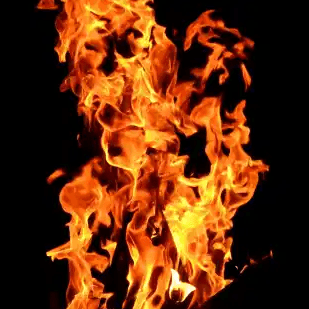
Fire is a good metaphorical representation for reality, as well as for all the phenomena occurring in human consciousness. Fire gives a clear visual in the present moment of being in an impermanent and constantly changing state, that is conditioned by external factors, and contains a fixed end to its manifestation that is as simple to see as the running out of wood. A close introspective look at our own subjective consciousness and its contents describes the same findings, and tells us a lot about our neurophysiology which makes up the ground level of our experience, yet is more difficult to clearly see. With fire we can see clearly from each present moment to the next that of changing nature, constantly present energy, moving, and never remaining the same, but with our own subjective identity, or “self”, we may be tricked into seeing something stable, and carried along from one moment to the next, as being the core defining aspect of who we are, or the CEO in charge that is carried over from one day to be next.
Who we are cannot follow different physical laws than fire does, and in fact it doesn’t, we both are part of the same reality, and we can observe that this self that we once thought to be permanent, unchanging, and moving through time without change or without being conditioned, is an illusion in which we were wrong about. Anything in this world that is conditioned, and is dependent on properties for it’s arising, like fire, is subject to change, impermanent, and is liable to end the moment its dependent substances are removed. Consciousness and its contents, in fact everything in reality that we can know, must be understood as it actual is, not as we wish it to be. Wishful thinking is a delusion that hinders an honest search for the truth, while for many it can be beneficial, for him who vows to adhere to the truth, regardless of the cost, it must be eradicated. Like the fire, our subjective experience of consciousness and its contents are in a constantly fluctuating state from moment to moment, also explicitly dependent on conditions. This isn’t only true for the totality of our experience, but for each aspect within it, such as feelings, sensory awareness, or thoughts. Every aspect is explicitly dependent on prior causes, and are able to be changed. The internal state that is best desirable for us would be also dependent on external causes, but I see the highest spiritual goal as something not only to strive to define and understand, but to work towards in a methodical way.
The highest spiritual goal is twofold yet intertwined; that of achieving an understanding of the truth of reality, and that of manifesting perfect wisdom and virtue in any circumstance. Both are impossible, but defining enlightenment in this way is useful, and not deceiving, as any progress on the path to these two things is undoubtedly a good thing. It must be clearly acknowledged that the completion of the task is impossible due to a number as factors such as the very nature of the goals in question are those that can continually be pushed to higher limits. It’s worth noting possible dangers in such spiritual goals that must be avoided in a mindful way, such as the suffering inherit in all craving, even for improvement, or becoming attached to any beneficial ideal, as well as the danger in arrogance and pride once achieving spiritual progress, the wise would do well to keep a mindful awareness that these factors do not manifest themselves as they will hinder any spiritual journey. This ultimate spiritual journey of self improvement both in terms of understanding reality, as well as transcending the historically appropriate Darwinian evolutionary ties, calls for the actualization of potential for an updated version of ourselves which we all have the ability to pursue. This is characterized by becoming compassionate, content, wise and virtuous within every present moment, and should be the ultimate goal of every human not only for their own self interest but for the interest of benefiting all sentient beings. Intention is important. A metaphor for the journey is like crossing a river, a journey to the summit, from the bottom of the sea to the surface, from sleep to becoming awake, as the change that is possible can completely redefine what you see around you, all present within your consciousness and displayed in its contents.
It’s wise to learn from people that have dedicated their whole lives to similar attainments, and to learn the knowledge produced from collective groups of humans in the areas of which are of use in the subject which you are interested in. Knowledge can be acquired through empirical observation and critical thinking, and through the help of others. Once you have knowledge of something in one way or another you have the basest level of wisdom. The next level in the hierarchy of wisdom would be to take this knowledge, such as in the domains of philosophy, psychology, meditation or morality, contemplation or even everyday thought, and to experience the truth or falsehood of the matter in practice. This practice, and training, is the second level of wisdom. It is taking conceptualized ideas and applying them to your life, and through experience, learning of their efficacy. The findings revealed through active testing will give you what I am defining as the next level of wisdom, that of practical wisdom. The third level of wisdom is attained after receiving knowledge, from whatever source, whether subjectively found, or from outside sources, experiencing life and finding the truth-hood or falsehood of claims, and then finding the insight of the nature that underlies the phenomena, penetrating into the source and reason as to why such things are the way they are. This ultimate realization is more useful, more applicable, and easier to call upon in all circumstances, as well as universal in its description. The wisdom of realization is what we are aiming at here, so that we find the truth we’re searching for, prove it to be true, implement it in our lives, and become more virtuous. All in all, the first step in the spiritual journey is acquiring knowledge, whether internally found, or externally, the second step would be that of experientially using the knowledge in your life to find out what’s beneficial or useful, and what’s not, and then realizing the truth of the truth itself, and how and why it works. We can train our minds to better understand reality, to be more virtuous, and to reduce suffering. This training can take place in every moment of our life, through mindfulness, meditation, knowledge passed down through others, and practicing virtuousness in order to train ourselves to be a better person unconsciously. The present moment is available to us at all times, and this is where mindfulness is useful in bringing our awareness to the present moment in order to observe and learn what it can teach us about reality, as well as our own psychology. This present moment is where everything in human experience takes place, and is where training and practice must be carried out.
 Seek Truth