Dunning Kruger Effect upon the Totality of the Set of Knowledge in One’s Life Span

Originally Written: January 31st 2018

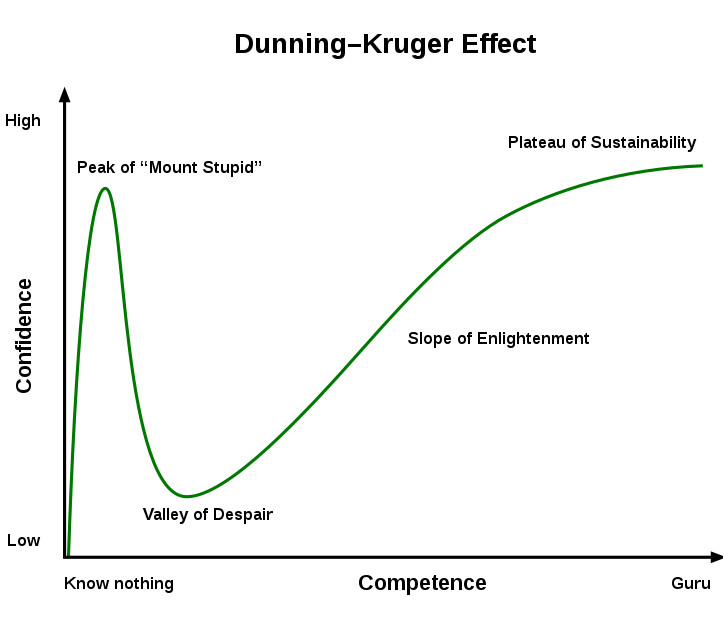
The Dunning Kruger effect can be applied to the totality of knowledge in any given domain, as well as the knowledge we have in relation to knowledge itself, or our own personal epistemological standpoint. The Dunning Kruger effect describes a process by which we undergo in the relation between “actual” knowledge, to our confidence in knowing. In a typical skill with which we have no knowledge, our confidence in our knowledge is close to zero, as we recognize complete ignorance. As we gain a small amount of knowledge, we are lead to the illusory belief that we have made much more actual progress in knowledge than we actually have in the domain, and our confidence in the acquired knowledge and competency in respect to it is extremely high. With this little acquisition of knowledge, in comparison to our original state of absolute ignorance, we are lead into the belief that we know much more on the topic than in reality we do, and this false belief leads us to a sense of overwhelming confidence in knowledge on the subject. After more time, experience, and knowledge is gained in the subject, the more complex and intricate its nuances become, the less confident we become in relation to the knowledge. After the initial point of simple conceptualization in the domain of said inquiry, all additional knowledge serves to prove how increasingly complex the topic truly is, and our confidence in the totality of knowledge of the subject generally degenerates as we see ever increasing pathways for growth, and an ever opening field of ignorance in relation to questions that are yet to be answered in the given domain. After continual study in the domain, our confidence reaches its lowest peak, as we become baffled by the amount of content yet unknown, and we undervalue what we do know in relation to the unknown. As we gain in knowledge, it seeks to illuminate the amount of ignorance we have in regards to the subject. There reaches a point when a broad foundational knowledge structure is established, and from there, we can begin to explore further areas of inquiry in relation to the domain of knowledge in whatever aspect it may be that we are attempting to gain in knowledge. From this bottomed-out valley of confidence in knowledge, we make the actual relational confidence grow, as our knowledge grows from this point, we slowly gain in confidence as to what we actually do know on the topic. The relation between knowledge and confidence at this point becomes more honest, and now, with an increase in progressing through additional knowledge in the domain, we grow in corresponding confidence of knowledge in the domain.

On a life size scale, the teenage years reflect the state of original boundless confidence in our knowledge, as we have reached the age where our set of knowledge in the total domain of knowledge has increased rapidly, the “beginner’s gains” have been acquired and we are led into the false supposition that we know much more than we actually do This explains most teenagers reluctance to parental and authoritorial advice, as they believe the knowledge they have is sufficient in answering life’s questions, and in navigating its landscapes. As the teenager continually experiences life, and grows into his twenties, where more complicated and nuanced life occurrences take place, the less his confidence becomes as his recognition of his own ignorance in so many topics grows. It isn’t till the individual has set himself on a stable, foundationally firm, course in life, after many chaotic elements have been ordered, many unknowns become known, that the process of honesty in the relation between knowledge and confidence grows. It seems like in the early twenties most people have a sort of existential dilemma, as their confidence has so dwindled that the sense of purpose, and how to navigate the future, is wholly unestablished. Once these questions have begun to be formulated in the young adult’s mind, he can work towards the relinquishment of the existential dread, and can seek to find what a truly meaningful life would be like, to him. In this way, his knowledge in the set of all domains begins to crystallize into a formulated conceptualization of what his purpose is, what a future he would like to exist for himself would look like. As career, relationship, shelter, hobbies, and interests begin to be decided upon in their direct evaluation in relation to the individual, he can begin to make progress towards that ideal possibility of his projected future self. This self-knowledge, and the basic defining and differentiating of values, allows the individual to make knowledge and experiential progress towards the goals. At this point the valley begins to ascend in the direction of the ideal peak. As he makes progress in the domains of interest and importance he has uncovered as being valuable to himself, he begins to grow in confidence as his competency and knowledge in these valuable areas of inquiry increase. Thus the dunning Kruger effect can, metaphorically, play itself out, to differing degrees, in the life cycle of the developing psyche, and the life attached to it.

The more you learn about the world in any of it’s aspects, the more you begin to realize how complicated it is. The growing understanding of the complexity in the world at every level, macro to micro, in every field of study, doesn’t necessarily make your subjective life more complicated. It is possible to have a grasp of the situation of reality, in admitting our fallibility and ignorance, yet still have a stabilized psyche that is content with the knowledge of the individual’s own ignorance. The deeper down the rabbit hole you go, in any direction, opens you up to see just how many different perspectives there are to see any objective fact, and how deep knowledge can possibly run, ad infinitum. The important knowledge to learn is how to wisely conduct yourself among this reality you are becoming more capable of understanding, and a big part of it is in being satisfied with your existence and not becoming overwhelmed in the unending stream of phenomena always arising in your experience, and rather keeping your desires pointed towards an ideal aim and distractions from that aim to a minimum, as you strive on diligently toward your goals. This will not only reduce suffering, but allow for clearer thinking, leading to a better more articulated understanding of reality in the future, and altogether a greater sense of purpose and wellbeing in relation to what could otherwise have been the case.

How an Increase in Knowledge Can Produce an Increase in Sorrow

Originally Written: January 26th 2018

Ecclesiastes “He who increases knowledge increases sorrow.” As we learn more about the travesties, malevolence, and evil acts commit across history, the more we come to see the potentiality humans have to cause suffering to others. The more we learn about the suffering which everyone undergoes, that we too experience, the more we potentially can feel disheartened as to the experience of life, and thus result in a sorrowful existence. While knowledge of this sort can cause debilitation, and a negative mode of being for the individual, it doesn’t necessarily have this effect across the board. Many people can spin a different perspective with the increase of knowledge of this sort, and look at the potential for humans to attempt to alleviate it, and if the individual finds that desire within himself, he can view the human condition as essentially compassionate, rather than malevolent, producing the opposite effect, of hope and virtue.

This quote is true in regards to some situations, yet is too broad to cover the set of all experiences, and all individuals. In line with the quote, the more knowledge you have in regards to understanding the effects of our actions, and their implications in the wellbeing of ourselves and others, the more you notice your own deficiency in acting in the optimal method, producing more moral shame than the ignorant moral agent. In times when passions override reason, and we fail to hit the mark, we suffer in relation to how high that mark is, in how well articulated it is, in how much knowledge we have as to a better way of Being. Thus you increase in sorrow from every mistake because you understand it as a mistake, you understand that rationally you knew the better thing to do, yet emotions or competing values over rode the conscious thinking process and you thus acted from a base that isn’t in line with a higher value. An increase in knowledge results in a better understanding of what has and is taking place, and causes the individual to be distraught over their lack of discipline over making more optimal rational decisions, as well as noticing the mistake for what it is and how it was caused, and this nature of humans, is natural, and at times can make one sorrow for how little control our “ego” or consciousness has in overriding the unconscious, or external effects, which are more powerful at times.

On the other hand, in regards to morality, an increase in knowledge can produce a more virtuous agent, and in virtuous actions, comes pride and happiness in accomplishing what we have uncovered as being right or meaningful, at least to us. Does this compensate for the moral shame in developing virtue? Does the happiness outweigh the sorrow? In general, probably not, and Ecclesiastes is right. But this quote doesn’t give us an imperative to not strive for knowledge regardless, and I would argue that the acquisition of knowledge in regards to moral questions and their implications is worth it as the meaning and the results outweighs the individual experience of sorrow, whether or not that sorrow in acquiring it outweighs the pleasure in virtuous action or not.

The increase in knowledge of causality enables the individual to see many things the ignorant would otherwise profit in the short term of not knowing, but in the long term, and in the implications, the knowledgeable gains the upper hand. The foundations and implications of actions and speech in regard to morality can be extrapolated to a further than optimal direction, potentially causing suffering in “overthinking” and can become overwhelming to the degree of causality explored as the potential negative down river effects can cause stress to the moral agent. Here, knowledge of morality, and the nature of suffering and satisfaction, and the causes and experiences related to them, also can become a burden to the individual in this scenario of “increasing in knowledge”. The burden of responsibility in relation to knowledge of the effect of actions, can be debilitating and stagnating the mind that has more knowledge of the subject, and thus his sorrow can be understood as a production of such conflicts.

Certain realizations outside of the realm of morality offer a source of further inquiry into the beneficial or detrimental experience in the knower. Such truth revelations such as in the full complexity of the issue of freewill, and its incompatibility with the actual experience of life, can be a source of great dissatisfaction for him who once thought he contained “freewill” in the libertarian sense. The uncovering of the truth of strict determinism can cause the individual to feel a lack of purpose, or choice, and can be a source of sorrow. On the other hand, it can be relieving, and remove anger, cognitive dissonance, and pride, in cases where it would otherwise be manifest (if viewed correctly).

The relinquishing of illusions of a personal God, or of an afterlife, can be extremely sorrowful to the naïve seeker, and may cause great distress and depression as a result. The meaninglessness of the universe, objectively, can be hard to cope with, and the proper response and compartmentalizing of such truths is no easy matter. Where, after time, integration will prove useful to the individual, and ultimately produce greater heights of wellbeing and potentiality for a moral virtuous life (I believe!) the initial adoption of responsibility and acceptance of non-desirous truths can break the unprepared individual, and everyone may not be endowed with the requisite mental capacities to wrestle with such ideas. While these are potential situations in which an increase in knowledge can cause an increase in sorrow, it is entirely possible for a more positive interpretation, and actual an actual reciprocal effect to take place in him who gains the knowledge. One may feel profound pleasure in uncovering insights into the nature of reality, and may feel themselves better attuned to who they are and the reasons why they do things. The openness to being fallible, and the corrective nature of novel knowledge in improving the individuals understanding, doesn’t always need produce dissonance or distraught, but can prove to springboard the individual to greater heights of wellbeing through a better use of his speech, it can prove to clear up previous dissonance, and to grant clarity to the individual. So an open generalization such as stated in Ecclesiastes is interpretable in respect to certain experiences, and in situational accounts, it is in no way possible to generalize it across the set of all possible acquisitions of knowledge. While certain knowledge in relation to individuals can cause sorrow, it can, in other individuals, provide a useful and beneficial effect. The state of the individual, the type of knowledge, the circumstances for its adoption, the framework in which it is revealed, all are integral factors in determining the beneficiality of knowledge. We would be wise to consciously discriminate in which knowledge we share, and attempt to uncover for ourselves, in addition to being prudent to whom, and in what fashion, and in which circumstances, we receive or give said knowledge. This is truly informed by experiential knowledge, contemplative reasoning, and overall, wisdom.

The Importance of Intentionality and the Decline of the Beneficiality of Religious Morality

Originally Written: Jan 5th 2018

Although our modern societies have arisen from Judeo-Christian, eastern religion, and ancient philosophical influences, it is still entirely possible for an individual to abstain from dogmatic belief structures and moral systems, in order to discover the truths of such systems in his own experience, with evidence driven from experience. This doesn’t necessarily mean that he will discover values that are separate from those instantiated on society by our religious foundation, but it means that one can have evidence and good reason to hold such values with a lack of a faith-based moral system. Rather than looking to scripture, to religious organizations, or to traditional family values, one can, in an entirely secular way, seek to develop one’s morals and beliefs in a way that aligns with reality, and be just as useful or more useful than the system expounded by our forefathers. In many cases this means stepping on the heads of those who came before us, in order to reach new heights, but simultaneously I think we should look for the causal connectivity of value systems into how and why they are beneficial to us, based on our own self-introspection and experiences.

For the majority of people who do not endeavor to spend their lives contemplating a moral code, and discovering truth for themselves and how best to live, religion is useful in informing them of a moral system, which, in most cases, is more beneficial than a lack of a structured one. This means there is some functionality of religion and it has a use that is beneficial to most people, but it is not necessary, nor the most beneficial, and by no means infallible, in producing a good person who has a good grasp on reality. The use of reason is sufficient enough to discover the benefits that many religions claim to be exclusive to their supernatural beliefs. For example, most religions claim their followers to be on a level higher than all other religions, and certainly nonbelievers, in their understanding of reality and morality, and for those who do not follow their supernatural claims, to be destined for hell or not able to understand basic truths of life, and they make this distinction solely based upon stating that you are not a member of their ranks. This is simply not true, anyone, no matter their race, religion, political view, or gender, any functionally conscious human is able to discover any real existing truth about the world through sufficient reason, and dependent on causes that are not exclusive to those who believe in any supernatural occurrence. I would claim the opposite. While one person may perform an act of charity because it is dogmatically passed down as being pleasing to God, and another may perform the same act because they have systematically explored how it would increase the wellbeing of another, the two acts are surely not on the same footing, from my point of view. Intentionality truly matters in these cases.

If you perform an action with the intent of eternal life in heaven, your action pales in comparison to the person who does it based on an understanding of alleviating suffering in the experience of another person. The sameness in the action distorts the causal web that leads from such actions. It initially appears that if the same action proceeds from different intentions, it truly doesn’t matter how we get the goal as long as the goal is equal. This is a fallacy and short sighted. There are implications that range into the future beyond solely the same action. The individual who does it for God, does not grow in virtue and habitual good-will that the secular individual does, thus producing a less capable person to perform beneficial deeds in the future. Not only does the rationale which connects us to our actions influence ourselves in a way that can be more or less beneficial to our own wellbeing and thus further development, it also has an effect upon our expanded circle of influence, i.e. in those we have a connection to in some way or another. To him who discovers the evidence of psychological wellbeing based upon doing the right thing in a philosophically sound method which aims to be moral through the alleviation of suffering and increase of wellbeing, he gains confidence in the methodology and further evidence towards the claim that such actions are indeed beneficial and useful. His conviction and his ability to share such knowledge, for other people to improve themselves and carry out meaningful actions using a similar methodology, also improves, with a causal implication of being more beneficial to the lives of other people through their implementation of similar intentionality. The God fearing individual who performs the action, does not gain in his conviction, nor in his ability to influence others in a positive way through the same action, the proof that his action is or is not pleasing to God, and the framework from which it stems from, that of dogmatically imposed “this is the moral law”, is not confirmed or denied in his experience, it is merely carried out. The reason why the action was performed, is not strengthened by the data of the result of the action, and this further limits the range of beneficial effect the individual may have in affecting his expanded circle of influence. The individual who does something merely because it is right, and is honest in his ego driven benefit, as we all truly act from desire, proves to reinforce itself through the proven result of the action, in aiding the other person, in providing wellbeing for the agent, and in following the philosophically sound moral system of moral realism, proving that there are right and wrong answers to moral questions, not based upon the dictation of a higher power, but based upon experience and evidence. To continue acting in a way which stems from convictions that aren’t based upon a rationale that is valid, might be the method for those who have less time to contemplate, or are less intellectually gifted to continue doing beneficial actions, but isn’t optimal towards the growth of the individual, nor is it optimal in influencing further generations to do the same. While religious language, stories, and laws, surely have been beneficial and useful to people for thousands of years, the influence of a better scientific and philosophical methodology is becoming prevalent, and religion is waning in its position of being the most optimal framework from which to act on. How can I make such a claim, it seems opinionated right? Well if we all accept that wellbeing is good, and suffering is bad, and that there are better and worse ways to achieve wellbeing and reduce suffering, than we must accept that the methodology which produces actions in accordance with these goals, more so than other methods, surely is the right methodology in which to follow.

That being said, we all lie upon a spectrum of intellectual ability, and environmental circumstances, which limit or support our ability and time available to develop a moral system. While we are in differing places as to the practicality of developing and working towards a philosophical system that is in accordance with our self-uncovered value system, I believe those that are capable of such inquiry, ought to pursue it, with the admission that many people are not in the right place in life in order to shed off their supernatural beliefs. This is okay! It is not a moral imperative that everyone ought to shed their religious beliefs for a philosophical / scientific worldview. We must admit that given the certain circumstances many people find themselves in, whether it by physically, mentally, or circumstantially, that for many people it is actually more optimal for their wellbeing for them to not shed religious systems. Moral Philosophers must not be arrogant in their claims that it would be better for everyone to pursue this kind of inquiry and development, and must remain truthful to the practical nature of human existence, that for many people the optimal course of development does not lie upon changing their worldview, but merely optimizing other situational factors in contributing to their wellbeing.  

Regardless of the millions of factors that make up who we are, most people are able to logically come to the reasons behind good morality on their own, without religion, whether they choose to do so or not. Someone is morally superior due to their actions, their speech, and their intentions, in the effect they have upon the lives of sentient being’s experience. To say that any religion, philosopher, or individual has a monopoly on the truth, on wisdom, and outside of their confines it is not achievable, is surely a fallacy. No matter which perspective we look at the world from, no matter which system we have underlying our actions, every individual lies upon a spectrum of moral value, and the quantification of morality and the peaks it is capable to achieve are not owned or restricted to any one group. No matter the course we lie on, differing degrees of understanding in our truth claims is available, different heights and improvement to our moral decisions are possible, and we all can grow to become the potential person that we ought to strive to be. We can all become better, and in relation to everyone else, we all ought to encourage the growth in both truth-seeking and moral action. A rising tide surely lifts all boats, and to demoralize and sink other boats, is not the method we ought to impose. We ought to attempt to raise ourselves, encourage others to do the same, and seek optimal solutions to novel problems as they so arise, and in doing so improve the quality of life for everyone within our influence, which turns out to be a lot larger number than originally intuitable! Schisms between sects, religious feuds, philosophical battles, all shouldn’t be eradicated, but should be predicated on good-will for others involved, and carried out with an open mind and the intention of learning something from those we disagree with. As we move from thesis, to antithesis, we necessarily transcend our current knowledge in the integration of both in to a larger worldview. As we strive to heights of knowledge, as we seek correct answers to moral situations, we become better prepared for the slangs and arrows of misfortune, and we are better able to aide other people in their journey to improve their own wellbeing and reduce suffering. Evidence for truth is conversant, explainable, and evident in the lives of those who have grasped it, and cannot be shrugged off to a nonbeliever as being something they simply couldn’t understand due to their religious position. Religion is useful in providing people a key to becoming a good person that would have taken a large effort to gain independently, but it is less valuable than discovering that morality for yourself, without faith, based on your experience and rationality. Yes, our current values and way of thinking has ancient roots in religious doctrine and its thinkers and expounders, but it is not the only cause of our current state, and to give it any more credit than solely being an influence among others would be categorically untrue. Even biology and evolution has played a part in the development of compassion and cooperation, key tenets of good morality. It’s evident that those who did not cooperate with groups, or aide others, eventual died without their genes being spread, and those that did lived in larger numbers and populated more, so even the deep evolutionary drive to good morality has been proven by evolutionary biologists as being a factor long before any human made religion was invented and gained ground in affecting society. As the meme of God has been the most popular unit of cultural heredity, I believe it is time for the meme of moral realism to make its head-space, as I believe it to be more valuable unit towards the beneficiality of all the members of our species. The God meme has done its role in getting us to this point, more or less, and for those with “little dust on their eyes” it is well past the time when we should look for alternative, more useful, more beneficial systems towards that aide us in the uncovering of the true nature of reality, and aide us in our moral decisions.