

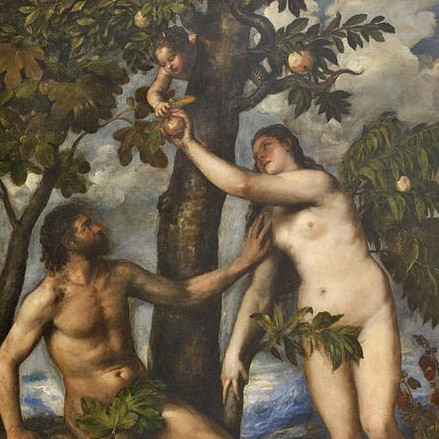
The original symbols of good and bad, before language, in primitive humans, developed out of the organism’s ability to decipher what is beneficially useful, and on the contrary, harmful, to it, just like any other evolutionary developed attribute. We can imagine certain symbols which were found in human’s prehistoric pictures / experiences which later on were used as religious symbology, to get an idea of the impact certain symbols could have had in improving our wellbeing once we understood them, leading to higher cognitive ability in the acquisition and understanding of symbols, and eventually to language. Although in their primitive form, these symbols went pre-conceptualized in their abstract utility, their direct perceptional advantage in recognizing, and differentiation, was fleshed out in experience.
A symbol of what is good or bad is useful to the organism in aligning his aim, or in avoidance, both geared towards survival and prosperity. Two examples of symbols which in their practical understanding increased survival, and later became central to religious mythology, are the snake and the apple. A bright red fruit, or a red apple, symbolizing the affirmation of life, sustainability, ripeness, nutriment, prosperity, as that which enables life to persist, obviously is something to be aimed at, as something representing, generally speaking, cross culturally, the good. In regards to “the bad,” this was symbolized as the snake, as that which is dangerous, deadly, life negating, cunning, hard to see, easily mistakeable, as that which is a threat to life, obviously representing the bad, the original symbol of adversity. It is clear to us why the distinction became archetypal in nature, as those which could recognize ripe fruit lived, those that couldn’t, died, and thus the descendants of the lived, lived to carry whatever genetic propensity allowed for the heightened awareness of the attribute. In the same method, those that could identify a snake, and those that couldn’t, had very different fates, thus the recognizeablility of what the symbols represented led to the necessary evolutionary development in reference to both phenomena.
In pre-symbolic worldly experience, the benefit of recognizing these two means the difference between life and death, and became a societally inherited trait through the reproduction of the individuals who had the greater propensity towards “awareness” and other factors that contributed to identification. As the knowledge was passed down through generations, the symbols become ingrained in their beneficiality, regardless as if the actuality which they represented was decisive in life and death millennia down the line (modern day – we still recognize and have natural tendencies of significance in regards to red, ripeness (female attractiveness) as well as snakes (ropes still scare us)). Obviously these two phenomena aren’t the only factors, but their predominance as meaningful symbols, and their evolutionary implications, are still prevalent among modern man.
Everything that makes sense to us now, had its roots in an evolutionarily developed process. Thus, the importance in recognizing such phenomenon is the difference between life and death, and natural selection created an unconscious formulation of such things which is able to distinguish these phenomena clearly, and perhaps this unconscious ability manifested itself into the original symbols of such things, which we now interpret as good/evil, implying an unconscious, archetypal, value system manifesting its contents into the symbol. Symbols such as these are of utmost importance to primitive societies, groups, and individuals, in expression of an inner truth, in passing down knowledge, as being used as a precursor for language, and later in the development of consciousness. In this way symbols of all kinds develop, from external reality, introjected to the unconscious, then expressed externally.
We all understand unconsciously why the Biblical story of Adam and Eve makes sense, regardless of how strange it may sound in conscious formulation, it is due to the strong symbolism which is inherit within it being immediately understood sub-consciously. The knowledge of good and evil, which is the light of awareness, of consciousness itself, becomes metaphorically entwined with the ripe red apple/pomegranate, (also taken perhaps from Greek mythology) as truth. This protected produce of God himself, who represents that which creates, sustains, and is the highest aim of all life and from which in pursuing (the highest ideal of our potentiality) places a restriction upon the apple. In its consummation, it brings humanity to the divine, it brings freewill, awareness, and life, to the determined being and leads them away from the “walled garden” or protected society, into the full nature of truth, autonomy, in short, consciousness and its suffering. It is that forbidden understanding, the unknown, towards which we strive, and it is in our disobeying of the highest ideal, that we suffer the life of mortals. The snake is the anthropomorphized representation of the highest evil, of Satan himself, of betrayal and the one who leads astray, away from the highest good which is represented in the image of God and his word. The snake is death, and that which hinders life from being protected in the walled city, it is that distraction and desire which perverts our course from the highest possible aim, our greatest potentiality, and leads into suffering.
This story not only makes sense for us, but has the tremendous staying power in still affecting believers across the world who feel it represents a deep truth of existence, which it does, literally, and metaphorically. The story represents phenomena which are of utmost importance to understanding ourselves, and directs us to survival in pursuit of the good and the recognition of evil in order to avoid it or be dealt the punishment. All other symbols, religions, myths, which have staying power in captivating millions, all emerge in this manner, by primitive man introjecting external phenomena, developing them into symbols through evolutionarily ingrained archetypal creative power, subconsciously, and finally in their successful emergence as a good representation of relatable phenomena, apparent in ancient stories and iconography. These creative works help mankind and society in pointing us in the right direction, giving us a framework of understanding toward greater cooperation and survival. Only much later, with much more developed consciousnesses, are we able to examine the very symbols which gave rise to our intellect, and we are able to tease apart the meaning which underlies them, this, in general, is the task of the depth psychologist.
 Seek Truth