

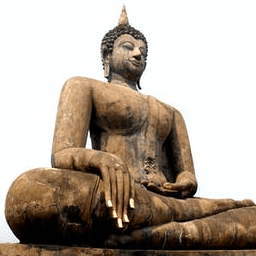
It appears as if the Buddhist population, at least that identify is so, is dwindling in proportion to the total population, and I fear the valuable lessons inherent in the religion too are fading away. I believe this is due to the strict adherence to traditional supernatural claims, instead of leniency on the part of these truth-claims and an improved exemplification of the practice and subjectively intuitable aspects of personal growth. Why not allow the religion to evolve in a way that is beneficial while mutually acceptable in modern society? Why throw out the baby with the bathwater? We ought to parse out the valuable from the unverifiable, and in so doing so, show the true message, and the true benefit, to the Buddha’s teaching, namely, those contents which reduce suffering, increase morality, and better align our being with reality. The traditional practices of mindfulness and meditation, and the expounding of immortal truths such as impermanence, suffering, and the removal of suffering and the path and causes all can be noticed within one’s own experience, and thus retain their usefulness and their replication as memetic units of transmission. The parts of the tradition that are no longer useful, or simply stated, not able to be realized within our experience (supernatural metaphysical claims) must be set aside. I think if we set aside certain doctrines, while promoting truthful and useful doctrines, then they will be successful at replication, based solely on their firm foundation and the fact that as fact seeking individuals, and as selfish machines, their beneficially and ability to withstand scrutiny and be directly realized will propagate them. The truth always can prevail in this way, and so can what is important in Buddhism.
The Buddhist religion as it was originally conceived of by the followers, we can be sure of, is not the form in which it is found in any modern society today. Thus constantly attempting to recreate an outdated system with a mind that has modern knowledge is not the path forward. We must share and expound the manners in which the Buddha’s teachings are applicable, useful, and significant in our lives today, and explain scientifically or at the very least phenomenologically, the truthfulness of certain claims that both share the meaning and explanation that Buddha gave, as well as align with our current scientific understanding. I concede that this is cherry picking, but this is not a bad thing, in fact in all times in all units of transmission (Gene’s/memes) the ones that survive, the knowledge that prevails, is that which naturally separates the wheat from the chaff, an endeavor which we, as modern humans, must seek to do if we are interested in promoting the further exposure of the truths within the Buddha’s teachings. I know this is both cherry picking and blasphemy, but the intention is to help spread the knowledge and practices leading to valuable insights that will enable a larger percentage of humans to ultimately understand suffering, reduce it, and improve their lives and comprehension of reality through the teachings. Noble goals must be pursued through noble means, and I believe in this case it is through the utilization of good judgment and properly propagated useful information which is in accordance with the spirit of the Buddha’s teaching, rather than archaic adherence to superficial religious overtones, that will most contribute to an increase in wellbeing in those who learn, preserving the religion and its beneficiality here on Earth. The philosophy is what we need, and what must be carried on, so we must accept if the religion dies as long as its philosophy lives.
I am not claiming that anyone knows all, as I am staunchly in opposition to the mode of being-certain, that no one ever has or will know all. But what we have as society progresses is knowledge and wisdom that can potentially progress, expound, and become more accurate as we uncover unknowns, become more articulate in our explanations, and science and phenomenological evidence, both material and experiential, help us to climb higher than our predecessors. All Buddhists are familiar with the sutra in which the Buddha urges us to test his teachings, and all teaches, within our own experience. It is just this that Buddhists have been doing for centuries. Everything important that Buddha has proclaimed is found within what we are able to experience, and see for ourselves. The impermanence of all conditioned phenomenon, the ability to be aware of consciousness in the present moment, the lack of self and inherent emptiness within all experience and material. The morality and path to a better way of living, the precepts, moral shame, guilt, the advocating of sila and its expounding by the Buddha is all extremely reliable in its practicality and beneficiality to sentient being, and we would be wise to spread the message of these two sides (the truths and morals). Now, what we cannot and have not experienced, what philosophical and phenomenological exploration has not uncovered, to anyone, ever, are the aspects of the religion which we must criticize and move past a literal interpretation, at the most we must use a metaphorical explanation for them, and recognize their resonance with us through archetypal psychological significations. I understand this can be insulting to someone’s beliefs, but from a higher resolution image of it, it can be considered under right view, and may be helpful in the propagating of the knowledge and wisdom within the religion which we agree would be useful to spread and rather than diminish in modern society. Aspects such as declarations of what happens after death, reincarnation, realms of supernatural beings, heavens and hell’s, minor deities, even enlightened beings and the possibility of becoming one, these truly are useful in their pursuing and may provide psychological benefit, but this is not the core of the Buddha’s teaching. The core is, in one aspect, to view the suffering, view the transitoriness, view what is unsettling, and work to overcome it. It is not false beliefs and their pursuing, whether pursuing would be beneficial or not. We must come closer to the real message, and discard the added superfluous unexperiencial aspects. I hope you can see that the intention here is to fix a detrimental problem, which is the contradictory nature of traditional superstitious beliefs and their contradiction to our current understanding. We ought to focus more on the intention to cultivate right view, and in spreading the truth to enable more sentient beings to see the dharma within themselves, and act in accordance with it (the truth, both metaphysically and morally).
 Seek Truth