

It’s A Wild World, The Answer to the Absurd Conundrum

Originally Written: Feb 11th 2019

Since I was young I have been saying “it’s a crazy world” in that the unexpected, the irrational, the unknown, always seems find a way of manifesting itself when we least expect it. A couple years ago I re(discovered) the song “wild world” by Cat Steven’s, which deeply resonated with me, and expressed a similar sentiment to that phrase which I had repeated over the course of my life. It seems like in times when reality appears to contradict itself, when what I never thought to be true, suddenly appears to actually be true, in times of revelation, and understanding, in rational conceptualization, insight of the nature of the world, in discoveries such as determinism, the lack of a soul, the lack of inherit meaning in the world, with insight into the vastness of the universe, and the minuteness of finite human life, of the unimportance within us, yet the ability to change so much; I state that it’s a crazy world, expressing my amazement with the irrational, seemingly contradictory, aspects of the true nature of things. I realized just now this was an intimation of the philosophical term, the absurd, and the feeling, and thought, that accompanied such circumstances that merit the utterance or thought of, “it’s a crazy world”, is what Camus called the feeling of the absurd.

The Absurd is a description of the situation that arises between a human and the universe, it requires both, it is, in its essence, reality, yet it is in recognizing realities strange dualistic nature, its absurd qualities, the conflict between characteristics of the world, and characteristics which humans possess, that constitutes “the absurd”. For example, the universe is meaningless, purposeless, just a determinate web of cause and effect, with no intrinsic objective morality, nor any meaning or purpose. Yet humans run around their whole lives searching for meaning, or believing in a meaning which doesn’t exist outside of their belief in it. This is the absurd. The search for meaning where it doesn’t exist is absurd. It is contradictory, irrational, yet, it really exists, and we all are engulfed in it. If you were to learn of a man who is spending his entire life counting the grains on the beach, and he is content doing so and finds profound beauty in the act, and feels it is meaningful, your response would be that it is absurd. This is, in effect, what all of us do every day. We feel as if our actions first are produced by us (freewill), second as if they are meaningful and matter, yet, in the grand scheme of things, both these conceptions are starkly not true. Even when someone has this insight, they continue doing the same things, living in the same manner, due to the habitual and various other factors involved. This is truly the absurd.

When faced with the absurd, philosophers such as Camus and Kierkegaard both devised strategies, to how one should deal with the absurd, once it is realized, and contemplated. One is suicide, an attempt to negate the absurd reality, to end what doesn’t matter anyway. To escape the pointless suffering of human existence. Of course, this solution isn’t any way in which to live, it’s clearly a way only to die, yet it is a way to react to the realization, but from the perspective of the universe, it merely is another effect, with a cause. It is neither good or bad, just an event. Camus points out it actually makes the whole situation more absurd.

The second solution purported is the general existentialist point of view, which Kierkegaard urged us towards, to create your own meaning, or to act on faith in following an arbitrarily man made meaning, believe in an idea, a moral, a transcendental reality, supernatural phenomena, god, religion, etc. Create your own morality, philosophical structure, in something which is outside, above, or more encompassing than the absurd, thus creating meaning, and a path to follow. Once you have found or created the meaning, you no longer believe the universe is meaningless, you have past that, you have taken a leap of faith, a leap beyond the originally noted fact of the unimportance of our actions from the universal standpoint. This is what Camus calls philosophical suicide, as opposed to the first option, physical suicide. In essence, by supposing something that transcends the absurd you are removing your awareness of the absurd, as if what is rational and true to this reality isn’t important if there is a higher reality. This view replaces a recognition of the absurd, with the belief that what one has created (the meaning) is the true reality, which it can be, for you, subjectively, but never objectively, and that is the aspect which most existentialists fail to realize. This option is only valid if you wish to sacrifice reason, logic, and a valid, untheoretical, un faith based, understanding of reality, for something which makes you feel better, solving existential dread, solving the problem of the finitude of human life, solving death, solving the search for meaning we all experience. It is the easy way out.  It is the belief in God at the sacrifice of reason. It is, in a way, a rational leap of faith, in that the leaping will make you better, whether the landing place is real or imaginary, your life will be happier, and the suffering of the realization of the absurd is suppressed by the higher ideal.

The third solution is Camus’ choice, the acceptance of the absurd, yet the continued searching for truth and meaning within its structure. It is the rational understanding of the absurdity of existence, coupled with the human ability and perseverance to discover meaning and truth, to continue on without laying yourself sacrifice to what you “wish to be true”, accepting what you know to be true, and moving onward.  People say this means rejecting morality, but it is possible to strive onwards while upholding a temporary morality which best fits reality as to your current understanding dictates, without believing it to be infallible, permanent, or all pervading.

I think there is room for expansion in this final solution, in that we can discovery that there is a meaningful, best way to live, science can help show us this, the road that leads to the best human life, this is what objective moralist regard as the movement away from the worst possible misery for everyone, i.e. moral realism. (Basic Moral Realism) Any step away from that would be morally correct, if we accept the axiom that the worst suffering for everyone is itself something that is true in the context of morality. From the absurd perspective, this axiom is valid only within the individuals, human conception of morality, which itself doesn’t hold ground on a universal scale. Since we’re recognizing reality, and the absurdity of it, the coupling of these ideas necessarily entails the conceptual understanding, and for success, acceptance, of the fact the universe is purposeless through and through. But, since we are human, and are alive, we must recognize morality, since we fall under its sway in our actual experience, yet we cannot escape the broader domain of the universes “point of view”. So it is possible to recognize absurdity, the absence of morality, and meaning in the universe from a perspective that is anything but life itself.

Since we are human, we are life, not philosophical abstraction, we must operate under the purview of some morality whether known or unknown. Something within us forms a conscience whether we like it or not, this is actually, part of the absurd itself. Our conscience dictates our conceptions of right and wrong and is alterable due to influence. Even if we conceptually fall into the sway of a philosophical doctrine such as nihilism, within the absurd framework, this holds only as a conceptual framework. It is a word game that never represents a human life, as one can think there is no right and wrong, good and bad, you can’t escape determinism, and each moment will prove to any observer what you (as a living organism) believes to be right or wrong, based on your action. There is an inbuilt biological value system within any life system, whether known or unknown to the organism, we know this because we choose to focus and pursue certain things, and not others. We contain, as part of our being, a perceptual filtration system, which is strained through the developed (both genetically and learned) value system, which, produces our conscious experience “Universal Existentialism“. We pay attention to certain things, spend time with certain people, participate in certain activities. This is a product of evolution, culture, genetics, environment, an amalgam of all life experiences leading up to the present moment, including consciousness itself. The conscious awareness of suicidal tendencies is somewhat of an issue philosophically in how it fits into this picture, but it does have a rational deterministic path towards its fruition, no matter how irrational and contradictory to inert value systems it appears to be. This is obviously quite absurd.

All things considered, where life is, morality is always there, as morality contains human action, and humans always act, every moment, where humans are acting, there is an experience, this experience can be better or worse, subjectively. If there can be better or worse subjective experiences, better or worse methods of navigating life to produce an optimal mode of Being to the individual, than there necessarily are better or worse methods towards that aim. Within this bracketing of human life, in this way, we can determine meaningful solutions. Outside of the bracket, these meaningful actions, pursuits, and their accomplishment or not, merely are null in meaning. This is the absurd contradiction we must face and work within. In this way we all have a philosophy, including a morality, including a world view, including beliefs, this is all real, and unavoidable in any life, while outside of subjective experience, from an objective point of view, there is no meaning or purpose to this process, it merely is. I think recognizing the absurd necessarily requires a divorce from this type of subjective purpose perspective and the acceptance of the consequences of an objective answer to purpose, but it is absurd to think it’s possible for a conscious entity to lose that subjective perspective entirely. It truly is absurd that it exists at all. The solution, from my perspective, which, obviously isn’t universal, is in rebelling against the contradiction we find ourselves in, and in pursuing meaning in our bracketed universe regardless of the overarching evaluation. For a critique of Camus’ perspective see – “Critique of Absurdism“.

Whether the universe cares or not, (which it doesn’t!), we care, our Being is defined by the care in which we use to navigate our experience. We like positive states of consciousness, produced by what we value, or find meaningful, this doesn’t mean it actually has meaning, or that we’re fooling ourselves, but in pursuing these things, with a recognition of the absurd, we are rebelling against nature, rebelling against reality and choosing our own way, despite it, yet, within it. This is the option I believe we ought to choose, because any other pathway, would either result in a terrible experience, psychological suffering, or in some form of deception, rather its deceiving ourselves into thinking something is true that isn’t, existentialism, or in believing that nothing, not even from our own perspective, has any meaningful significance, nihilism (it does, to us). While this method appears as the only option left for the truth valuing and life affirming individual, it still must be recognized in its ultimate fallibility, it is the best option which currently makes sense; my morality, understanding, intelligence, reason, beliefs, knowledge, wisdom, are all subject to change, it is my mission, my arbitrary meaning, in a meaningless universe, to improve them, because, I will not sacrifice the greatest aspects of which make me human; reason, mindfulness, the present moment, under another human’s supernatural ideas. I won’t sacrifice the highest form of life currently known, human life, the human brain, in believing in an imaginary reality outside or after the one I’m embedded in. I won’t sacrifice my search for truth for an untruth and a pleasant life, I’ll push the capabilities of this brain to develop in a way which I deem to be good, which is itself arbitrary, and knowingly so, but it is personally the only road I see left after the others have burned away. It is the only path standing, the path to truth, wisdom, knowledge, understanding, virtue, within a meaningless universe. The whole endeavor of my life may be meaningless, but it means something to me, and it means something to my family and those who know me. For them, for all humans, we make this endeavor, to aim for the stars while staying grounded. 

The Causal Tethers Which Bind Us

Originally Written: January 29th 2019

Things are the way they are. The present moment is the universe manifesting itself now. Everything is conditioned, everything is predetermined. Meaning: everything requires certain conditions and circumstances to exist in their current state. Everything came to this current state based on prior causes. Anything that happens in this present moment is an effect with prior causes, it never stands alone, it is never exempt from causation arising from prior conditions. The words or actions we express, follow these same principles. We ought to not allow ourselves to be conditionally pulled along to a causal reaction that is negative, yet, we oftentimes do, despite our good intentions and awareness. A clear understanding of the causality behind valuable phenomena, such as in science, behind meaningful actions and our own subjective experience, through introspection, serves to inform our comprehension of the causal tethers which bind us. While knowledge and understanding of who we are is inextricably linked to causal information, also, our management and navigation of novel experience and arising phenomena within our own conscious gaze can be mitigated and modified by a greater understanding of the determinacy of its arising, and thus can be utilized in a practical method to influence the content of our experience. When some event goes counter to our subjective will in a way that sparks anger, irritability, or in a more general way, an unpleasant feeling, it is wise to remind ourselves of the causal web prior to the event. In a fundamental “universal” way, it is out of anyone’s hands – the event, our reactions, this moment, is all just reality’s expression of the next moment in its unfolding, yet, in a “conventional” or practical sense, the content which affects us and our reaction can be modified to be better suited to a positive experience or in alignment with our value system based on intentional conditioning, or the process of forming habits, proceeding from conscious direction.

We can scientifically test the causal nature of material phenomena, and external events, and can verify its truthfulness through establishing mathematical models of the physical world that accurately predict and describe phenomena as they change. This provides us with a verifiable method in which to base our objective understanding of the world’s causality, and, as far as determinacy has evidential claims, the works of physicist and scientists have been unraveling the laws which constitute the physical world for hundreds of years. While their claims are repeatable, and observable to anyone who looks towards applying them, they still remain fallible in their fundamental conceptions, meaning, they follow the rational and logical principles which constitute “truth claims” but, from a philosophically absolute sense, the rational and logical principles which are presupposed by scientific laws and theory are only those which we have uncovered being the beings which we are, in the space and time in which we find ourselves. Excluding that specific phenomenologically uncovered caveat, we can say with a high degree of certainty, due to the ability to be reproduced and evidential datum, that causality is universal across the world in which we find ourselves. Most people, at this point, tend to agree with these points as to the scientifically formulated nature of deterministic qualities in the world outside of us, it is only in the cross of the same principle towards our inner experience in which people find it difficult to accept.

Being that we are part of the same universe in which science is describing, that we are made of the same matter that constitutes the rest of the observable universe, there is no reason not to naturally extend hard deterministic causality to the experience of our own Being, outside of course, of the subjective experience in which convinces us otherwise. It is only when we lack proper mindfulness that the intuition of freewill manifests itself. Upon proper introspection, in a short time, we can see that such a concept holds no weight as an accurate truth claim. Merely by paying attention to the content of consciousness, within the present moment, we can see that the next thought, the next idea, the next experience of consciousness, is merely arising. If the thought arises, “I will raise my right hand, to prove my free will” and then I raise my right hand, it would be naïve to suppose that this proves the existence of free will, as the question remains, from where did the initial thought arise? Who chose for that thought, and not any other thought, to emerge? Why did we act on the thought, and why didn’t we choose not to? It is because things could not have been otherwise. They had to happen in the way that they did, otherwise, they wouldn’t have, and this is only true because of the causal determinacy that underlies all phenomena. While it appears we are choosing one path or the other, the very inclination and “push” to choose it, is, in all cases, not chosen. “While we can do what we will, we cannot will what we will” as Schopenhauer famously remarked. It is obvious our decisions are, in an absolute sense, out of our control.

If it is our very Being which produces the causal chain that emerges in our conscious experience, and this very Being is preconditioned genetically, and through perceptually integrated phenomena that then arise in subjective experience, how can we possibly claim that the causal nature of the physicists doesn’t apply to our experience? We have evidence as to the chain of influence which flows from external phenomena, to stimuli, to sensory receptors, through the nervous system, to specific areas of the brain, through the organizational structure, then, consciously, we can denote an experience. We have scientific evidence of this. While this only explains sensory phenomena, it doesn’t fully encapsulate the totality of our being, and, being a merely empirical study, it obviously falls short of philosophic coherency necessary in a complete truth claim, but, further evidence, to further phenomena and their relations, only seeks to further justify our understanding in the direction of hard determinism. The more evidence we acquire, the stronger the claim is supported, the more evidence we have to the lack of evidence for any other conceptualization of reality, the more it seems our initial intuition of some kind of “special circumstance” in regards to consciousness is disregardable. The point is, the more scientific data produced by neuroscientists, geneticists, psychological behaviorists, and the more data they conclude in their findings, the more we are able to discern the causality that is inherent to our very Being, in the same manner in which it is inherent in all phenomena that exists, for how couldn’t it be? This same method of repeated verification, and mutually supported experimental evidence is used in any scientific theory, such as gravity, the laws of motion, the mathematic underpinnings of the four forces, they all have repeated verification in scientific testing, and as our experimental quality and quantity grows, the more the data seeks to confirm the hypothesis. We are a far distance from conclusively being able to scientifically pinpoint the causal interrelations between all subjective experience and its precursors, yet, with the constant striving of scientific endeavors, we have become increasingly more informed as to the content of our Being and the environment we interact with, and their relation towards the development of different psychological phenomena, character traits, actions, speech, emotions, and in general, behavior. The more information we have in the different domains, whether it is to our relation to DNA, the relation of our subjectivity to our perceptions and their filtration through hour value systems, the very creation and formulation of our value systems, i.e. the more information we have on our own causal tethers, the better we are able to understand ourselves, and optimize our further experience and the phenomena that influences us towards creating who we wish to be.

Being a witness of reality unfolding, rather than subjectively losing ourselves in the emotional or mental processes that are conditioned by this moment’s environment and the neural memory of prior moments, enables us to mitigate the suffering inherent in life’s consistent desiring, and creates the space for a certain mode of inner peace. This awareness and present moment mindedness creates an acceptance of the mental phenomena unfolding, no matter of which nature they may be, positive or negative. The assent and voluntary withholding of desiring change to that content, being content with the suffering and the pleasure, unwavering in constitution regardless, produces a fortified mind in the face of extremities in either direction. When our brains are producing a biochemical reaction that is experientially felt as negative emotions, anger, sadness, etc., you can still observe reality taking place and find peace in accepting it as it is, albeit, the stronger the emotional reaction the more practice and training in mindfulness will be needed to modify the mode of being. From this place of mindfulness, the natural reacting and speaking, thinking and acting, all still take place, but they come from a place of rational understanding, rather than emotive unconscious reacting. The mind is a tool to be used, not a labyrinth to be lost in.

On a skeptical note, even the understanding of the ultimate blamelessness of others, and their actions being based on factors that they are not “responsible” for in an ultimate rather than conventional use of the word, this state of understanding, even being mindful itself, is still a production of the brain, of the human organism, it is still itself a conditioned state, based on prior causes, existing only due to outside influences (outside of the thing in itself of consciousness.) The major factor is that it is a better state of consciousness then our default mode of operating. What is important is the potentiality to have a consciously directed experience that is modified in such a way to be better than the momentary spontaneous reaction which is presented to us, we contain the potentiality of producing a richer experience of life, and is a skill which forges opportunity of a brighter future.

What is the benefit in the realization of reality’s conditioned and determinate nature? While such conclusions may not be beneficial for everyone, those who seek the truth can find comfort in the discovery of such truths as being immediately experientially validated through careful attention to the present moment, and in an honest analysis of oneself. The beneficiality of such truths is useful in the diminishment of egoistic pride, and in the blamelessness stemming from other’s ignorance in regard to our judged conception of a negative action. The results of such knowledge can lead to the knowledge of the causal determinations arising from the content of which we spend time engaging in, and what we pay attention to. This can be used to the optimization of our experience, in a way which is potentially wisdom enhancing and can produce a better preparedness in regard to navigating novel situations with competency. If we realize which content is a stimulant for the arising of mental phenomena, we can diverge conscious effort in the direction of what is meaningful to us, to the exemplification of the things we uncover as being high in our value structure. Without the attentive realization of the present moment experience which we undergo, the necessary connections between causes and effects and the relation they have in consciousness would go unnoticed. In regards to the truths of determinacy, and our immediate unpleasant reaction to them, it can be said that when evidence is provided that implies a result that is contradictory to what we would like to be true, we can be more or less sure that it is actually true. This realization in practicality opens up a world of opportunities in navigating our subjective experiences of reality, grounded on a firm foundation of truth. Whether the immediate positive emotion is lacking or not in the discovery of such truths, is merely something to be overcome. The removal of ignorance is altogether, in the end, contains a net benefit to most of us, and will prove to be of use in the management of our conscious experience, and our orientation in the world towards what is best for ourselves and those important to us.

Why be mindful and pay attention to the content of consciousness in the moment? Because you gain the experiential knowledge and insight of things which are fundamental to improving individual quality of life, understanding of reality, and conduct, in an increasing quantity of situational encounters. It’s one thing to mentally understand something on a conceptual level, it’s another to experientially know something as true, the benefit of personal experience is a thousand fold that of conceptual, the wisdom gained is immense, and the practical application with practice improves, meaning an improved character, relationships, and influence upon our expanding circle. As to the personal arising of suffering, and its mitigation, and how the dependent chain is interpreted through a Buddhist lens, see the essay “Dependent Origination (Buddhist Conditionality)”.

It’s impossible to understand the whole without understanding the pieces, and while we cannot, in practice, uncover “all the pieces”, we can still verify that the truth claims we do make are firmly established, so as to produce a conceptualization of the whole that is not false. The more firmly established our truth conceptions, the more we are able to vet additional information, and, if it is true, it will coincide in an uncontradictory manner to the pre-established verified truths. Non-self, impermanence, the cause and diminishment of suffering, present moment awareness, determinism, objective morality, all fit together into a picture that corresponds scientifically, philosophically, and psychologically. If you believe in freewill, but at the same time non-self, you will experience cognitive dissonance. If you see the causal connectedness necessitated by the physics of the outside world, but fail to apply it to the physical underpinnings of our consciousness, dissonance will arise. If you believe in determinism, but believe you have a permanent unchanging soul, you will experience cognitive dissonance. If you believe in a traditional Christian God, but believe freewill is an illusion, something is wrong. This is because contradictions don’t exist in reality, the whole truth does not contain falsehood. This part of the inherent logical necessity of truth claims we know to be objectively true (at least recognized as a foundational standpoint to reason and logic). The truths are mutually supportive, and rectify the emergence of each other, that is, if they are true, and one falsehood will unbalance the structure. 

Primitive Symbolic Differentiation

Originally Written: November 9th 2018

The original symbols of good and bad, before language, in primitive humans, developed out of the organism’s ability to decipher what is beneficially useful, and on the contrary, harmful, to it, just like any other evolutionary developed attribute. We can imagine certain symbols which were found in human’s prehistoric pictures / experiences which later on were used as religious symbology, to get an idea of the impact certain symbols could have had in improving our wellbeing once we understood them, leading to higher cognitive ability in the acquisition and understanding of symbols, and eventually to language. Although in their primitive form, these symbols went pre-conceptualized in their abstract utility, their direct perceptional advantage in recognizing, and differentiation, was fleshed out in experience.

A symbol of what is good or bad is useful to the organism in aligning his aim, or in avoidance, both geared towards survival and prosperity. Two examples of symbols which in their practical understanding increased survival, and later became central to religious mythology, are the snake and the apple. A bright red fruit, or a red apple, symbolizing the affirmation of life, sustainability, ripeness, nutriment, prosperity, as that which enables life to persist, obviously is something to be aimed at, as something representing, generally speaking, cross culturally, the good. In regards to “the bad,” this was symbolized as the snake, as that which is dangerous, deadly, life negating, cunning, hard to see, easily mistakeable, as that which is a threat to life, obviously representing the bad, the original symbol of adversity. It is clear to us why the distinction became archetypal in nature, as those which could recognize ripe fruit lived, those that couldn’t, died, and thus the descendants of the lived, lived to carry whatever genetic propensity allowed for the heightened awareness of the attribute. In the same method, those that could identify a snake, and those that couldn’t, had very different fates, thus the recognizeablility of what the symbols represented led to the necessary evolutionary development in reference to both phenomena.  

In pre-symbolic worldly experience, the benefit of recognizing these two means the difference between life and death, and became a societally inherited trait through the reproduction of the individuals who had the greater propensity towards “awareness” and other factors that contributed to identification. As the knowledge was passed down through generations, the symbols become ingrained in their beneficiality, regardless as if the actuality which they represented was decisive in life and death millennia down the line (modern day – we still recognize and have natural tendencies of significance in regards to red, ripeness (female attractiveness) as well as snakes (ropes still scare us)). Obviously these two phenomena aren’t the only factors, but their predominance as meaningful symbols, and their evolutionary implications, are still prevalent among modern man.

Everything that makes sense to us now, had its roots in an evolutionarily developed process.   Thus, the importance in recognizing such phenomenon is the difference between life and death, and natural selection created an unconscious formulation of such things which is able to distinguish these phenomena clearly, and perhaps this unconscious ability manifested itself into the original symbols of such things, which we now interpret as good/evil, implying an unconscious, archetypal, value system manifesting its contents into the symbol.  Symbols such as these are of utmost importance to primitive societies, groups, and individuals, in expression of an inner truth, in passing down knowledge, as being used as a precursor for language, and later in the development of consciousness. In this way symbols of all kinds develop, from external reality, introjected to the unconscious, then expressed externally.

We all understand unconsciously why the Biblical story of Adam and Eve makes sense, regardless of how strange it may sound in conscious formulation, it is due to the strong symbolism which is inherit within it being immediately understood sub-consciously. The knowledge of good and evil, which is the light of awareness, of consciousness itself, becomes metaphorically entwined with the ripe red apple/pomegranate, (also taken perhaps from Greek mythology) as truth. This protected produce of God himself, who represents that which creates, sustains, and is the highest aim of all life and from which in pursuing (the highest ideal of our potentiality) places a restriction upon the apple. In its consummation, it brings humanity to the divine, it brings freewill, awareness, and life, to the determined being and leads them away from the “walled garden” or protected society, into the full nature of truth, autonomy, in short, consciousness and its suffering. It is that forbidden understanding, the unknown, towards which we strive, and it is in our disobeying of the highest ideal, that we suffer the life of mortals. The snake is the anthropomorphized representation of the highest evil, of Satan himself, of betrayal and the one who leads astray, away from the highest good which is represented in the image of God and his word. The snake is death, and that which hinders life from being protected in the walled city, it is that distraction and desire which perverts our course from the highest possible aim, our greatest potentiality, and leads into suffering.

This story not only makes sense for us, but has the tremendous staying power in still affecting believers across the world who feel it represents a deep truth of existence, which it does, literally, and metaphorically.   The story represents phenomena which are of utmost importance to understanding ourselves, and directs us to survival in pursuit of the good and the recognition of evil in order to avoid it or be dealt the punishment. All other symbols, religions, myths, which have staying power in captivating millions, all emerge in this manner, by primitive man introjecting external phenomena, developing them into symbols through evolutionarily ingrained archetypal creative power, subconsciously, and finally in their successful emergence as a good representation of relatable phenomena, apparent in ancient stories and iconography. These creative works help mankind and society in pointing us in the right direction, giving us a framework of understanding toward greater cooperation and survival. Only much later, with much more developed consciousnesses, are we able to examine the very symbols which gave rise to our intellect, and we are able to tease apart the meaning which underlies them, this, in general, is the task of the depth psychologist.

Precursor to Wisdom Ethics

Originally Written: November 6th 2018

Wisdom is a value, a virtue, to be attained by increasing exposure to a wider range of conscious states, experiences, situations, cultures, positions, professions, and knowledge, over time. Experience directed upon analyzation of one’s own experience, and in contemplation of causality, whether leading up to retrospective actions and situations, or extrapolated into the future, aids in the development of optimizing the mode of Being which is able to produce actions in alignment with what would be most optimal, for the individual, and his expanding circle of influence. While wisdom can increase in any individual, it is modified to a more comprehensive optimizing of situational reciprocity due to genetic factors, personality traits, and intelligence. All things considered equal, we will continue in an abstract and generalized way, although acquisition and implementation will be modified by the before stated factors.

Through persevering voluntarily into the unknown, in exploring what is most remote from your own experience, you most expand your wisdom. The wider range of experiences one is able to experience, explore, and analyze, with an eye towards the best way of handling and climbing the hierarchy intrinsic to said realm of experience, enables us to become more competent over that aspect of reality, increasing wisdom. It isn’t merely experience directed in arbitrary directions, but rather those areas which rationally are conducive to one’s uncovered value structure, in what is significantly meaningful. Whether the areas of significant meaning are those that are pleasurable, and conducive to one’s nature, or they are areas that incite fear, or anxiety, the optimal directedness towards both and in deciphering which paths ought to be carried down, for further competency in a skill, or toward a greater improvement in virtue and character traits, is the role of wisdom itself to learn how to navigate.  Knowing better modes of Being in relation to circumstances, better articulation and modification of speech depending on the audience, in intentioned thinking that is in alignment with one’s aims, as they apply to different situations, is the hallmark of the wise man over the fool, and improving in these domains should be of utmost importance to any human. Due to the applicability of wisdom to better or worse optimize our subjective experience regardless of the situation, in handling the set of all problems, in general, it ought to be our highest value. In properly orienting ourselves towards our aims, integrating our psyche, and providing a meaningful life, the domain of wisdom covers all experience, and its improvement is of utmost importance to the set of not only all problems, but all experience.

The tricky part of wisdom is not only developing competence in a range of different aspects or states of mind, but in knowing which aspects, activities, experiences, are worth spending the time developing competence within. Thus, wisdom has an exponentially beneficial result for the individual, as we gain more experience in an array of different functions, we are able to better determine which aspects of life are most important to invest our time into developing, and as we know which aspects of life are most important to develop in, we can increase our competency and concentrate on the areas which are of highest importance. There is a positive feedback loop in this development, which is why we all should aim at increasing our wisdom, in trying new things, in exploring the unexplored, and constantly be scrutinizing our experiences to learn from mistakes and to correct ourselves. For a more comprehensive look at the optimality of developing a system of ethics based upon “wisdom ethics” and its differentiation and utility over that of utilitarianism and virtue ethics, see the essay “Utilitarianism, Virtue Ethics, and Wisdom Ethics”.

What it means to be Conscious

Originally Written: October 23 2018

Consciousness developed to impose order on the increasingly complex and chaotic mechanisms at work in the human organism, and the chaotic environment in which we are “thrown” into – to improve the usefulness/survivability of the organism. It does this not only through awareness but more importantly through selection/suppression between a matrix of multiple stimuli and the direction of the organism to a calculated decision deemed most beneficial. This is systematically carried out through hierarchical relational reasoning, ordering desires and responsibilities – towards survival mechanisms – and enabling the individual to learn more optimal routes towards these ends. These “selections” are chosen through an environmentally, culturally, socially, deterministic lens, organized hierarchically in beneficiality to the organism (all factors included). Thus, even though consciousnesses may technically be what it “feels like” to be an organism, it really is just being aware of some aspects of the psyche within an organism, solely those aspects that arise from the brain and the vast matrix of external and internal factors into the sphere of conscious awareness (or the ego, or subjectivity, etc), which is of course a very small amount of the total stimuli received by the body’s sense organs, and a small representation of the activity of the brain.

This feeling of what it “feels” like to be a being, or consciousness, includes the thoughts to take a certain action, or the conceptualization of different situations, all which arise from the brain into subjective experience, all which have a deterministic cause preceding manifestation into subjective experience, i.e. consciousness. Also, because a number of thoughts enter consciousness, in reference to possible actions or answers to a particular problem, we feel like our consciousness chooses a solution, like “we” choose a solution, or we feel like we are in control just because a conscious idea ends up being selected and coming to fruition in the external world. In actuality, this is a mechanistic process in which the conscious awareness and selection is a cog in the chain of deterministic factors preceding events that seemingly “come from consciousness” itself, this is the very role of consciousness, it is a tool developed through evolution, just like eyes and ears serve the organism, consciousness developed for the same broad purpose in coalition with the material structure that it is. Consciousness may seem to be making decisions, and it may sometimes be the crucial element which does in fact lead to decisions, but what is unconscious or unrealized by consciousness, is the fact that everything that enters into its sphere is not chosen by it because that is NOT it. The number of external stimuli contacting the sense organs, relaying to the brain, the brain projecting conceptualizations in thoughts, release of hormones, manifestation of feelings, perceptions, as well as conscious instinctual reaction, accumulation of past volitional formations/habits, all funnel into what one delusionaly is coerced by the psyche to thinking are parts of consciousness, choices made by consciousness, by an “I” or individual in the sense of thinking they are choices of the being behind the eyes, the delusional “me” which is itself a manifestation of intrinsic neural pathways producing a delusional belief which appears to be a correct conceptualization, but doesn’t match up with reality except in its usefulness to the preservation of the whole organism.

It doesn’t seem logically necessary that this center for awareness of certain aspects of experience become subjective, and the hard problem of consciousness will always remain in the skeptics’ mind, but if we take what we actually know, and apply it to what we “think we are” we can deduce that it is, in fact, the necessary correlation to being that which it is, which is the higher nervous system located in the brain in the human. Consciousness is the material basis which we have, up to this point, assumed to underlie conscious formations. What matters to us here is the recognition of answers to questions we can ask, of what the nature of consciousness is, and how it manifests itself to us in experience, and of what content is thus arising. What we can effectively do is examine the role it seems to play, and deduce its necessity as an information filter. The bundles of content bodily perceived, whether conceptualized and transmitted to consciousness, or merely experienced in the present as sensory datum perceived through the bodies perceptive abilities, will here be generalized as “information”, meaning, information that represents underlying value structures reflecting what is important to the organism. That which the gaze of consciousness is directed towards to, apart from being culturally, biologically (bodily perceived), and environmentally determined, reflects what is important to the genetic material and thus the survival machine in which it has constructed (the entire organism), whether that content is what is consciously important to us or not is not here the point, it reflects what is important to the totality of the current state of the developed organism. Thus our predominance of sight and visualization in consciousness’ subjective experience is due to the large relevance it has to our survival in identification of our external environment, which we developed a plethora of ways to manipulate towards our genes benefit. Our body perceives content through the value system instantiated first and foremost by the genetic material, which is the initial blueprint for how to filter content, which develops due to the environmental factors that play a role on the organism through their life, further informing the value system – including, what content is bodily perceived and in what way, impacting, if the information is valuable enough, what content rises to conscious awareness, and what content doesn’t (Intro to Phenomenology of Action, Spontaneity and Conscious Directedness). This bottom up system can be influenced reflexively, through conscious direction towards the manifestation of actions and which serve to inform the system in a top-down manner, in short, they inform each other, and are, in actuality, one system.

 In analysis of this content of consciousness which arises, we find information which is most crucial to progressing the individual organism’s internal desires are those contents which arise, implying a value structure inherent in us. As to why this content can’t be systematically deduced from the totality, and acted upon without subjective experience, a satisfactory response has yet to be posited, I here will attempt to provide the answer to the conundrum, albeit, it is hard to conceptualize, and I’m aware of the limitations of language, and the fact that language is an integral part of what it is to be what we think we are.

Our relational reasoning powers, and the ability to have the most viable content presented to the organism in the present moment is an evolutionary basis which must produce consciousness in direct proportion to the quantity of mental formations arising in the organism. We have consciousness in degrees to the quantity of content with which an organism’s nervous structure is able to systematically organize. The less psychic ability, the less sensory input, the less ability to rationalize and provide an internal representation of externalities, including our present notion of language in conceptualizations, the degree in which a life form has the physical “underpinnings” (which are, in fact, what we are) to these systems is the degree to which it is conscious, or able to have what is conceptualized as “subjective experience” – this ability to rationalize itself as “subjective experience” may currently be a strictly human ability, and problem, but the same goes for any other material in the natural world. The subjective experience is really just what it feels like to be that part of the organism which is presented as the most presently deduced (by the nervous system) valuable content in relation to the totality of the organism. It isn’t a subjective experience; it is an objective experience of that part of the organism, of that specific aspect of reality, essentially just like any other part of reality, but different in the material basis organization. Just as elements, and compounds, just like cells and multicellular organisms, all differ in their material basis, and thus their roles, and what they are, so too we can differentiate ourselves from reality, and thus the differences we easily can see between ourselves and other “things”. Perhaps it “feels” (please note the usage of this anthropomorphized word as representing the idea of “being”) like something to be any other part of an organism, or to be anything in material existence, just the fact that we (I mean we in the sense of our identity of what it feels like to “be” the organism) happen to be that part of the organism that is the information hierarchy’s representation system, which itself necessitates the “experience” of subjectively “being” the organism. If we were any other part of the organism, it wouldn’t have the tools (language / reason) which are the directly related correlates to the brain and thus the part of the organism which we claim “to be”.

Each thought that arises isn’t chosen by consciousness to arise, rather it is forced into the realm of consciousness by innumerable factors which rightfully escape our scrutiny. One should not identify oneself with this ego, or conscious awareness/conscious directing force, or the illusory conscious control mechanism, yet with the whole psyche, the whole organism, or more realistically with none of it. We should maintain the thought when thinking of agency of being the whole organism acting with all aspects of the psyche/body/universe coming into manifestation, and there being no center, no “I” which directs, just a feeling within, consciousness, of this process happening, just as any other material substratum potentially has this ability to “feel like what it is” it merely doesn’t talk about it, because it is not that part of the material reality which has language, which has neural structure that produces language, amongst other important factors. It is merely because we are that part of the material reality which IS the brain of a highly developed biological organism that we are able to experience and describe what it is like to BE IT.

Rather than ascribing consciousness to all forms of matter, and thus separating the duality between mind and matter, as panpsychists attempt to do, here we are making a distinctly different move. Panpsychists unknowingly ascribe consciousness because that word has been used to conceptualize our version of “Being” in its many forms, and thus generalize it across the spectrum to a matter in degrees. Our employment of the word “consciousness” is quite misleading in this context, as to the method in which we are using it is a great deal different form its conventional usage. What we here are recognizing is that there merely is a bias and a limit to the method of cognition which is available to us through what we are, and the “limit” is something which every effective group of matter and life all contain in relation to our conceptualization of the word consciousness. Consciousness here is a symbolic representation which fits into a pattern which is practical and useful for us to use in our daily lives, as the notion of “self”, “me”, “mine”, also are useful, but in an Absolute Universal Objective sense, they fail at accurately representing reality. Many aspects of philosophy hold this distinction, between practically being “true” in a “metaphorical truth” notion, as being in contradiction to Absolute or Objective Truth. Here the limit of Being which we find ourselves as containing can be compared to the process through which we recognize it. As in particle physics, specifically on the quantum level, we theorize that quantum particles have been known to fit into patterns recognizable to us when we observe them, giving them properties and displaying the effect of an observer onto the wave function, which, enables the separation of observable particles from the mathematical and theoretical wave which they represent. This is due to a limit in our perceptive ability, and includes the limit of perceivability in relation to time. We formulate conceptual frameworks and recognize patterns due to the nature of what we are. In a similar way, we conceptualize and differentiate ourselves into a pattern that we use to describe ourselves, the pattern, and method in which we do so, is limited and determined by the beings which we are. In other words, we shouldn’t ascribe consciousness to all matter, as our notion of consciousness is used as a practical description of the being which we find ourselves to be, rather we should recognize that everything is as it is, and the experience given to us in which propagates the idea of subjectivity is merely something individualized to the type of Being which we find ourselves as, as it seeks to attach a symbolic representation of itself (the description of subjectivity or experience itself is this symbolic representation which is useful, for biological and psychological reasons, as is the intuition of free will or “selfhood”).   

Conscious Employment of the Unconscious

Originally Written: October 20th 2018

An unbalanced psyche in the direction of overwhelming conscious direction to action will unerringly result in an overwhelmed psychic state. A clear distinction must here be made between conscious awareness – an awareness of consciousness’ contents, and conscious direction – an arising thought in consciousness with the intentional content of directing an action or proceeding subsequent phenomena. While conscious direction is an emergence from the unconscious, and conditioned by prior factors, its biological role is useful in everyday life to override automatic instincts, emotions, and other natural hindrances, as well as for understanding and maneuvering through complex social behavior and innovation and exploration of unknown frontiers. The conscious rational faculty always is employed in conscious direction, and is a tool we have at our disposal for intuiting and planning, for evaluation and contemplation. This is entirely useful, most of the time, but as we will see, employment of rationality, and conscious direction, can often be sub-optimal and a hindrance to progressing towards our aims, and in manifesting action in accordance with our values. That being said, one can be aware of the content of consciousness while limiting consciousness’ desire to counter the unconscious in controlling every moment of the individual’s life.

Wisdom dictates the appropriate action in a given circumstance, in certain circumstances it is most beneficial to consciously employ the use of the unconsciousness in acting spontaneously or emotionally as opposed to the rational attitude of consciousness. This is possible to do, and can cause relief in circumstances of “overthinking” minute decisions of little importance, by consciously employing a spontaneous unconscious mode of being (reciprocity) in the face of the present moment’s perceived qualities. We can opt for this mode of being marked by spontaneity rather than conscious direction when the situation calls for acting quickly rather than having a delayed, rational response. The conscious employment of this method doesn’t upset the ego and the controlling nature of the ego, neither does it give too much free roam to the unconscious as it is conditionally put into play. 

A conscious direction to walking on the muscular or individual motion level, is increasingly impractical as you grow past the infants initial understanding of the action. It is something best picked up, learned, and delegated to the employment of the unconscious. You can spend all day focusing on the raising of the heel, the bend of the knee, the twist of the hips, in making a single step, or, as we normally do, we merely walk without conscious direction of the individual motions. We can see here how overthinking in the form of over directing in many cases is entirely impractical. In this way one can delegate, or resist the urge to have a consciously directed mindset, and in turn utilize the psyches unconscious to the benefit of the individual, this is part of the integration aspect in the growth of consciousness. The ability for the psyche to use its parts to the best of its abilities is here the topic in question. One wouldn’t want to unconsciously direct an army, just as one wouldn’t want to consciously direct every movement of every soldier, we don’t want to remain unconscious through life, neither do we want to focus on blinking or inhaling and exhaling every moment of the day.

While the unconscious is not conscious by its very nature, the relinquishment of control by the conscious part of the psyche is possible, enabling a spontaneous, perhaps emotional, instinctual response. This instinctual or habitual response can be trained in accordance with our consciously uncovered value system, through the prior employment of conscious direction. Every experience seeks to better inform our knowledge, both consciously integrated and unconsciously collected, and the conscious direction towards patterns of behavior can serve to form the body and its responses to the environment in an optimal way. In terms of recognizing the difference, and evidence towards the usefulness of the employment of unconsciousness, we can attempt to experientially realize it in our everyday experience. Just try consciously either smiling or mean mugging any passing human as they pass you on the street, then consciously choose to stop, and just allow the whole of the psyche to naturally give the response which is most naturally manifests, given the individual interaction. Or consciously choose to blink your eyelids down, then back up, then restrict the conscious directing of the activity, and see how every moment of the day your unconscious is directing your eyelids. This demonstrates the effect, and ability of consciousness in both its own ability to be a direct causal precursor, which yet is still determined by causes, but also to relinquish the conscious knowledge in the form of a thought depicting the bodies next action, causing an “unconscious” reaction.

I say all this to say, we don’t know exactly when and what we should be consciously aware of, or in which situations to rationally or spontaneously enter into, this is a question of wisdom, and I think a mixture of both is the only answer, and a well-integrated psyche is that mode of being which is best prepared for such an endeavor. Through experience we learn which things we value enough to provide optimal conscious direction in response to, and which things are better off handled unconsciously. It is possible to consciously direct the implementation of unconscious behaviors and this can often be useful and wise.

Personal Ideal form of an Integrated Individualized Psyche from Which Further Exploration Would Most Optimally Stem From

Originally Written: October 18th 2018

In attempting to describe an integrated psyche, the information given in a description are necessarily subjectively determined, and limited by the use of language. As this ideal form is a construct of language, I believe the description and its characteristics, as seen by me, modified by my experience and biases, will still provide a useful benefit to anyone who strives to integrate their psyche into a coherent, optimal stage. While the psyche progresses in degrees, and no psyche is the same as another, I will give general abstractions of content that I believe to constitute this base foundational psyche. This is both an aim of something to strive to, as well as, if one “believes” to already be in the position, it can serve merely as a description of the place from which further growth stems from. In any form or interpretation of an integrated psyche, the distance it lies from our potentiality always varies, and we should merely seek to be founded upon firm ground, for which to further progress towards new heights, and a more optimal mode of being. This is not an impossible perfection, and doesn’t contain superstition, and is entirely possible. It isn’t becoming God, or being inhuman in any way. While it may be an end goal to many people’s current state of being, it is, merely the starting point, and knowledge required, from which we should strive to achieve before continuing onward.

 My ideal form of an integrated psyche is characterized by certain experiential and rational revelations into the nature of consciousness, and reality, which must be conclusively understood as “knowledge” in order to properly orient the individual towards a non-contradicting cohesive view of “the world”. The first of these descriptive axioms of knowledge that are necessary to a cohesive integrated psyche is the uncovering of “non-self doctrine”, or non-identification with conscious awareness and conscious direction as being the totality of who you are, it is realizing there is no permanent “you” or unchanging soul. By no longer identifying solely as consciousness, we open up the ability to properly see our Being in its totality, which includes subconscious distinctions such as the collective unconscious, subconscious internalizations, and the embodied perception which runs through the whole of our Being. In opening up the view of our totality, we become open to the integration of all parts of the psyche and no longer have a limited identification with a sole aspect of the psyche.

Stemming from an nonrestrictive identification, and broadening our knowledge of ourselves, necessarily comes insight into the causal nature of the production of current modes of being, and the causal determinacy that preconditions the present moment subjective experience. The more information of causal determinacy we have come to understand, whether it be biological, cultural, societal, in reference to our upbringing, friends, family, and in general, influences, the better equipped we are to understand ourselves as we find ourselves in the present moment. This can be reinforced through the realization of our own impermanence in regards to any aspect of our Being and its deterministic roots (impossible to understand every chain in this web of determinism, so to anyone that claims to do so is claiming to be conscious of every factor every existing in the universe since its conception, which would literally take eternity) and its collective parts becoming known as all being aspects of who you are.

In understanding causality and impermanence, we ought to be aware of some version of the 5 aggregates, or the different parts of the psyche, yet all integrated into conscious awareness, and understood as being parts of the whole totality of being. Different articulations of categorizations of the psyche have been developed, and we must have some form of conceptualization of the different aspects, or understand the framework of other’s categorizations, to better delineate different parts of our Being in a way that is useful to us in understanding ourselves. From a Jungian perspective these different aspects of the psyche are categorized as the unconscious, the persona, animus, shadow, collective unconscious, consciousness, ego. In Buddhist terms the aggregates that comprise experience are form, perception, mental formations, sensations, consciousness. Scientifically the mind is a product of genetically inherited traits, neurophysiology, and the nervous system of the embodied organism.

It is beneficial in developing an integrated psyche to have an acceptance of natural human restrictions, and the general fallibilist illusory perception of reality within which our experience is tempered by.

The range of details of each concept included within this stage varies from individual to individual, of course, and as they spend more time moving past this hypothetical stage of wholeness within the psyche, the individual will independently be better equipped to navigate the troubles of life, as they have a well-integrated psyche, producing a strong conscious awareness and control, able to lead the individual to greater heights in novel endeavor. A stronger base always enables a higher building. The ability for humans to create hierarchies and continually develop knowledge, wisdom, and competence into different aspects of reality after the formulation of this stage will necessary produce a beneficial springboard.  This base mature stage solely represents the unity and integration of all the components in a being’s conceptualization of “himself”. While each individual aspect can’t be fully explored, or conclusively depicted linguistically, due to the vastness of historical and individual information to which it is constituted, a general understanding and acceptance, as well as knowledge to its interrelatedness, on a basic level, is necessary to a suitably integrated psyche.  

We all possess the capacity to reach a basic comprehension of who we are, to understanding the fundamental parts of the totality of our Being, and the processes making up our conscious experience. Only the individual who has reached this conscious knowledge, both conceptually and experientially, proven by actions stemming from the psyche that are optimal or sufficient to deal with the varied circumstances of existence, has actually integrated the experiential wisdom of understanding of all the aspects to the necessary degree to integrate them into his world view and has done so in his or her own conscious. This stage still has levels in heights, to unknown heights, in which we can strive to create a new base layer at a higher starting place for mature humans to start from. This novel place of what might constitute the “higher ideal integrated psyche” has undoubtedly been formulated already.

If we can grasp a low resolution image of the totality of our psyche, we can understand to a sufficiently necessary degree the mode of being which is capable of confronting any situation life may throw at us. It is in the manifestations of the mode of being that is capable of solving the set of all problems, that better or worse differentiates the integrated psyche. A higher resolution conception of every aspect of this moment is available upon additional investigation into the many components outlined above which make up the totality of your subjective experience. Such as, greater meditation practice enables greater mindfulness of what is passing through consciousness, greater neuroscience training enables a better understanding of how your brain is currently firing to produce your current conscious state, a greater psychological knowledge enables greater understanding on how you are currently affected by your unconscious, shadow, anima, persona, ego, a greater evolutionary biology training enables a greater understanding of your inherited traits, etc. Thus you can always progress, in a finite quantity of directions, to move to greater heights of understanding yourself. Yet this stage which I described, and its characteristics, are what is necessary, from my personal perspective, in which I believe we ought to inhabit in order to further explore the different domains of knowledge and morality, and understanding the psyche, in the many ways that we can. Before achieving this unified understanding, exploration in said directions is still profitable yet not integratable to the wholeness of your view of your own subjective experience to the degree that it would be useful if your psyche was integrated, and had the experiential knowledge to pursue that goal after the achievement of this stage of consciousness. None of this matters if you are not interested in your conscious state, your subjective experience, or in seeking the truth.

Basic Moral Realism

Originally Written: September 28th 2018

Is it possible for humans to have multiple philosophical structures or methods which are morally equal? From a moral relativist point of view, this is valid, but in actuality we are given a different situation, if we can look closer at what such claims imply. Sam Harris presented an objective method to which we can hypothetically determine better or worse methods, actions, and structures in the moral sphere, based on what is being used to determine what ought to be, in other words, we can scientifically determine, if given the requisite measuring tools and causal prediction datum, the conclusion of better or worse answers to moral questions. This method relies upon the acceptance of a moral axiom that the worst possible suffering for all sentient life is what would be considered an Absolute “Bad” in moral terms, and any movement away from this would be “good”. Suffering that is necessary to learning or developing, or suffering with a silver lining, or “tough love”, isn’t ruled out in this framework, and also, in its long term benefit, can still be accounted for. Pure pleasure or bliss isn’t measured as the extreme end of “Good”, but rather what is meaningful, beneficial, and useful, in totality, including some pain and suffering and hard lessons, may all be included under the title of “wellbeing”, to greater or less degrees. What is moral therefore isn’t simply what is nice, or hedonistic pleasures, but is much more nuanced in its implications.

 Given our experience, we can have better or worse states of mind, modes of being, and conscious experiences. We can be better equipped to navigate life, and less equipped. We can face difficulty, to degrees, and we can experience wellbeing, to different degrees. These degrees and modes of being are preconditioned by circumstance, knowledge, and actions, which effectively modify our experience. Due to the experience of life being modifiable by actions, and due to the differing degrees of wellbeing which are produced in correspondence to action, or knowledge, or in general, differing factors, there necessarily implies better or worse preconditions in relation to the effect of actions in their manifestation.

As there are better or worse ways to orient yourself in the world, and therefore in terms of action, and frameworks for action, (value systems, philosophies, psychological tools) we will always produce a hierarchy in useful beneficiality. In analyzing the results of factors on the conscious states of those affected, we can easily intuit better or worse actions, modes of being from which actions stem, and preconditions in their relation to the effects caused, and deem one better or worse than the other, in direct relation. In the rare case that two different methods, moral systems, or actions, produce the apparent same consequence, take the same amount of time, effort, energy, competence, all factors equal, yet the result was acquired in different ways, I think it is still possible for one method to be morally superior to the other, in terms of its impact on all conscious creatures, in the method employed in achieving the same end goal, meaning, technically, a different end result. One method may provide an understanding more useful to the individual than the other knowledge upon creating the end consequence, in that, in the intentionality, the effect that stretches beyond the immediate action and its effect, may be more or less beneficial to the individual and his expanding circle of influence. While a mere action stemming from different modes of being may be the same, the modification on the subsequent mode of being of the individual, and its later effect in manifesting further action, can be better or worse in relation to the modification of the original intention of the “same action”.

I think the method as well as consequence should always be measured and taken into consideration. We may not currently be able to calculate the hierarchy correctly, due to the difficulty in a complete analysis of repercussions and preconditions, but I believe it is certainly true that there are better and worse ways to produce the same results as we can easily intuit from the change in conscious experience that results from different sources of intentionality. Due to the causal factors emanating from an action, we can never test a system in the present moment against another, as any individual system, in its fullness and facticity, can never truly be created, but this doesn’t mean that we can’t intuit using reason and subjective experience to formulate an extrapolation of causal effects to make definite claims on the extreme ends of the moral spectrum as to their effect upon the wellbeing of sentient beings. Even in situations where the moral outcome appears to be the same, it never can, in practice, in reality, outside of thought experiments and labs, actually be, because the method used to achieve it changes the universe, it is by definition a method, a movement of something, a change in something, and changes produce better or worse outcomes, always. We can never recreate an action, because the time is always changing, as the moment changes, the action inevitably will not be the same. Time, place, people, situation, all matter.

Any talk of universalizing action or moral imperatives is extremely shallow and definitely isn’t accounting for the nuances between different times and situations, but just because this is the case, doesn’t imply that a moral relativist perspective holds its ground, it more points to the fallibility in measuring differences between potential actions, and the inaccuracy in determining optimal solutions to moral problems. We can judge and predict future outcomes based on experiential data from the past in a way that is informed and wise. As it is true that we can’t prove gravity will exist in the future, yet from past verification we can assume the probability of its efficacy extrapolated into the future will be high, high enough to act as if it was truly a fact. In the same way, moral conclusions based on past experience, which are, in this case, objective datum, can be extrapolated to their probability of being effective at producing similar results of wellbeing and reduction in suffering into the future, in similar situations as recorded experience, and thus treat the imperatives or experiential knowledge as if it we’re real in the sense of, worth acting upon for the desired future results.

Moral realism is plausible if you accept that morality is the business of moving away from the most possible misery for everyone towards something better. This creates a spectrum where moral statements, if carried out, move us more or less far from that place, thus producing better and worse solutions to moral problems, validating the claim that there are right or wrong answers to moral claims. Accepting this premise for morality is akin to accepting other axioms in other fields. Such as, that truth and evidence matter to science, health is good for medicine, that burning the whole world down would be a terrible plan for an economist, etc. For moral philosophy, a good bedrock is the positiveness of moving away from the most possible misery for every sentient being. While this conceptualization of an objective and non – relativistic moral system appears to be valid in optimizing how we view experience and moral decisions, that is, based on wellbeing and suffering, this structure itself may be fallible in that there may be a better way of conceptualizing the moral landscape, or other views on morality could possible by more effective than this method.

Basic Archetypal Emergence in Ancient History, Historical Conscious Development, and Individuation

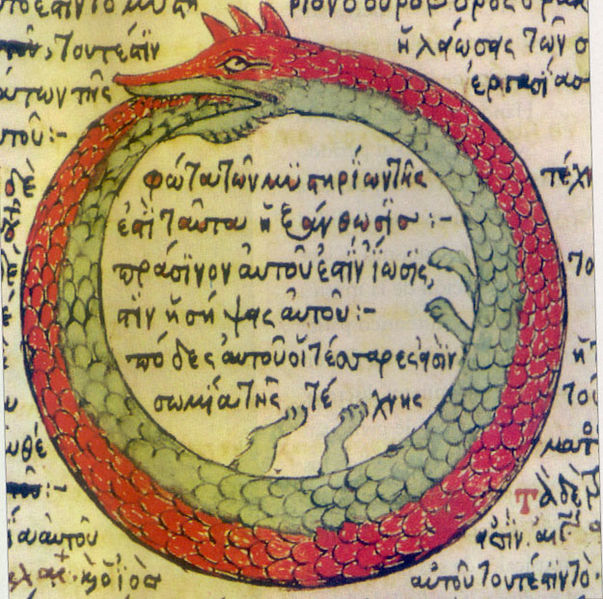
File:Serpiente alquimica.jpg
Originally Written: September 8th 2018

There are archetypal artifacts of deep evolutionary developed psychologically stages which are common collectively in all humans, which were first explicitly expressed in their symbolic forms in ancient stories, mythology, and religions. These archetypes have been transmitted genetically, and it wasn’t till recently that they have been analyzed and understood in their true nature in influencing the human psyche through advent of depth psychology and the findings of Carl Jung in analytical psychology. What you find is not only a symbolic representation of the developmental stages of consciousness, as described by Neumann, but basic understandings ingrained into all of us that operate on a level at the bottom of the unconsciousness, as pointed by Jung, which enable us to operate effectively in the world, and which work also as an a priori structure in which our values can be derived from.

These archetypes are not socially or culturally constructed, but biologically significant to us as their impact on survival and the evolution of our species made them useful. In the development of consciousness, as pointed out by Neumann, the original archetype represented as the Uroboros is the first stage in the human psyche. The Uroboros is the dragon eating its tail, the ring, never ending, without beginning. In this first stage of life or in conscious development, both historically and individually, the individual is not an individual and is effectively submerged in the unconscious, only affected by external findings. This state is common among primitive humans as well as modern human infants, and is characterized by the inability to distinguish opposites, or identify phenomena. It is the unity, or lack of distinctness, between inner and outer, self and other, or good and evil, which we see to be present in our pre-consciousness states. The individual is effectively cared for by parents (mother) and has no worries of his own, and this symbol is represented as the original state of the universe, as Paradise, before knowledge of good and evil in Abrahamic religions, is found in old creation myths of heaven and earth combined, before there was light or dark, eternal. The Uroboros, a symbolic representation of this original stage of consciousness, is found all over the world and has manifested in various societies, such as the yin yang, or combination of chaos and order, before consciousness emerges.

Maori Creation Myth – Seperation of Sky God and Earth God (World Parents)

This leads into the development of the ego in Jungian terms, and the separation from the world parents. In this stage towards the individuation of consciousness, a shift takes place in development in which consciousness becomes separated from unconscious, and recognition of the differentiation of content and phenomena becomes apparent. This is the archetype of separation of world parents. This is the differentiation caused by God creating a separate heaven and hell, separating chaos and order, and in individual experience, the manifestation of a conscious for whom which his individuality becomes known, internal states become distinct from external phenomena, in general, identification of separateness is instantiated. It is in this stage of separation that the identification of opposites becomes apparent to the individual, and his state as being altogether a separate entity from other individuals also emerges. It is the revelation of man’s nakedness after eating the fruit of the tree of knowledge. In archetypal stories, this is depicted as an individual’s reluctance to rely on parental guidance, and an encountering of the world for himself through the abandonment, it is the independence gained through accepting responsibility for one’s own Being, rather than being dependent on parental guidance.

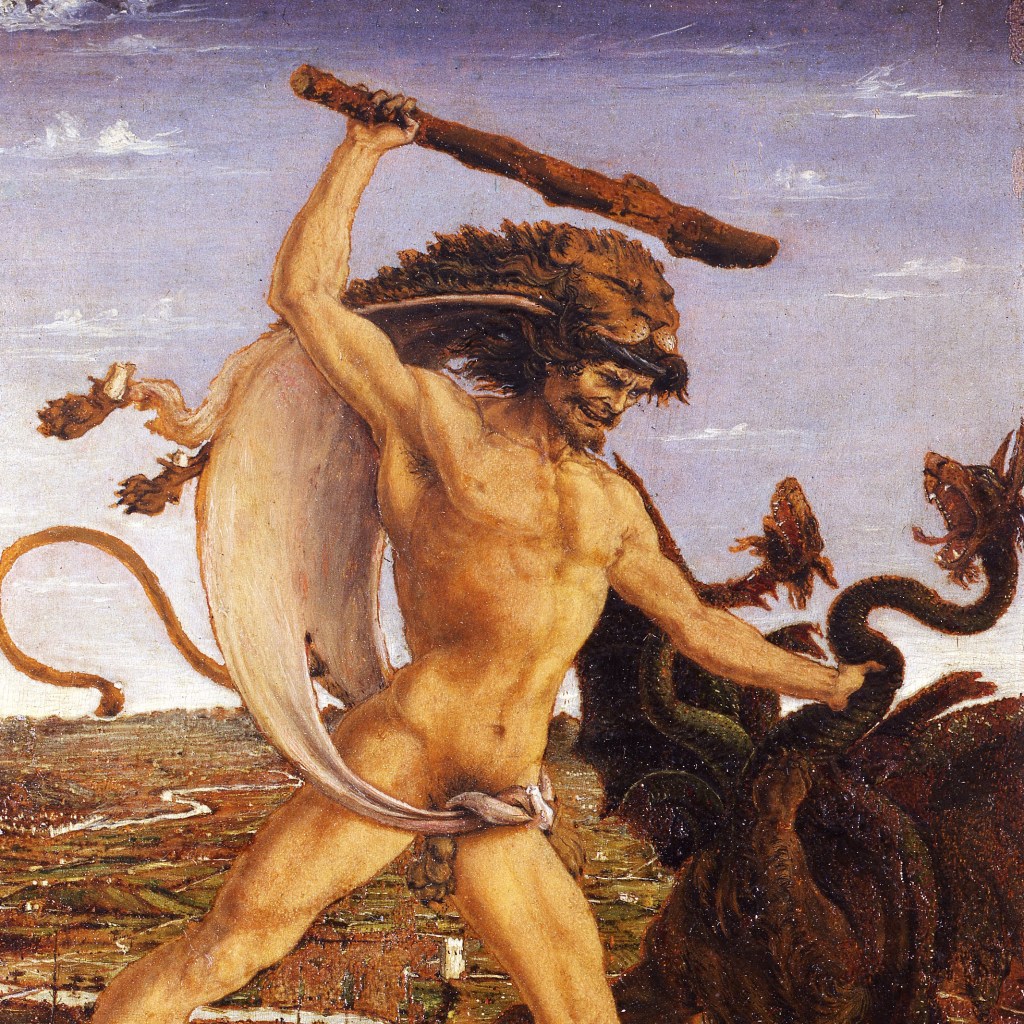
Heracles Slaying the Dragon

After the separation from the world parents, the individual must go out forth to the world, and, in mythological stories, this is represented by the individual voluntarily undergoing a journey towards some daunting challenge, the acquisition or success in which appears to yield great value. The hero’s journey is marked by trials and tribulations which test him as an individual, entailing pitfalls, re-calibration, and eventual victory over minor challenges that lay on the path towards his goal. In the final test, the individual encounters the dragon, the manifestation of extreme chaos, in which the individual must kill in order to retrieve the value in which he set out to acquire. The value is a boon, a treasure, the fountain of youth, wisdom, it is that which is most valuable. In attaining the value after discovering the antidote to chaos, in relinquishing its protector, the hero brings the valuable treasure back to the people he had separated from, and provides them with the value he had acquired in his journey. The hero grows through the process, and in achieving the final step in providing value to the people, he not only hits the mark in terms of the aim in which he set out to achieve, but he grows through the journey in becoming the type of person that can order chaos, he becomes the hero through the hero’s journey.

In psychological terms, or insofar as individual consciousness, and the historical development of consciousness is concerned, the hero’s journey represents exactly what we too must go through to achieve an integrated psyche in the process of individualization. We must relinquish dependence upon our parents, set an aim, a goal, a place we have the potential of being, and through diligent striving and overcoming of challenges and tribulations, actualize that potential, and become the person we had the potential of being. For us to successfully do this, like the archetypal hero’s journey, we too must voluntary accept the responsibility of attempting to do what is meaningful in our lives. In striving to accomplish the meaningful end, we necessarily will fail, must recalibrate, and must strive on diligently. In the final scene, we must ultimately organize the psyches range of potentialities into a unified whole through exploration and integration, we must set our lives in order, our lives being that of chaotic nature, and conscious intentionality being the means by which we can order both ourselves, psychologically, and the world in which we inhabit.

By ordering the chaos in our psyches, and our lives, we become individualized. In striving towards the aim of actualizing the potential we inherently possess we grow in the process, and in pursuing what is meaningful we, if successful, create or uncover a novel, unique, new, phenomena, which is meaningful to us and our fellow man. This boon we create, uncover, or discover, the treasure of our efforts, the fruit of our labor, the resultant knowledge and wisdom we have gained in our journey, we must, in order to complete the journey, provide what is found to meaningful to our society, to our fellow man. In so doing so, we fulfill the hero’s journey, and become fully individualized as a Being who has integrated his psyche, overcome difficulty, uncovered what is meaningful and valuable, and provided the people with a lasting benefit that is beneficial and useful.

The hero archetype is ingrained in us, and found in stories across the world, from the dawn of civilization, and has this same plot. It is the plot of the original hunter who could venture out from his tribe, slay the animal, bring back food to the people. This for him is liberating, is useful, helpful, and to the people in which he proved for, he is hailed as the original hero, for he provides life, the means to continue living, the means to which they too can actualize their potential. In return the hero is worshiped as ultimately good, good for survival, reproduction, and the continuance of the species, but he is not interpreted as such, rather, he is immortalized through the stories in which follow after him. The hero is the one who can conquer what is difficult and return to the people with value. Thus we value individuals and those pursuits that merit this type of accomplishment, those who discover new insights in things which prove useful to all, is rightfully seen as a hero. We value and strive to be like the hero. This is an archetype everyone understands automatically. You watch a movie and you know who is the good guy and bad guy. These are not arbitrarily socio-culturally developed, they are ingrained in us, for a good reason, and in understanding them we can better understand ourselves, reality, the truth, how to progress, and become the hero of our own journey.

The archetypes can be interpreted as effecting the emergence of consciousness across the domain of human history, in the developing of it to its current peak. They can also be used to describe the process by which, in our individual lives, our own consciousness develops. Lastly, in our present moment experience, they can be seen in the manifestation of personal and interpersonal relations through their emergent manifestations, and be perceived and interpreted in giving a descriptive analysis of the current factors at play in the emergence of actions.

Intro to Phenomenology of Action, Spontaneity and Conscious Directedness

Originally Written: July 17th 2018

Just because you have a perfect abstract knowledge of good and evil doesn’t mean you act from that knowledge. In our individual case we never have this perfect knowledge, but we often do have our conscience and rationality directing us towards a solution to a problem which is in contradiction with competing desires and emotions. Just because we have rationally conceptualized the more optimal path doesn’t mean we will take it, oftentimes we operate not under the intentionality of reason, and more so on the pressures of the moment, most notably due to emotional responses and instant gratification, but, I’ll argue, more subtly on the level of perceived bodily reactions, from which consciousness itself, and rationality, emerge from. To these situations, I designate the classification of “The Spinoza Effect” even though notably similar ideal conceptualizations of the situation has been recorded before his time, I think his conceptualization of it fully exposes the breath of the ideal.

To say that action stemming in contradiction to reason is necessarily bad, and that only action in accordance with reason is optimal, seems a reasonable claim to make, but I believe there is more nuance to be found in relation to our conscious direction, and the choices that “appear” to stem from it. It seems in line with rationality to suppose that certain situations may call for the relinquishing of reason in their optimal resolving, yet, to do so, necessary includes the rational interpretation of instantiating a non-rational approach. Would the action then be rational if it stems from a rational analysis? E.g. If I decide that given my next interaction with someone, I’m going to act spontaneously in the moment, so as to not overthink the best thing to say, or the best way to handle it, if I decide to relinquish logic and reason for spontaneity and emotion, then the decision to do so, is itself rational, yet the action in itself isn’t rational, but it stems from reason in its instantiation. So, in theory, there never could be situation in which conscious forethought antedated an emotional reaction in which the causal determinacy isn’t rational, by definition, yet the action itself, if characterized by emotion, or by lack of reason, in itself, is always emotional.

Conceptualizing a response to a situation that is predicated on emotions, is as much a representation of our Being as a response that is preceded by conscious contemplation attempting to reason out a logical explanation. This is due to depicting the degree to which someone has conscious awareness of situations, and their ability to have conscious forethought preceding their actions. The very quality of a Being of acting spontaneously or through conscious contemplation, in response to different stimuli, is itself a character trait. The discipline in restraint of spontaneity, the reluctance to move instinctual and habit formed responses to conscious cognizing, all tell you something about the Being which is the person in question. Any action that is manifest from an individual, regardless of its content, the situation presented, or the state of mind from which it stems from, will give a relational description that is always accurate in representing the individual. The conceptualization of the perception that enters consciousness in describing a person’s action isn’t the accurate description, as it is mediated by the perception and the developed biological system which filters and accounts for internal values in its representation into a linguistic account of which we are consciously aware, but rather, the action itself is the direct description, in the pre-conceptualized world. This action itself, regardless of its preceding instantiating cause, represents the type of Being which performs it, as much as someone would like to claim “it’s not me” or “if I had time to think, I would have acted differently” are impermissible excuses, as, it is you, and if things were different, of course things would be different, but they’re not, and therefore the action is descriptive.  

In respect to the actual instantiation of any “action”, whether the motivation is predetermined by rational and non-contradictory forethought, i.e. conscious direction, or spontaneous embodied reaction, the resultant action is always, in any case, a reflection of internal values. Whether those values which are embodied are reflective of the consciously formulated hierarchy of importance, or not, is dependent on the action itself in comparison with the conscious values. To say that action which is preceded by reason is always reflective of these, also doesn’t follow. It is possible that spontaneous, emotionally driven responses to situations do, in fact, upon reflexive analysis, follow in alignment with our consciously uncovered value system. Any action, whether or not employed by conscious direction using our rational faculty, or motivated by emotion and perceptive embodied reaction, tells us something about ourselves. We are not merely our rational consciousness, nor are we merely our embodied reciprocal system, we are both, and both serve to provide data as to what it is we value, and to the nature of our character in general.

Are they the same thing? Our emotional and spontaneous reactions are built upon a biological system that has compiled “bodily perceived optimal responses” to the effects of situational encounters. These spontaneous reactions are the result of the biological system, built up by genetic information, which has incorporated perceptive datum, modified by the biological structure, in which forms the habitual response to situations and stimuli. Further experience serves to inform the optimality and development of these spontaneous reactions, which always present themselves in the actions our body performs within the present moment. Consciousness and its contents are presented to us, subjectively, under the same preconditions, resting on the formulations of our bodily perceptions in cohesion with the genetic instruction of evaluation and integration into the totality of the organism.

Our consciously developed state of mind and its contents are the active result of situational stimuli in the same manner that an unconsciously directed spontaneous reaction manifests itself. Both systems are created from the groundwork of genetic material, and modified through the perceptive lens that is outlined on the foundational structure. Body and mind are essentially undifferentiated in the method towards their state in the present moment, as the foot is conditioned to flex up or down in the movement of the body as it is “walking”, the mind is conditioned to manifest the content which it is currently manifesting, just as the heart pumps blood and the lungs inhale and exhale, our consciousness is also conditioned and tempered by the pressures of the world for which, like our body, being our body, is in the world.

We still make the fundamental differentiations in regards to parts of a whole, but we must acknowledge that the whole is more than the sum of its parts, and that, being a whole, the parts (only differentiated conceptually) are essentially modified in a manner that contains a continuity and homogeneity. We often make a hard distinction between consciousness and the body, between sensory organs and the subjective experience of them, when, if looked closely enough, there is no fundamental distinction between these parts. Sure it is useful to delineate the roles and physiological underpinnings which give rise to consciousness, but the scientific endeavor of separating, slicing, differentiation, and defining, doesn’t lend itself to an accurate experience to the subjective Being in which we experience the embodiment of the totality of the organism which we perceive to “house” consciousness. The distinction that “I am that which is behind the eyes”, that “we” are this consciousness which directs and controls the body as a ship’s captain steers a boat, is missing the fundamental connection that predetermines and presupposes the very tool in which it is using to suppose such a distinction. Consciousness and subjective experience have qualities in which we can describe as to their arising through physiology, and through the ways in which “stimuli” affects us and how to “deal” with said stimuli in the science of psychology, but both are missing the mark as to what presupposes even these conceptualizations, even before the descriptive element of linguistics arises to describe something, the bodily perceptions in response to the situation which calls for such a description, plays the role of producing the thought through its habitual, “seemingly spontaneous” creation of mental content that has been developed over the lifetime of the individual in his evolved state of Being. The bodily perceptions which internalize the stimuli of the situation perceive in using the “sensory” tools, but these tools are mediated and imposed based upon an internal value system of importance, all of which developed based on the genetic blueprint and subsequent life experience development of the organism, as a whole and his parts, which presuppose the action which is presently appearing within our subjective experience. This subjective experience is no different in essence to the other aspects of the body in their perceiving based on underlying values that have been created throughout the lifetime of the organism. While physiological differences, material composition, and the functionality of parts of the whole of our physical body can be described and are individually quite different from each other, in regards to the Being which we find ourselves, and the subjective experience in which we go through life thinking we are, we must make the necessary connection towards what exactly makes up and is this subjective experience, in which case, I argue, it is merely what the organism intuits as being “who they are” due to the divisive and separational nature of concepts developed using language, but in actuality, it merely is what it is like to Be the Being which you are, that Being which is, currently, markedly differentiated as a human, which developed language, and developed the ability to have a describable experience.  

Being that we experience ourselves under a certain conceptualized differentiation than the body, we intuit that the rational faculty is entirely different than the spontaneous capabilities, and that the two are separate by a gulf, the former which is us, the later which is not. While they both describe different situations, one in which conscious thought is allowed to arise, conceptualize, organize, plan, and decide, taking substantially more time, and the other in which the perception of a situation fails to be modified and internalized through the biological system to the point of arises into conscious awareness, and reacts before any “Idea” enters conscious awareness, while these two situations are, in their facticity, different, they both are the representation of the organism to equal degrees. The developed spontaneous reaction can be consciously modified by the conscious direction to repeat certain tasks, conditioning the body in a way that is in line with the thought. On the other hand, the very thought to do such a thing, and in fact, the totality of consciousness itself, is modified and created by the bodily perceptions which are filtered and modified by the nervous system and its genetic coding before being filtered through the internal value system and arising into consciousness. In this way, both systems, being conceptually differentiated, create each other, and in actuality, prior to any conceptual differentiation, necessarily are the same in their cohabitation, their cohesion, and their co-creation. Spontaneity is merely conceived as such in consciousness, and conscious deliberation or rationalization is an instinctively driven response to stimuli in the same manner as a bodily reaction is perceived to be a habituated response, they are, in essence, one and the same.