People must fulfill their sensual desires, so they can realize they do not provide lasting happiness, and desire instead an inner peace not dependent on externals, or possibly even abandon craving and attachment, and desiring altogether. Once realized that even the most profound stimulating consciousness altering substances doesn’t produce enlightenment, and that there is still something lacking, only then will one seek the truth to be found within this present moment.
All drugs should be legal, out of the government’s hands, and up to the individual. There are good, and bad reasons to do drugs. For medicinal purposes, life saving reasons, is the best reason. Next would be for scientific research purposes, in discovering ways to improve the welfare of living beings, as well as understanding reality, consciousness, and in general, the scientific understanding of the brain and cognitive structures / psychology. Next would be for personal spiritual growth, experiencing different states of consciousness, expanding perspective, to learn about the mind, and better it. Next for social fun, enjoyment, a good time, so to say. Next, to escape from reality, escape from the normal state of consciousness, which is one of suffering. And the worst reason to be doing or trying drugs is to fit in with the masses, to be cool, or like someone else, for popularity, social pressure, or for status contrary to one’s own beliefs. So there is a range of intentions when doing drugs which can be used as a reference in whether you are doing them for the right reasons, the first three I would say it would be positive, and the rest negative, thus I would encourage drug use if someone had honest intentions of the first reasons, and discourage it for the other reasons, based on its potential benefit to the individual and others.
This is a hierarchy of what is a good reason to a bad reason, relating to individual welfare, societal wellbeing, insight, wisdom, and inner peace. As always, the moral realist perspective holds, in that there are right and wrong answers to moral questions, based upon the axiom that morality necessarily entails the suffering and satisfaction of life, and the movement away from complete utter suffering for all beings across time would constitute the “good”. Thus, here we refer to the use of drugs being “right” when the net wellbeing of the situation is optimal to the progression of the individuals who indulge. This isn’t necessarily a utilitarian account of pleasure, as I believe suffering, as a rule, will always outweigh the pleasure, but rather, it is in looking for a morally neutral, or in a better case, a wellbeing optimal position, in which the use will instantiate.
In general, if someone wishes to try a new substance, they should do extensive research and be prepared mentally and physically for the experience, as well as be aware of the potential risk and negative side effects, or else they have the potential of paying the price of ignorance later on. If the experience ends up being a net positive, then more power to the individual, if they can avoid attachment, addiction, or injustice to others, the possibility of which the doer must be aware of beforehand in order to combat the actualization of these effects, and if under their sway, the responsibility rests on the government to imprison them for wrongdoing, and on the universe to choose to help them out of addiction or never escape it, a possibility which is important to be known prior to indulgence. If the individuals experience turns out to be negative, or leads to addiction or injustice, the individual will suffer the consequences, his family and society will too, which is the greatest argument against legalization of most drugs, yet must be the price we pay for freedom and liberty.
The possibility of the benefit of positive attributes such as knowledge, wisdom, understanding, and free exploration of one’s own consciousness can potentially outweigh the negatives in certain situations. It’s worth noting that even a negative experience on drugs can teach you how your consciousness can be changed, and the silver lining may outweigh the present dissatisfaction with the experience. Of course trauma, and a lifelong causal influence of misery or addiction, is something one must keep in the forefront of their mind as a possibility when consuming any type of mind altering substance. Wisdom will be necessary to avoid pitfalls, and improve the quality of one’s experiences. The majority of people are currently using drugs for purposes low in the above hierarchy, yet, for government to take away the possibility, albeit of the small minority who are interested in an honest, virtuous inquiry into the most important aspect of all life, consciousness, is a crime in itself. The ignorant, unintelligent, unwise, unvirtuous people will undergo the misuse and abuse of drugs and pay for it in suffering, but this is the price a nation must pay for its freedom to explore the unexplored, and seek the truth.
There also exists a hierarchy for the most beneficial drugs for the purpose of spiritual insight, and medical treatment. I think if drugs like meth/crack/heroine were legal, and the public is properly informed on their effects, neural toxicity, chance of death, moral defilement, etc., then most people would never try them, and those that do, do it fully understanding what they are getting themselves into, and if they break the law on drugs, if morals change to commit crimes, then they will face familial/societal/federal punishments for their acts, whether it came from ignorance, delusion, or enlightened thought, the law of the land will still hold (the question on the current law of the land and its atrocities is another conversation). Complete legalization of drugs would also reduce gang activity, street violence, improve the quality and price of substances, reduce criminal acts that are secondary to its acquirement and the underground business, lessen danger in the unknown content of drugs coming from currently unlicensed, anonymous sources, in which the drug could be spiked, impure, and the possibility of robbery and violence in acquiring it also gets significantly removed as the business moves from thugs in alleyways to licensed businesses with FDA tested quality.
Spiritual progress and expertise in meditation is a skill that can only be developed and cultivated with practice. Practice takes time, repetition, effort, concentration. It is of utmost importance to have this skill, as the development of the mind organizes the chaos of all we experience. The understanding of reality, and the fusion of your consciousness to the present moment, without being led away by delusion, destroys ignorance, destroys suffering, and its causes. To improve in the development of your mind, arguably called “spirituality”, enables experiences of ever increasing insight into the nature of your psychology, reality, “yourself”, that increases in profundity and clarity as you work on the skill.
To work in developing mindfulness in a Theravadan Buddhist sense, or in developing a non-dual state of mind as outline in the Hindu Advaita Vedanta tradition, increasingly enables experiencing the present moment, experiencing every shift in consciousness as its contents arise and fall, as it shifts from object of awareness to awareness itself. It is possible to become so mindfully located in the present moment that you are aware of even the slightest change in consciousness as it moves from one phenomena to another. To do this much practice, much time, effort is needed to cultivate the skill. Certain defilements must be uprooted; distractions must be eliminated. Any form of desire, craving, attachment, to anything – even a state of mind, yourself, peace – must be uprooted. Any type of aversion, blocking, avoidance must also be uprooted. This is the middle path, a pure acceptance of the present moment, with no will to be found. No will as in want, and no will as ability to control, as both are illusions made of the brain by the organism to produce effects.
The ability to experience Being, to experience pure experiencing, is to simply Be. To fully be mindful, is to be mindful of being mindful. It is to be aware of the exact content of consciousness as it constantly is changing, and to see it, watch it, free of motive, free of will, free of denial of will, unbiased, as it is. The effects of such insights lead to a greater understanding of causality as it relates to your psychological state. This includes the causality leading to the un-satisfactory nature of life, and thus to others, and how you and them can be aided. This cause is from the very desire or craving or attachment to anything, even happiness, and from seeing things as permanent, and as something to “hold on to”. Every phenomenon is merely occurring within the present moment, and it is all impermanent, these are truths we should make peace with by letting go of the notions otherwise. From a mode of being characterized by peaceful equanimity, in which the mind is not disturbed by any normally perturbing stimuli, such as those that go against our desire, by anger in others, by misfortune or by aversion, springs all the greatest things we would normally want, truth, happiness, morality. We often find in life that when we are not looking for something, we happen to find it, and in this case, when we are not searching after happiness, or satisfactoriness, but rather pursuing what is right morally, and by maintain a state of mind which is characterized by understanding and virtue, that it naturally follows in its wake.
If you understand how your wellbeing is diminished by the desire that moves us along in the present moment, you can understand how your wellbeing is possible in the present moment, by redirecting those desires towards something that truly has meaning to you, and by eliminating the desires that aren’t in alignment with consciously calculated goals. From this you can use that understanding to move your experience to that of well being, more and more so with more practice, more and more so you move to do what is in your best interest. Then extrapolate outward with the effects of such an undertaking and it becomes clear that you can improve the wellbeing of your family, your coworkers, friends, community, and onward. The key is to developing your mind, and the implications lead to a better present moment, better in every form of the term, not only for you. The more you develop and train and practice in this manner, the better your life can become, the more you can understand yourself, and your lack of self, the more you can acknowledge phenomena as they arise, and then remove defilements such as anger, hatred, jealousy, ill will, laziness, boredom, dissatisfaction, suffering, and so on.
It is natural when an unsatisfactory mode of being arises to not want it to proceed as dominating the psyche, but that very desire often confines us to stay within it. It is by the calm recognition of the arising, and the ability to let go of wishing to be otherwise, while simultaneously not acting in a way which satisfies the unwholesome state of mind, that we are able to overcome it. What skill could be more useful than that which enables you to be better equipped to the misfortune and negative modes of being inherent in every life? What would be a better way of becoming a better person, than developing knowledge of wellbeing, and how to attain it, and then improving the lives of others, by improving yourself? The skill cannot be bought, or shared, or worked on by anyone but you, and you can only develop it, it isn’t quick, and instantaneous, your improving in it is yours alone, and you can not share that. But you can help point others in the right direction so they too can develop it. Spiritual progress is yours alone, and thus shouldn’t be talked about lightheartedly, but to those with true willingness to learn, to improve, with “little dust on their eyes”, we should seek to aid them or answer their cries for help as Buddha was encouraged to do upon attaining enlightenment. Wisdom dictates our ability to decipher who it would be beneficial to share certain ideas with, and we should use our best judgment in discerning the ideas we share with others. Enlightenment is the most important thing in the world, the most valuable, and it is within you, hidden underneath biological impediments, culture, conditioning, and unwholesomeness, clean up your mind, remove impediments, develop wholesomeness, and become able to be experiencing right here, right now, in this present moment, and every present moment, the potential you contain – actualized.
I think the main confusion people have with understanding the self is in the understanding of consciousness and its contents, which is where you would look for such a thing. The confusion comes from attributing independent control to awareness. Consciousness (all subjective experience) simply is made up of stimuli arising into awareness then disappearing, there is no choice/selection by a self, there is only mindfulness, or knowledge of awareness of the present moment, available to us. If you pay attention to your experience, this is available to be seen now. Even thoughts of the past/future are simply arising into the moment. The feeling of control/choice/ being something permanent is an illusion, also arisen into conscious awareness.
There is no subject/object, experience/experiencer duality in relation to subjective experience. There is only the awareness of the present, of consciousness, there is only experience itself, there is no separation between a someone and something done to him, all there is is something happening, this happening is experience, and that is all. This is the non-dual nature of reality, there is no self, just change, just experience, just consciousness and its contents. This is Advaita Vedanta. To practice Advaita Vedanta, you are focusing on the awareness itself which is the backdrop in which contents of consciousness are appearing. Rather than recognizing the contents as they arise and fade away, as in Vipassana, and rather than focusing on a single content of consciousness and bringing the awareness constantly back to it, as in Samatha, in Advaita Vedanta you are focusing upon the field of pure consciousness within which these contents are appearing. It is the reflexive meditative act of focusing awareness upon the field of awareness itself. The best metaphor I have for it is that of a stage play, where actors and sets are constantly changing on the stage, but the whole act is occurring on the stage. The contents on the stage change, but the stage remains the same. Here the stage is consciousness, and the actors are the contents of consciousness. In Advaita Vedanta we are watching the stage, and realizing its “permanence” in a Hindu sense, as it is the backdrop and consistent aspect which lies behind all conscious content. Through this identification with awareness itself, we remove the distinction between there being a watched and a content watched, we lose the subject object distinguishing and identifying, entering into a non-dual state, which has with it the realization of the non-dual nature of consciousness itself. This insight, and this state, is the primary objective of Advaita Vedanta.
Here I want to give a quick differentiation of two basic types of traditional methods of meditation, Vipassana and Samatha. Samatha meditation is concentration meditation, and it was the first “formal” type of mediation. It was developed by the Hindus far before the birth of Buddha, and was common practice by contemplatives and spiritual gurus up until his time. Samatha meditation is the focusing of your concentration on a single phenomenon, this is most commonly practiced as breath meditation, where you focus on the breath exclusively, attempting to bring the attention to it, and back to it any time it strays. Any object can be the object of attention in Samatha meditation, whether it be a deity, a word, or a phrase. The important aspect is that any time your awareness drifts from the object of intentioned perception, you recognize its shift, and bring it back into the contemplation of the object. It is an attempt at minimalizing the distractions, and maintaining a steady awareness. As far as the effects of Samatha mediation, it can bring you into state of jhana (Four Jhanas of Buddhism), which are meditative states of increasingly different conscious states. The jhanas are marked by many aspects, as you move into the higher rungs throughout mediation. While many people state they are reserved for spiritual contemplatives, I believe they are attainable by anyone who is able to practice the mediation sufficiently. Some aspects of the different jhanas experienced during Samatha Meditation are; intense pleasure in concentration, seclusion and removal of distractions, one pointedness of thought, removal of desire and aversion, peace in the present moment, peace in seclusion, and as you get into further states – the abolition of thought, and the fetters of existence. The experience of non self, and equanimity regardless of the minds movement is most valuable here. Through dedicated concentration, and awareness of the minds ability to change from the object, you are cultivating character traits of equanimity, or undisturbedness in the face of misfortune, or fortune. It is cultivating a peaceful mind that is calm and unable to be perturbed, thus the benefits last longer than the actual mediation.
Vipassana Meditation was brought into existence by the Buddha himself, and entailed a further extension of Samatha meditation. Formally, it is translated as “insight” meditation, where the practitioner is developing insight into dharma (Basic Dharma Explanation), or the true nature of things. Rather than singular focus upon a single mental phenomenon, the practitioner here seeks to be mindfully aware of any content entering into conscious awareness, without an attempt to hold on to anything, or revert back to anything, nor to be averse to any unpleasant phenomena. This method of mediation is much more difficult, as many phenomena can distract us from the awareness of their arising. The goal is to be aware of the content of consciousness without judgment or desire for it to be otherwise, yet to remain aware on the present moment. The distraction here isn’t a content that is other than the object of awareness, as in Samatha, but rather a distraction is anything that takes us out of the mindfulness of the contents of consciousness in the present moment. So anytime our awareness breaks and we follow a thought stream without being explicitly aware that it is happening, the practitioner must bring his awareness back to the present moment and maintain that awareness of whatever content is arising. This form of meditation opens us up to some fundamental truths of our psychological state, namely, the inability to alter the contents of consciousness, as there is no controller, there merely is content arising and fading away, outside of any “self” controlling it. This is known as the doctrine of nonself. There merely are phenomena arising, there is no “free will” in determining what content appears next. We merely are motivated to the next thought or content, through desire. We don’t choose the desire. Therefore, whatever happens, is out of “our” control. There are the perceptions, emotions, sensations, thoughts, and mental formations, or habits of the mind, such as language and reactions, these things are the 5 aggregates that make up our experience, and they are arising and fading away.
The next insight to be gleamed from Vipassana is the realization of impermanence, that any phenomena that arises is not lasting, its transitory, subject to change, it is not permanent. This can be extrapolated from mental occurrences to all phenomena, and just like non-self, or any other Vipassana insights, it can be directly experienced and known by the practitioner as a foundational truth of our psychological existence. In addition to impermanence and nonself- we can realize that any phenomena that does appear, is appearing in the present moment. Whether it be a thought about the future, or the past, or any other phenomena, everything that occurs, is only occurring now, in this moment, and it will always be so.
The basic formula for performing Vipassana meditation is; present moment awareness, recognition of impermanence, and then letting go. If this is done sufficiently, these insights will come to the practitioner, and can be directly realized. This provides wisdom into the truth of reality, and allows us to align ourselves with the truth through the destruction of false beliefs previously held, such as the existence of a self and free will, or the existence of something “permanent”. The benefit in these realizations in providing a better equipped psyche in reference to mental phenomena as they arise, in not clinging to the pleasurable, or avoidance of the unpleasurable, but rather excepting them for what they are, phenomena out of our control. We can gain insight into the causal nature of what causes positive, wholesome states, as well as what produces unwholesome, suffering, states. This is through the mindful awareness of the causal chain of dependent origination (Dependent Origination (Buddhist Conditionality)), another insight to be gleamed. This chain is characterized by initial ignorance, and leads us through several successive steps which eventually leads to suffering. If we are able to recognize the processes occurring, in their causal determinacy in leading to unwholesome states, we are better able to navigate and destroy the chain before it propagates into destructive mental states and speech and actions. The ability to gain insight into these chains, allows us to handle ourselves in a wise, calm, equanimous manner, and better enables us to navigate the throes of existence, as well as provides us with insight into how others minds work, so we can aide them, or at least not hinder them, in the destruction of the suffering within their lives. The benefits of this type of insight mediation are honestly exhaustive, and the sill can be constantly improved upon. While Samatha necessarily requires one-pointed concentration on an object in the present moment, and thus, normally, requires quiet, sitting, eyes closed (traditional meditation stereotype), Vipassana, on the other hand, can be practiced in any situation in life, it merely requires a concentration on the content of the present moment, and thus is useful in many situations. It is advocated that a mindful existence, always, is beneficial, but I disagree, which is basically a blasphemous statement in Buddhist circles, but I have my reasons, as explained in the essay “Conscious employment of the Unconscious”.
As with all meditation, I don’t believe they are to be utilized in response to a negative situation, they are not a “fix it” tool for resolving life’s problems. I tend to see them as anticipatory tools. They are the cultivating of character traits, and in Vipassana, realization of truths, which better prepare us for when difficulties do arise in our lives. We shouldn’t perform meditation when life is going horrible for us, in these cases, we should attempt to actively rectify and set our lives in order. When life is going good is when we should meditate, to remind ourselves of the transitoriness of this pleasure and fortune, and to prepare us for when things fall apart, for when bad times do come it is better to be strong and calm minded in order to better deal with them. Vipassana improves our understanding of consciousness and reality, thus providing insight into the true nature of things. Samatha can change our conscious state more directly and dramatically to one of peace, non desire, equanimity, as well as improve our concentration.
Both types of mediation can change our conscious awareness of the present moment to an improved experience, and improve morality by acting/experiencing in a mindful, careful, wise way. Meditation is cultivation, expanding the mind, improving our understanding, morals, actions, speech, thought, beliefs, wisdom, purity, compassion. Say we feel angry or annoyed by something someone says. The effect lingers, we contemplate why they said it, the person’s horrible character, how they are wrong, we’re right, and the general situation that caused our anger/annoyance. To be mindful of the feeling, in the present moment, opens us up to its impermanence, allows us to let it go, and is the best tool to understanding/fixing negative emotions which in turn effects thoughts/speech/actions in effect changing our lives and others. We can become aware in such a way “I feel annoyed at this person, this annoyance sprung up into my Being after he said something. I didn’t choose for the person to say something, neither did I choose to feel this way in response, it just came into my conscious experience, and there is something mysterious yet amazing about its arising. So there was a cause, what the person said, then the feeling, then negative thinking, now I’m aware, I feel the emotion, it’s not me, it’s non-self, it’s causing suffering, and it’s impermanent. Viewing it merely as it is, I won’t crave my previous state of happiness, or be in a state of aversion towards it. I will accept it for what it is.” Merely by knowing our aware of its presence, and that there is no self that created it, it becomes merely part of experience, realizing it’s okay, just part of reality, of a life with an inherit conscious nature to experience suffering like this, we can accept the emergence of the emotion, and let it go, liberating ourselves from its influence, dispassionately, we can be mindful of the whole stream of events and it might occur to us that the whole situation was almost magic like. It’s astonishing in seeing how emotions happen, and we might even laugh/be happy on how we were able to see the emotion as just an emotion, to mindfully witness life happen, understand it, and fix the problem. The most important part of reciprocity is to not manifest those emotions into actions or speech that harbors ill-will, or isn’t useful or beneficial to the other person. This type of reaction to unwholesome, or negative influences, is all too natural for us, but only leads to further suffering for ourselves and the other person. By mindfully being aware of unwholesome states, we can reign back our automatic response in being defensive or going on the attack to the other person, and work to respond in a way that is wise, meaning, beneficial to all parties involved.
In addition to these two types of mediation, there is Advaita Vedanta meditation, and Buddho Mediation, as well as a whole variety of other traditional practices. Advaita Vedanta (Basic Advaita Vedanta Meditation) is a slightly different spin off of Vipassana, where the insight and methodology is slightly different in its focus upon non-duality, but certain insights are gleamed that are unique to it. Buddho meditation is a specific form of Samatha meditation, where the object of concentration is the word, which has significant meaning, and thus inspires us to gain the character traits associated with that meaning.
Everything in existence is preconditioned. Everything that exists in the present moment, exists only in that present moment, in the next moment it is not the same. It has changed. It is impermanent, not lasting, not permanent. All thoughts, emotions, perceptions, all of consciousness, its contents, the sense data, awareness, all is not permeating experience as concrete entities as it moves from moment to moment. It arises, and it fades away. There is no soul that controls them, or dictates what is next, or experiences the experience. There only is experience itself. There is awareness of what is happening in any of these realms. Awareness of the present moment, of seeing, smelling, hearing, tasting, thinking, and there is the knowledge of being aware. Seeing is being known. Thinking is being known. Anger is being known. In the moment of recognition of what is happening, there is no anger, no hatred, no delusion, no desire, no aversion, there is clarity, peace, and equanimity. This is the essence of Buddhist dharma, it is essentially made up of psychologically beneficial tools, to improve the welfare of your life.
What is most beneficial in your life is beneficial in the present moment, in the long term, and benefits your family, your society, and all sentient beings. If you are mindfully aware of reality, then you are able to recognize any unsatisfactoriness, or suffering which is inherit in your life. Anger, depression, anxiety, sickness, pain, aging, dying, family members dying, etc.; all is inherent in life. All the suffering caused by these things is because we crave for them to not happen, and we crave for good, beneficial things to happen, so much so that to the point when things don’t go our way, the suffering ensues. An understanding of the impermanence of life, enables you to be dispassionate about these things, accepting their inevitability, and helps you to be strong and supporting for others as they too go through the suffering in life. In addition to the craving that causes unsatisfactoriness, there is an attachment to the state of things when life goes our way. When all is good, your fame and fortune, career, family, all is in the state you desire, you become attached to that feeling, to that moment, to those material things, and mental feelings. The problem with becoming attached to anything in this world is that when it changes, you become unhappy, non-content, stressed, angry, and crave for it to be the way it was. You actually will suffer trying to maintain what you have, and in attempting to maintain it as “permanent”, your grip becomes tight upon the life you thought was perfect, and in that tight grip you lose the feeling of peace you thought everything you wanted was supposed to give you. This creates suffering. In not remembering that all these things are impermanent then the suffering will stretch beyond where it can potentially be modified, as it is in its nature to be modified. Not only are the things you become attached to likely to change, but it is inevitable they will.
The whole dynamic between craving and clinging really define our existence day to day, moment to moment, and it is the root of suffering in our lives. Once removed, the basis for anger, hatred, and delusion also will be removed, rendering our lives, and anyone we come into contact with, better, in that it promotes welfare. For this the Buddha laid out a plan that if followed, leads to the destruction of these negative emotions, to the destruction of the origin of suffering, this very craving and clinging. It’s worth noting that meditation becomes extremely useful here, you can experience subjectively the knowledge of awareness of phenomena as it arises and fades away, thoughts, emotions, the nature of consciousness, the impermanent nature of it all, and in practicing and cultivating this view, you can take it into possibly every moment of your life. So when anger arises, you know it’s based on causes, you know that it is based upon the desire for things to be different, you know acting on it will only increase its duration, you’re aware of angers presence, and in that moment of recognition, it goes away, possibly to return, but in every moment of conscious awareness of it, it is not there. You know anger is impermanent, unhelpful, that it’s not going to last forever. You became wise in considering the suffering inherit in yourself and in others if you continue being angry, or act on it towards someone else, thus the knowledge and mindfulness of angers presence allows you to eliminate the effective reaction it produces from your experience. The more practice in insight meditation, the more mindful – the more aware, and the more aware – the more you are able to cultivate good qualities, and eliminate negative ones, providing yourself and others a better life. So insight meditation, used in this way, enables the individual to improve his own understanding of his psyche, and thus become better equipped to integrate it and use it in an optimal fashion. In doing so, we improve the experience of life, as well as develop the ability to better conduct ourselves in a mindful way that is beneficial to others. This practice of mindfulness and the expansion of the mind in reference to the inherent dissatisfaction in life is a tool the Buddha articulated and shared with the world after he himself thought out the situation and its solution.
A more conclusive answer to the solution of suffering, which covers all aspects of human experience is the noble eight-fold path, the fourth noble truth in the Buddhist tradition. Like all religions, Buddhism is aimed at the individual aligning himself with the greatest possible good, and in that aligning, becoming better, and more like that object. For some religions it’s God, or Gods, who emulate ultimate wisdom, and ultimate goodness. In Buddhism you seek refuge in the Buddha and his teachings, he who has great wisdom, compassion, and purity, but you align yourself on the middle path, the eight-fold path, and it is not necessary to do this on faith. Once we can see the evidence for the things he laid out in our own lives, we find that he is not only teaching a different perspective, but that that perspective actually is in line with our actual experience of life. We find the truth of the teachings within us, not in the sense of “finding the holy spirit”, but that we see how desire and attachment lead to suffering, we see how it dominates life, in brief occurrences we see how virtuous conduct and proper behavior leads to temporary relief, we see the truth of the removal of suffering. The middle path outlines the things we can do to improve our situation, the correct conceptualization of eight areas of our lives that are directly intertwined with all of experience, and if we follow the teaching on them, will lead us to see reality more clearly, improve our moral character, and act in a way which promotes wellbeing. This necessarily will produce a more peaceful experience as we move throughout life.
The middle path lies in equanimity, in neither aversion nor in craving, in not emerging in sensual pleasures, nor in self mortification. It lies mindfully between any two extremes. It is a framework for which we can develop our minds, our actions, our lives, and in so doing so make the world a better place. It is comprised of eight subjects, at which the goal is to strive for rightness, wholesomeness, and perfection. The eight-fold path is right view, right intention, right speech, right action, right livelihood, right effort, right mindfulness, and right concentration. To sum up briefly, the first two in the chain are characterized as “wisdom steps”, the next three “practical steps”, and the last three “meditative steps”. Right view is a correct understanding of reality, of philosophical, scientific and psychological knowledge, most importantly an understanding of the three marks of existence (non self, impermanence, suffering), the four noble truths, and this path itself to the elimination of suffering. All the following areas on the path lead from this one, and if developed strongly as the primary step, we will see that the proceeding factors are better able to be developed strongly. The same goes for the following steps, developing them with an importance on the antecedent step, better allows the improvement of the successive one.
Right intention is having the best intentions for others, and yourself. This means not harboring ill-will towards anyone, why would you ever want something bad for someone else? It only makes sense to want what is best for them and society. Sometimes what is best isn’t always what is nice, or leads to short term gratification, sometimes it is punishment, or harshness, with a silver lining, but this is all about intentions. This implies the illumination of intention based on anger, hatred, or lies, to be replaced with intention based on truth, compassion, and good will. This step also includes right thought, as intentions are located on that realm of perceptions and conscious contemplation, which we conceptualize as thought.
From these intentions springs the next rung in the ladder, right speech, the first of the three “Practical Steps”. This means, first of all, speech that is true, and not false. Speech that is helpful and not harmful. Speech that is unifying, and not divisive, or backfiring, or gossip. And for ultimately perfect speech, this means only speech that is truly beneficial, not idle gossip, or discussion of unimportant topics. Next is right action. This is characterized by similar standards as right speech, but includes, in the Buddhist tradition, not killing, not using drugs or alcohol, not intending for the harm of any beings, for acting out of compassion. With the right intentions which were previously cultivated, we are better able to act with virtuosity in our interactions. Next is right livelihood. In performing the right occupation, we necessarily are taking action in a manner that supports ourselves and our families, and the job we take, the way we spend our time in providing for ourselves, must be conducted along the same moral imperatives as right action and right speech. This excludes any type of labor that deals with the harm of sentient beings, any job that has to do with deception, manipulation, gambling, drug dealing, hustling, fortune telling, illusions, is advised against pursuing, for its effect on our moral character and on other sentient beings. Right livelihood is providing for yourself in a way that is beneficial to yourself, and to others without encompassing dishonesty, cheating, or harm to others.
Next is the three “meditative steps”, which become easier to develop the more we cultivate the previous steps. Defilements in any of the previous steps, or immorality, or ignorance, causes an diminishment of our ability to “meditate” or arouse effort, mindfulness, and concentration, as we are impaired. This is why the development of previous steps is important towards the maximizing of our potential in cultivating the later steps. Any moral wrongdoing, which produces shame or dread, will impede upon meditative practice, producing difficulty in their development. The first of the three meditative steps is right effort. This is effort in the sense of striving to eliminate negative qualities/defilements, and putting in effort to keep them away for a long time. On the flip side, right effort includes cultivating positive qualities/states of mind, and in keeping those states present for longer periods of time. After proper effort is cultivated, comes right mindfulness. Right mindfulness, in a nutshell, is correctly being aware of what is happening in the present moment, and knowing that you are aware. It means awareness without motives, without trying to change or manipulate, without distraction, without aversion or craving or attachment. It means being the observer with equanimity and ultimate clarity, to provide for a greater understanding of the phenomena of one’s own mind, and thus reality. From right mindfulness is the last step in the chain, right concentration. This means one-pointedness of mind. Being able to concentrate on what is important, and discarding distractions, or unworthy activities that aren’t useful or beneficial. If you are able to actively practice the improvement of yourself in these eight areas, you will notice a change in your psychological state to one of less suffering, greater understanding, and increased wellbeing, that is, to the extent of which you progress. The great thing is, these areas are constantly able to be improved upon. As we increase in experience, and increase in practice, we can move towards greater and greater heights of understanding and morality. In the Buddhist tradition the pinnacle is perfection in all eight categories, producing enlightenment, in which case the practitioner either will become an Arahant, which is an enlightened one who has ended the cycle of birth and rebirth, and attained Nirvana, or, the state of Bodhisattva, who isn’t excluded from renewed existence, but rather will remain in the cyclic existence of Samsara to be able to aide others in enlightening them. As I don’t believe perfection in the Buddhist sense is possible, I do think the striving and intention of either of these two goals is noble and a good goal in which we can attempt to move closer to. Having an ideal conceptualization of a noble direction in which to grow, and keeping in mind the ways to do so, and practicing along the path, is something I believe to be truly worthy of our attention and time, as our own personal wellbeing, as well as expanding to our circle of influence, is all effected positively by forward progress in this direction. This is the ultimate goal, development of the mind, so that knowledge of the truth can be seen, and that virtuous qualities can be exemplified and implemented.
Is it good to always be content, or is it good to not be content so as to strive to better yourself or the lives of others? Always be content, but still strive on diligently, mindfully, with wisdom, to better yourself, and the universe. I believe it’s healthy to always be content with the present moment. This means that no matter what changes may take place in your life, which come to you through your conscious understanding, you will be content with the fact that the present is good enough. This doesn’t mean you won’t rise up against injustice, strive to help others, or try to better yourself. It means that in the process of doing these things, you will remain peaceful and calm, controlled and not chaotic. It seems like wisdom is the only answer to most questions. You can recognize something is not good, or be unhappy, or dislike something that is happening, while remaining content and accepting of reality as it is in the present moment. This doesn’t mean you quit attempting to solve problems because the present is good enough, it means you pursue them with wisdom, attempt to be virtuous, and whether you succeed or fail you remain equanimous and content with the result, always learning something new from the experience, then move on. It is this process of wisdom in testing and displaying virtue that naturally cultivates contentment and peace. Having few desires is crucial to this concept.
You should do what is right always, and if your present situation is one of much physical pain, or psychological suffering, or someone you care about is in these situations, the wise thing to do is not to be content with it and not react, but be accepting of reality for what it is, analyze what you can do to better the situation, then act accordingly. If there is nothing possible to fix the situation, you should be wise enough to accept that too. So it’s contentment, with conditions. Those conditions imply action and striving towards an optimal goal, and in finding meaning in every moment. We can do this by thinking of every moment as containing the potential for training towards our ideal aim in the domains of character traits, in embodying virtue that we value, and in progressing towards the potential person we would like to be. This training can entail multiple dimensions, depending on what we desire to improve upon, whether it be in developing the mind to be able to handle novel situations, in developing the character to react to the situation appropriately, or potentially in better understanding ourselves and reality through introspection into the content of our own Being in a phenomenological analysis. In any moment you can pay attention to your psyche, what’s passing in and out of consciousness, and create the preconditions for an intentioned consciousness directed towards what you value, or wholesome states of Being. In addition to the positive potentiality, we can also utilize the ability of conscious intentionality to direct our mode of being through causal instantiation of habits and action patterns that work to modify unwholesome or negative states of Being, or diminish the effect they have upon us (based on a solid understanding of the psyche and its contents). I understanding the causal relationships between stimuli, in the form of prior causes and their effects to the current state of consciousness, we can utilize the ability to modify our experience, in one way we can do this to remain content regardless of the content of experience, to merely accept what the moment presents and not be either averse or attached to the content.
Social interactions can be viewed in a similar manner, in the potentiality they contain to improve our habitual formation in solidifying virtuous speech, actions, and intentions in reciprocity as well as directed interaction. On a surface level, this can be done by speaking the truth, manifesting action out of compassionate intention, in managing the psyche by not acting upon egotistic or persona emergence in the psyche. In recognizing the mode of being which is present in the moment, through signals given off from action, thought, and in general, experience, we can take note of the potential manifestations which would stem forth from such a being, and resist or encourage actions depending on how the mode of being is situation in relation to our values. These are some trainings to better yourself you can undergo in any moment of your life, it can make any moment meaningful, and can teach you how to remain peaceful, and content in this very present moment, while not remaining stagnant, and instead being useful, and productive to society in cultivating a good person to reciprocate with, as well as bettering yourself in your own experience of life
Moments of moral shame and dread, or in analyzing criticism of our own shortcomings, do not necessarily need to be impediments to this contentment, but they will inevitably be. We shouldn’t stop looking or listening to criticisms of our faults, and we shouldn’t be content in relation to those errors, we should seek to make amends for them, and to recognize the error in our ways. That being said, while we can hold ourselves responsible for our mistakes through acknowledging them and seeking to rectify them, we can, possibly, remain content within our being that doing so is the right thing to do. We should never seek to stagnate, or remain infallible in our beliefs towards better modes of being. We can always recognize the potential for ourselves to be better, and strive to do so, while simultaneously being okay with the state of things in the present. On a practical note, our desires and unsatisfactoriness is necessarily a condition of our experience, and drives every present moment, here we are seeking to instantiate a contentedness within our psychological relation to experience. The biological desire to achieve this contentedness, may itself produce suffering, and the desire inherent in us and our experience cannot be eradicated, but the psychological story and motivation we can give to ourselves to be able to deal with this fact of existence, can here be optimized to increase individual wellbeing. This is the possibility of contentedness which we are here describing. It is the psychological reaction to the stimulus of the world, it is putting ourselves in relation to the facts of existence, and being okay with the circumstances we find ourselves in, whether we’re rebelling against them or not. It can be developed as an underlying aspect of the mode of being which produces the experience that we experience, and this is something which must be trained, and consciously directed to begin its manifestation. We can understand the all-pervading dream of conscious contentment as being lofty, unrealistic goal, and seems like an impossible Utopian state of mind, which, in an ultimate sense, it is, but that doesn’t mean that we can’t get better at managing the different situations and experiences that shake us from it, and in so seeking, and in so training ourselves, we can move closer, to a degree, to that ultimate contentedness that we form as an impossible ideal, but recognize as being more conducive to a better experience through its production of better reactions to novel situations. In those times with which we experience unwholesome states of being, whether it be due to misfortune, injustices done against us, or acts we regret, we can seek to accept reality for what it is, seek to psychologically place ourselves in a position that is optimal to the overcoming of such difficulties, allowing a calm and rational starting place that is better suited to the reciprocity necessary in confronting difficulty.
Here we are using the traditional form of the term “consciousness” in its conventional usage, and wish to expound upon its arising from a strictly evolutionary biological point of view. Conscious awareness exists as an evolutionary byproduct for good reasons, and is not merely arbitrary. It enables an organism to systematically observe what is happening within the present moment, in order to respond in a way most optimal to different situations, in promoting its own survival, for the purpose of heretical transference, and arose like other biological features through natural selection. The distinguishing of various external and internal stimuli floods the brain with relational importance to the wellbeing of the genetic material underlying the biological organisms Being. These many factors, are hierarchically selected for, and we cannot possibly compute and react upon all of them. Only those most in line with our belief structure, which is fundamentally tied to an underlying evaluation system, arise into consciousness. It is this propensity to act on singular goals, rather than upon every stimulus, that necessitates the system for a central operating system, one centralized in the brain, but which is only aware of the contents which are deemed most important by the subcortical connections, in reference to the organism’s suffering and wellbeing. This system where the most important phenomena are represented, is consciousness, and the emergence of phenomena therein, and then our propensity to direct actions based upon the conscious content (and our ability to reason and contemplate within the sphere of consciousness) drives optimal solutions of what to do next.
This process exists within a mechanical system, following a deterministic directed array of stimuli and prior causes on which it is dependent on for its arising, just like all other phenomena in existence. It has a reason for its existence, it has physical properties, and the subjective experience it gives us is determined by the state of the present physiological structure of the brain and nervous system, as well as interoceptive senses (internal), coupled with that of our 5 standard sense organs and their corresponding stimuli (external). We subjectively experience consciousness as a direct response to these two general factors (which contain many other specific parts, most noticeably mental, thought, emotion, etc). The reason why it was necessary for consciousness to be an evolutionary product, rather than the organism existing in the present moment yet unaware, points to the benefit it must have generated in improving survival and providing sufficient future genetic propogation, or else it never would have proliferated. The embodied perception that is filtered through the value system antedates the conscious presentation of stimuli, the bodies perceptive system inputs the data, the value system hierarchically organizes and the resultant most significant (individually judged as to most relevant meaning), dependent on many factors, is presented into conscious awareness, which potentially can be transferred to conceptualized form using language. Humans needed a more abstract processing mechanism to solve more difficult problems, and we developed it. Other animal life, and life in general, and really all matter, I believe, as later pointed out in the essay “What it means to be Conscious” has degrees of consciousness, but in a form which is far from our standard defining of consciousness, which is used in the biological sense in this essay.
Conscious awareness exists as a process determined by external and internal conditions, for the purpose of increasing survivability in analyzing the present moment as a whole, for the continuity of its genome. Its main feature is that it is a module of the organism which is to analyze, edit, and respond to other modules, much like how in DNA there is a mechanism that similarly cuts out parts, duplicates, and changes its structure to be most beneficial to the organism, I believe consciousness has a similar role on a larger scale in the observation of phenomena so that other mechanisms can act towards a unified purpose. This is a wholly deterministic process, which, if we understood more about the brain, we would be able to map onto the brain with increasingly more accurate measures. Yet emergence of this trait gave rise to many other similar behaviors not originally considered by the forces of evolution, which arose out of its selection, such as the psychological subjective idea that this consciousness is ruled by a controller, who dictates its actions, in order to be in the best interest of the organism, which turns out to be beneficial to the survival of the organism, while not reflecting any resemblance of the truth of the situation, or accounting for the individual, and his surrounding societies wellbeing, happiness, or reduction of suffering.
Like the eye was a product of evolution for the benefit it gives to an individual in order to observe its surroundings, to increase fitness and survival, consciousness evolved for the same purpose. Now its functionality can be altered to be used towards different ends than it once had. This change in goal of conscious was, or in usability, is itself a product of prior causes such as evolution, but still holds many of the original groundwork upon which it was constructed upon, such as the lower brain, reptilian brain, and other parts behind the frontal cortex, so the ability of consciousness has grown with time as its physiological underpinnings have grown, and has altered itself through the experience it itself has been aware of. Sort of like a self replicating machine, or the future AI commonly referred to in modern literature, the human species has already carried out similar processes in its own growth thus far. If all before goes unaccepted, with the most doubt and the highest skepticism, it must be an infallible assumption to assume consciousness in its current state was bound to arise in the way it did from the cause effect nature of the universe, and the subjective proof we have of its contents within the present moment, as being a product of a series of prior causes, to deny this would to deny physics and hundreds of years of scientific progress giving to our current understanding of the universe.
The capacity for complex language which allows us to retain a higher magnitude representation of reality influenced this conceptualization of biological “conscious” development that wasn’t originally intended by the ancient underlying structures. Improvement in language has had a huge impact in our expansion of knowledge and perhaps even the future growth of the brain, as well as how we perceive the world, our place in it, and how to optimize that place, lending to not only the original evolutionary benefit, but also to extracurricular endeavors such as fun, beauty, flourishing, inner peace, non anger, psychology, philosophy, science, and almost all aspects of scholarly study. This fundamental change, that of the goal of consciousness, is like any other skilled endeavor we choose to pursue, it entails the possibility of change from purely survival based interests to anything else, which is a first for any species. In addition, it allows another possibility of increased concentration towards academic pursuits in finding the truths of reality, which is a scientifically feasible process of such a biological process, which we can take to understand things much further removed from our immediate survival, to increasingly greater degrees.
My main emphasis is in the training or development of the mind in such a way that optimizes the experience of Being towards the navigation of life, in understand reality farther on the spectrum towards objective truth itself and lastly to improve morality so as to act virtuously in order to improve the well being of other organisms. This type of autodidactic self conditioning is done just like any other training, through repeated practice and exposure to that which you wish to improve, in this case consciousness, or awareness, or the brain, or martial arts, or anything else of value to you. As far as I can see, this practice and training we can do mentally exists as expanding the minds knowledge through secondary sources, critical thinking, and introspection, as well as meditation and observance of the phenomena arising in the present moment, the contemplation and effort given to increasing beneficial states of existence, and how to further cultivate them. I say autodidactic, because the emphasis is here upon the mind’s own desire directed towards improvement in topics of his own choosing, using methods and tools he directs himself to be influenced by. Of course the knowledge comes from experience, and external sources, but the framework from which he learns is selected by himself with an intention of improving character, skills, and virtue. This includes concentrated goal oriented study towards the knowledge we wish to obtain, as well as the implication of continual striving towards purity and moral excellence obtained by virtuous action in every moment of life, with higher degrees of moral shame and dread towards smaller faults, so that our actions reflect the mindset or the memes you wish to spread and implement. The moral aspect of the expansion of the mind is not arbitrary, it is necessary in its expansion. We must develop this aspect due to its ability to harness cultivated intentionality in providing a mode of consciousness that allows more abstract modes of being from which solutions to set of problems, rather than individual problems, becomes optimized. This allows skills and traits such as single-pointed concentration or discipline to be more readily accessible, and not as hindered or fettered by the transgressions against our conscience. We must support the growth of our conscience by defining what it is we value, what is good and bad, what we value, the hierarchical placement of these things, and then we can pursue those with value and are able to continue along on our road to expansion. This topic is explained in depth in the essay “Value System Instantiation, Meaning Pursuance, and Progress through Overcoming Difficulty”. Throwing morality into the mix of aims of improvement in terms of conscious direction isn’t necessarily just an interest of mine, or something I value highly, it is something with an objective benefit to the totality of the individual in an objectively beneficial way in which we each ought to figure out and work to improve. Actions that disregard the conscience are proven in our experience to disrupt consciousness, and in the pursuit of expanding consciousness, disruptance is a hindrance. In this way the content of your consciousness, and the brains ability to effect speech and actions, effects the universe in a way that is beneficial and in line with the highest form currently conceivable of human usefulness. Every moment is a moment to practice, to improve, and to transcend our current biological state towards the next generation in a way which we believe to be best.
If there is a soul/self then these are its properties – it is the accumulation of every aspect of human experience, it is that which has the possibility of being aware of some of the brain/bodies thoughts, speech, actions, feelings, perceptions, sensations, but the awareness is constantly changing, and every aspect of what is within its focus in the present moment is not in its control, and it never has controlled anything directly of “it’s own volition”. It’s the product of evolution, genetics, upbringing, society, influences and drives, molded through neural plasticity and eons of evolutionary construction, it’s the expression of the current state of neural circuitry affected by millions of factors expressing itself in what we intuit as being subjective experience, all of this acting upon the laws of the natural universe, cause and effect, and none of it is spooky, magical, or was chosen by any independent entity. It is an accumulation of nature molding stardust over millions of years, constantly changing matter until it develops enough to be able to produce what we experience as conscious human experience.
We all act in ways which proceed from a desire to do so. Every moment we are pursuing our will, whether it be unconscious or conscious. This will springs from our beliefs, not only conscious beliefs, but the things which we have adapted through our perceptions to be better or worse course of actions, this is dependent on our experiential knowledge, prior reasoning, genetic and other biological connections which deem what is better are worse for the organism, and his genes. In a word, we do not control these desires. Since we do not control these desires, we do not control the acts which stem from them. We do what we desire to do but we do not choose what we desire. We cannot alter a belief or a desire without evidence or some type of temporal or experiential stimuli. Since we cannot change our desire (albeit – it can be changed in the ways above described), and everything we do, every experience we have stems from this desire, we have no free will, and there is no permanent, or controlling “self” that exists, other than the illusion that we control our acts, which, if the premises above are accepted, is a mere fallacy of belief. Due to the goal of human’s desire to maximize pleasure, or wellbeing, or welfare, of its own genetic material and thus its survival machine, there inevitably exists better or worse methods of doing this. To move in the direction of ultimate suffering, not only for the individual in his own conscious experience, but to those in his expanded circle towards all sentient beings, would be to make a wrong decision. This wrongness is predicated on the standard of life which we perceive to be “better” for sentient life, in the sense of moving it away from that most possible suffering for everyone, which, if we are speaking of morality, is the standard and axiomatic fundamental truth which we must make, otherwise we are no longer talking about morality. As a side note- morality has to have life as its precursor, as the experience of pleasure and pain is what determines the rightness or wrongness of an action, to degrees, in reference to novel circumstances. The answers that are more “right” are more in line with that goal of fulfilling desire in a way that produces less suffering, and more pleasure, for the individual and his expanded circle of influence. In this way we can use the subjective basis of biological life’s ability to experience pleasure and pain, wellbeing and suffering, to make objective claims about the rightness or wrongness (perhaps wrongfully conceived as “good” and “bad”) of actions. Basically, from an objective standpoint, we acknowledge that the experience of life can be better or worse for all sentient beings, depending upon the amount of wellbeing and suffering they experience. Therefore, the answers to circumstantial actions, speech, thought, any form of being, is to be framed in morality in its relation to this objective ability to experience pain and pleasure, and its benefit, or rightness, or goodness, is determined in relation to other options effect upon sentient being’s wellbeing.
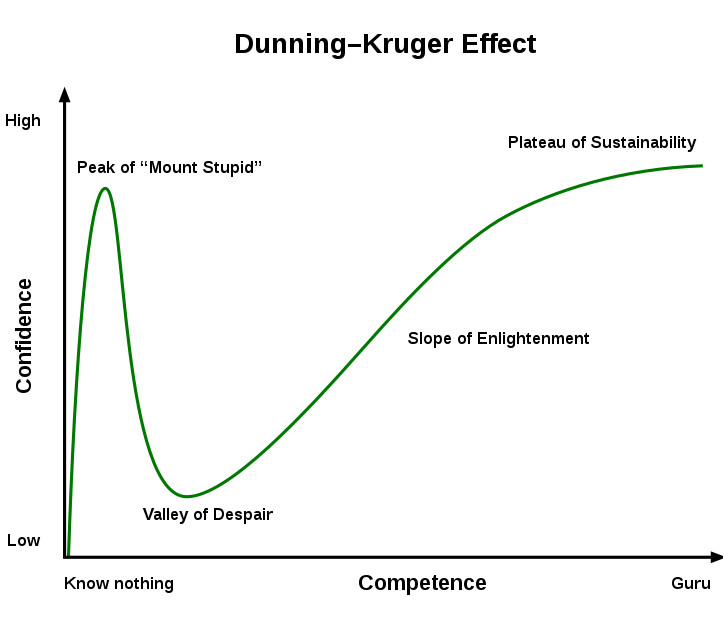
The Dunning Kruger effect can be applied to the totality of knowledge in any given domain, as well as the knowledge we have in relation to knowledge itself, or our own personal epistemological standpoint. The Dunning Kruger effect describes a process by which we undergo in the relation between “actual” knowledge, to our confidence in knowing. In a typical skill with which we have no knowledge, our confidence in our knowledge is close to zero, as we recognize complete ignorance. As we gain a small amount of knowledge, we are lead to the illusory belief that we have made much more actual progress in knowledge than we actually have in the domain, and our confidence in the acquired knowledge and competency in respect to it is extremely high. With this little acquisition of knowledge, in comparison to our original state of absolute ignorance, we are lead into the belief that we know much more on the topic than in reality we do, and this false belief leads us to a sense of overwhelming confidence in knowledge on the subject. After more time, experience, and knowledge is gained in the subject, the more complex and intricate its nuances become, the less confident we become in relation to the knowledge. After the initial point of simple conceptualization in the domain of said inquiry, all additional knowledge serves to prove how increasingly complex the topic truly is, and our confidence in the totality of knowledge of the subject generally degenerates as we see ever increasing pathways for growth, and an ever opening field of ignorance in relation to questions that are yet to be answered in the given domain. After continual study in the domain, our confidence reaches its lowest peak, as we become baffled by the amount of content yet unknown, and we undervalue what we do know in relation to the unknown. As we gain in knowledge, it seeks to illuminate the amount of ignorance we have in regards to the subject. There reaches a point when a broad foundational knowledge structure is established, and from there, we can begin to explore further areas of inquiry in relation to the domain of knowledge in whatever aspect it may be that we are attempting to gain in knowledge. From this bottomed-out valley of confidence in knowledge, we make the actual relational confidence grow, as our knowledge grows from this point, we slowly gain in confidence as to what we actually do know on the topic. The relation between knowledge and confidence at this point becomes more honest, and now, with an increase in progressing through additional knowledge in the domain, we grow in corresponding confidence of knowledge in the domain.
On a life size scale, the teenage years reflect the state of original boundless confidence in our knowledge, as we have reached the age where our set of knowledge in the total domain of knowledge has increased rapidly, the “beginner’s gains” have been acquired and we are led into the false supposition that we know much more than we actually do This explains most teenagers reluctance to parental and authoritorial advice, as they believe the knowledge they have is sufficient in answering life’s questions, and in navigating its landscapes. As the teenager continually experiences life, and grows into his twenties, where more complicated and nuanced life occurrences take place, the less his confidence becomes as his recognition of his own ignorance in so many topics grows. It isn’t till the individual has set himself on a stable, foundationally firm, course in life, after many chaotic elements have been ordered, many unknowns become known, that the process of honesty in the relation between knowledge and confidence grows. It seems like in the early twenties most people have a sort of existential dilemma, as their confidence has so dwindled that the sense of purpose, and how to navigate the future, is wholly unestablished. Once these questions have begun to be formulated in the young adult’s mind, he can work towards the relinquishment of the existential dread, and can seek to find what a truly meaningful life would be like, to him. In this way, his knowledge in the set of all domains begins to crystallize into a formulated conceptualization of what his purpose is, what a future he would like to exist for himself would look like. As career, relationship, shelter, hobbies, and interests begin to be decided upon in their direct evaluation in relation to the individual, he can begin to make progress towards that ideal possibility of his projected future self. This self-knowledge, and the basic defining and differentiating of values, allows the individual to make knowledge and experiential progress towards the goals. At this point the valley begins to ascend in the direction of the ideal peak. As he makes progress in the domains of interest and importance he has uncovered as being valuable to himself, he begins to grow in confidence as his competency and knowledge in these valuable areas of inquiry increase. Thus the dunning Kruger effect can, metaphorically, play itself out, to differing degrees, in the life cycle of the developing psyche, and the life attached to it.
The more you learn about the world in any of it’s aspects, the more you begin to realize how complicated it is. The growing understanding of the complexity in the world at every level, macro to micro, in every field of study, doesn’t necessarily make your subjective life more complicated. It is possible to have a grasp of the situation of reality, in admitting our fallibility and ignorance, yet still have a stabilized psyche that is content with the knowledge of the individual’s own ignorance. The deeper down the rabbit hole you go, in any direction, opens you up to see just how many different perspectives there are to see any objective fact, and how deep knowledge can possibly run, ad infinitum. The important knowledge to learn is how to wisely conduct yourself among this reality you are becoming more capable of understanding, and a big part of it is in being satisfied with your existence and not becoming overwhelmed in the unending stream of phenomena always arising in your experience, and rather keeping your desires pointed towards an ideal aim and distractions from that aim to a minimum, as you strive on diligently toward your goals. This will not only reduce suffering, but allow for clearer thinking, leading to a better more articulated understanding of reality in the future, and altogether a greater sense of purpose and wellbeing in relation to what could otherwise have been the case.
Ecclesiastes “He who increases knowledge increases sorrow.” As we learn more about the travesties, malevolence, and evil acts commit across history, the more we come to see the potentiality humans have to cause suffering to others. The more we learn about the suffering which everyone undergoes, that we too experience, the more we potentially can feel disheartened as to the experience of life, and thus result in a sorrowful existence. While knowledge of this sort can cause debilitation, and a negative mode of being for the individual, it doesn’t necessarily have this effect across the board. Many people can spin a different perspective with the increase of knowledge of this sort, and look at the potential for humans to attempt to alleviate it, and if the individual finds that desire within himself, he can view the human condition as essentially compassionate, rather than malevolent, producing the opposite effect, of hope and virtue.
This quote is true in regards to some situations, yet is too broad to cover the set of all experiences, and all individuals. In line with the quote, the more knowledge you have in regards to understanding the effects of our actions, and their implications in the wellbeing of ourselves and others, the more you notice your own deficiency in acting in the optimal method, producing more moral shame than the ignorant moral agent. In times when passions override reason, and we fail to hit the mark, we suffer in relation to how high that mark is, in how well articulated it is, in how much knowledge we have as to a better way of Being. Thus you increase in sorrow from every mistake because you understand it as a mistake, you understand that rationally you knew the better thing to do, yet emotions or competing values over rode the conscious thinking process and you thus acted from a base that isn’t in line with a higher value. An increase in knowledge results in a better understanding of what has and is taking place, and causes the individual to be distraught over their lack of discipline over making more optimal rational decisions, as well as noticing the mistake for what it is and how it was caused, and this nature of humans, is natural, and at times can make one sorrow for how little control our “ego” or consciousness has in overriding the unconscious, or external effects, which are more powerful at times.
On the other hand, in regards to morality, an increase in knowledge can produce a more virtuous agent, and in virtuous actions, comes pride and happiness in accomplishing what we have uncovered as being right or meaningful, at leastto us. Does this compensate for the moral shame in developing virtue? Does the happiness outweigh the sorrow? In general, probably not, and Ecclesiastes is right. But this quote doesn’t give us an imperative to not strive for knowledge regardless, and I would argue that the acquisition of knowledge in regards to moral questions and their implications is worth it as the meaning and the results outweighs the individual experience of sorrow, whether or not that sorrow in acquiring it outweighs the pleasure in virtuous action or not.
The increase in knowledge of causality enables the individual to see many things the ignorant would otherwise profit in the short term of not knowing, but in the long term, and in the implications, the knowledgeable gains the upper hand. The foundations and implications of actions and speech in regard to morality can be extrapolated to a further than optimal direction, potentially causing suffering in “overthinking” and can become overwhelming to the degree of causality explored as the potential negative down river effects can cause stress to the moral agent. Here, knowledge of morality, and the nature of suffering and satisfaction, and the causes and experiences related to them, also can become a burden to the individual in this scenario of “increasing in knowledge”. The burden of responsibility in relation to knowledge of the effect of actions, can be debilitating and stagnating the mind that has more knowledge of the subject, and thus his sorrow can be understood as a production of such conflicts.
Certain realizations outside of the realm of morality offer a source of further inquiry into the beneficial or detrimental experience in the knower. Such truth revelations such as in the full complexity of the issue of freewill, and its incompatibility with the actual experience of life, can be a source of great dissatisfaction for him who once thought he contained “freewill” in the libertarian sense. The uncovering of the truth of strict determinism can cause the individual to feel a lack of purpose, or choice, and can be a source of sorrow. On the other hand, it can be relieving, and remove anger, cognitive dissonance, and pride, in cases where it would otherwise be manifest (if viewed correctly).
The relinquishing of illusions of a personal God, or of an afterlife, can be extremely sorrowful to the naïve seeker, and may cause great distress and depression as a result. The meaninglessness of the universe, objectively, can be hard to cope with, and the proper response and compartmentalizing of such truths is no easy matter. Where, after time, integration will prove useful to the individual, and ultimately produce greater heights of wellbeing and potentiality for a moral virtuous life (I believe!) the initial adoption of responsibility and acceptance of non-desirous truths can break the unprepared individual, and everyone may not be endowed with the requisite mental capacities to wrestle with such ideas. While these are potential situations in which an increase in knowledge can cause an increase in sorrow, it is entirely possible for a more positive interpretation, and actual an actual reciprocal effect to take place in him who gains the knowledge. One may feel profound pleasure in uncovering insights into the nature of reality, and may feel themselves better attuned to who they are and the reasons why they do things. The openness to being fallible, and the corrective nature of novel knowledge in improving the individuals understanding, doesn’t always need produce dissonance or distraught, but can prove to springboard the individual to greater heights of wellbeing through a better use of his speech, it can prove to clear up previous dissonance, and to grant clarity to the individual. So an open generalization such as stated in Ecclesiastes is interpretable in respect to certain experiences, and in situational accounts, it is in no way possible to generalize it across the set of all possible acquisitions of knowledge. While certain knowledge in relation to individuals can cause sorrow, it can, in other individuals, provide a useful and beneficial effect. The state of the individual, the type of knowledge, the circumstances for its adoption, the framework in which it is revealed, all are integral factors in determining the beneficiality of knowledge. We would be wise to consciously discriminate in which knowledge we share, and attempt to uncover for ourselves, in addition to being prudent to whom, and in what fashion, and in which circumstances, we receive or give said knowledge. This is truly informed by experiential knowledge, contemplative reasoning, and overall, wisdom.



















 Seek Truth