I wish to make a few distinctions between certain concepts such as “known unknown” and “unknown known” within two different contextual frameworks. The first is between conscious content, and reality. The second is between our subconscious content and conscious content. I don’t wish to be bogged down by the formal relation of the two, but will do a preliminary defining in a simplistic way to make the proceeding distinctions clear.
By conscious content we are referring to conscious noetic experience, this describes the content which is able to be subjectively experienced, or that which we can become aware of as content within consciousness, whether it is content of the 5 senses, or content of the mind, including; thoughts, perceptions, memories, or in general terms the mental formations we are consciously aware of (includes abstract symbolic representations, language, conceptualizations, phenomenological content).
By reality we are referencing the totality of the empirical world in its real existing, what is true about the world, and about our experience. When referring to reality, we are referring to the truth. This doesn’t mean the apparent or perceived truth, but as it truly is. If we wish to be more specific, then it must be stated that we cannot truly know this reality, as all we have to work with is our own perception of it (On “Truth” Claims). Granted, we have logical tools which point us in the right direction. In any sense, it doesn’t matter if we can accurately define reality, or the “thing-in-itself”, as we always have our own biological lenses which give us the vantage point of a separate unit. In reference to reality here, we truly mean only what “really exists” in an abstract sense, the word “reality” to be an abstract symbolic representation of what is true about the world and its contents in general (follows our prediscovered logical maxims – them being judged as accurate descriptions). By reality we mean that which is accurately depicted and recognizable by us as being constituted by objective knowledge in short, scientific knowledge, material knowledge, or even knowledge which constitutes the formation of subjective experience. It is not this objective knowledge itself, it is not the logical and rational proof, but rather the content which this is used to describe. Of course the intricacies and details of this surely could constitute a novel.
As for the subconscious we are referring here to that which is below consciousness, and is therefore not in conscious experience. It contains the unconscious personal content, such as memories, habit formations and their manifestations, in short, the aspects of our psyche which are not contained in the present moment conscious experience. It contained evolutionary aspects such as archetypes and biological drives and motives. This entails the perspective structure which filters content through a values system instantiation, which is in turn modified by, primarily, genetic factors, leading to evolved values based on our environment, cultural, and learned acquisitions. This perceptive system and its filtration of content produces data which gives rise to consciousness, which produces the conscious awareness of a certain content within the present moment. In a neurophysiological sense it is that which organizes information from internal and external data and selects through a “care” or “hierarchical importance” structure to be displayed in conscious awareness. This, of course, can be subject to a feedback loop of consciousness choosing to direct it’s Being in such a way to produce new habits, and new information to be integrated into the subconscious structure, affecting future conscious experience. The recognition and utilization of this process, is priceless. This subconscious produces the content that enters conscious moment to moment, yet also contains content which hasn’t entered into conscious awareness, or isn’t currently in conscious awareness. This content is able to be realized by consciousness as existing, but it truly acts and exists unconsciously.
A known unknown, using the relation between conscious content and reality, means that consciousness realizes that reality contains some information, yet realizes its own ignorance in regards to its content. For example, one may know that differential calculus exists, but is unaware of its contents or what the concept entails, or one may know that the sun is a star, and know that it is reacting in a way converting hydrogen to helium, and know that there is a method, but in both instances, one doesn’t know the how or why, but truly knows that it must exist, that it does exist, but its content is unknown. This is a known unknown in this relation.
An unknown known, using the relation between conscious content and reality, means that consciousness doesn’t realize what it is missing, i.e. consciousness doesn’t realize its own ignorance in regards to content in reality. Reality “knows” in that it contains some information, with which in reference to consciousness doesn’t “know” or even “know to be unknown” and thus is an unknown known. I would attempt to give an example, but if I knew one, it would be known. Say someone didn’t know algebra, and didn’t even know of its existence, or didn’t know the chemical composition of the sun, or didn’t even know that the sun existed, this would be an unknown known in this reference.
A known unknown, using the relation between conscious content and the subconscious, means that consciousness realizes that the subconscious contains some information, yet realizes its own ignorance in regards to its content. This can be in regard to cultural, societal, biological, or in general, determinate effects of prior causes acting upon the psyche. Consciousness is aware of their presence but unaware of their exact relation, thus it is a known unknown in this context. An unknown known, using the relation between conscious content and the subconscious, means that consciousness doesn’t realize what it is missing, i.e. consciousness doesn’t realize its own ignorance in regards to content in its subconscious. The subconscious “knows” in that it contains some information, with which in reference to consciousness, consciousness doesn’t “know” or even “know to be unknown” and thus is an unknown known. This contains information that is repressed, or memories or habits which are not important or stimuli not present to bring that information into conscious awareness. Habits, latent abilities, knowledge not needed in present circumstances, are all unknown knowns on this reference.
On the subject of disclosing a simplistic conceptualization of our basic alignments, we should not do so out of ignorance, inexperience or lack of analysis, but only once we have worked hard to develop the structure that underlies them. What’s the issue with disclosing a simplistic view of one’s beliefs? If it is an accurate representation of one’s inner states, and one has spent ample time in considering the reasoning behind why they believe the idea to be valid, at least in reference to consciously held inner belief, then it would be useful in the transmission of one’s nature to others.
In conversations we often find ourselves frustrated by people pointing to information which they lack an in-depth knowledge of, or making truth claims upon subjects with which they have minimal knowledge, especially when we ourselves happen to hold a greater degree of expertise and competency in the conversed domains. As we recognize this in the manifestations of other’s beliefs in conversations, we must safeguard against falling into similar areas in our own conceptualizations and in the content with which we too make truth-claims on. While we may do this unconsciously over trivial matters, we must seek to train our minds to better articulate a truthful representation of our knowledge. If we have little experience in a subject, but still have an opinion on a matter, we can disclose both in a way to articulate that we believe something to be so but with minimal confidence due to inexperience. When questioned, the person spouting off erroneous beliefs betrays his true nature, sort of like mask wearing, emitting a representation of himself that is less than descriptive.
Once we have put in the work to develop a hierarchy of values, and a system of philosophical understanding that is coherent and through and through non-contradictory (logical), then I see no harm in reporting the spark note version of such claims. If this is done with the intention to properly represent oneself, or to inform the other, rather than espouse an egoic defense or further antagonism, or make a truth claim where it is quite uncertain, then the lack of complexity is something we can forgo in the short term. If the other party is further interested in the simplistic claim (we should never generalize), then expansion on the subject into its complexity would be warranted.
The frequency of directed introspection, the more we learn in regards to better being able to articulate our own Being, the more we live, and experience, the more insightful we become into the nature of the content of our consciousness. That being said, consistent pursuit of philosophical understanding is often hindered by its repetitive nature, if it is consistent and never “left alone” for a substantial period of time. What happens is the same schema and content will be consistently recirculated, that of whichever path we are looking to explore. Breaks from this pursuit, interest in different fields, attempting to acquire different knowledge in different subject, experiencing different content within our day to day lives, actually proves to provide us with new insight into the same issues we were pursuing once we return our attention to them. Aside from learning in this fashion, the mere escaping from the loop of relatable memes and schema that make up our conceptual understanding, allows for our brains to develop new representations once we return to the subject, opening up the playing field for new insight.
But on the other hand, the more we can expand upon the intricacies of our thought the more we open ourselves up to accurate comprehension by the receiver, as well as to a more thorough representation of our ideas, for the benefit of our own cognitive abilities (through more elaborate conceptualization, profundity), as well as for the benefit in clarity of the subject matter.
The true adherents to a specific philosophical school or philosopher, are few and far between in reference to any single domain. Specialists always have a greater degree of competency and understanding in regards to their specific field, yet, they have a less ability to draw distinctions between and compare with other schools or distinct philosophers. If we are to endeavor in philosophic exploration, shouldn’t we be ever seeking after truth from all corners? It seems close minded and ignorant to select a few good authors and dedicate study to them alone, if those few philosophers happen to be among the first you encounter. Not to mention, in order to find authors whose work you would like to pursue, you must read and research a large variety in order to better inform a more specific study towards what you are interested in, or what resonates more with your individual value structure. In reconciling generality and specificity in regards to philosophical study and research, as well as into what tradition or domain an original thinker should contribute to producing individual content in, we ought to have a broad knowledge of the history of philosophy and its most influential individual schools. What I recommend is a broad survey of the landscape, before deciding to pursue further investigation in a given direction, both with philosophy, and with life.
How can we find which topic it would be optimal to become an expert in without surveying the landscape? Same goes for different fields of study, whether it be biology, cosmology, philosophy, and their specific sub-fields, same goes for any pursuit in life, or any purpose or skill set, we can’t know what hierarchy to enter into until we have gained at least some knowledge of the available hierarchies. I don’t think we should just arbitrary pick something in life and pursue it, or pursue what has been presented to us parentally or societally, but rather, attempt to experience the biggest slice of life, within our means, and with the experience and wisdom gained, have a good idea of which road to then pursue.
As well as in the domain of practical pursuits, so too in the realm of ideas. Multiple points of view allows us to take something from each of them, or form our own opinion based upon what we value to be most truthful within all the point of views, of course you can’t contain contradictory perspectives upon a single subject in the form of belief, you can subsume multiple ones with an overarching idea, or correctly categorize them in order to order them for further reference to be used in identification. The more we explore and see the world from different perspectives the better informed we are to create a synthesis or a conceptualization that enables them all to exist, or to refute and approve different ones, or to altogether transcend all of them to a view that is closer to the truth, maybe in a Hegelian dialectical fashion.
Broad exploration is one route, specific intensive study “niche” work is also another route. Both are needed to perpetuate new ideas and new innovations. We need someone with a broad knowledge to be able to connect and articulate the different pieces into a coherent structure, and find similarities and ways of transcending individual ideas. But, also, we need someone with a pointed interest in a specific aspect of a field to be able to push that field to newer, deeper, more expansive heights. The tool to reconcile which road to cross, is to pursue both. We must continue to explore along the periphery of our knowledge into the unknown, but we must also be updating our value structure as to which aspects within our realm of experience we want to delve deeper into. In this way we can use our time, in proportion to our values, both to pursue the things which we have found to be important to us, as well as not stagnate within one area of expertise, and expand into other areas.
The investigation of unrelated knowledge in ulterior fields can provide useful knowledge towards unexpected discoveries in a different domain that often isn’t obvious in preconceived evaluation. Often times juxtaposed fields can provide insight into each other in novel ways that concentration down a singular domain would be blind to. For example, we think of evolutionary biology and philosophy to be two very different studies, but we can use the knowledge we gain from the scientific study of evolutionary biology to inform predictions about how our Being is related to other lifeforms, and to offer a parallel explanation to why we may choose to perform a certain action, which, we can include within a philosophical framework. Conversely, we can use a phenomenological method to makes conclusions on what it means to be conscious, and explore why and how these findings might have come to be through the study of prior species brain developments. We can use philosophy to find questions that can be answered in biology, as well as find biological answers to questions we didn’t know existed yet in philosophy. This is just an example of how different scientific and philosophical endeavors, into different school of thought, or areas of expertise, can be cross-used in the informing of others, in order to stumble across undiscovered territories, or ideas we wouldn’t have access to if we were narrowly focused on one area of expertise.
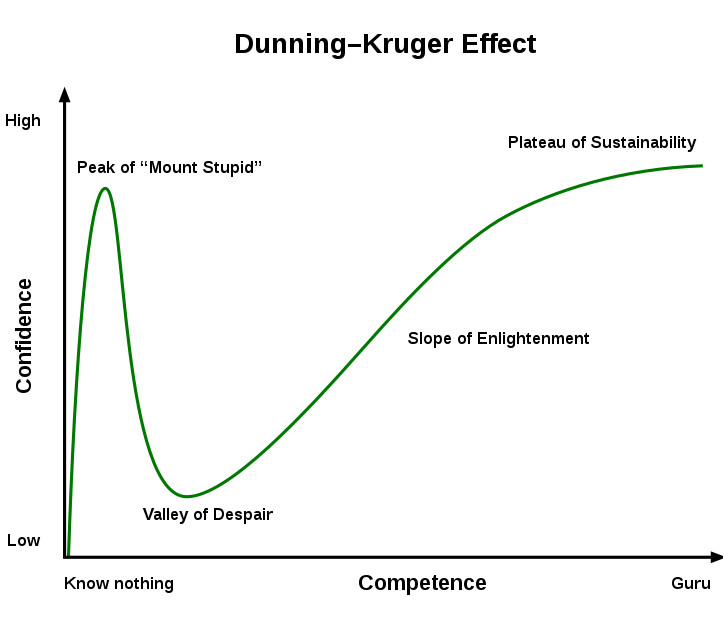
The Dunning Kruger effect can be applied to the totality of knowledge in any given domain, as well as the knowledge we have in relation to knowledge itself, or our own personal epistemological standpoint. The Dunning Kruger effect describes a process by which we undergo in the relation between “actual” knowledge, to our confidence in knowing. In a typical skill with which we have no knowledge, our confidence in our knowledge is close to zero, as we recognize complete ignorance. As we gain a small amount of knowledge, we are lead to the illusory belief that we have made much more actual progress in knowledge than we actually have in the domain, and our confidence in the acquired knowledge and competency in respect to it is extremely high. With this little acquisition of knowledge, in comparison to our original state of absolute ignorance, we are lead into the belief that we know much more on the topic than in reality we do, and this false belief leads us to a sense of overwhelming confidence in knowledge on the subject. After more time, experience, and knowledge is gained in the subject, the more complex and intricate its nuances become, the less confident we become in relation to the knowledge. After the initial point of simple conceptualization in the domain of said inquiry, all additional knowledge serves to prove how increasingly complex the topic truly is, and our confidence in the totality of knowledge of the subject generally degenerates as we see ever increasing pathways for growth, and an ever opening field of ignorance in relation to questions that are yet to be answered in the given domain. After continual study in the domain, our confidence reaches its lowest peak, as we become baffled by the amount of content yet unknown, and we undervalue what we do know in relation to the unknown. As we gain in knowledge, it seeks to illuminate the amount of ignorance we have in regards to the subject. There reaches a point when a broad foundational knowledge structure is established, and from there, we can begin to explore further areas of inquiry in relation to the domain of knowledge in whatever aspect it may be that we are attempting to gain in knowledge. From this bottomed-out valley of confidence in knowledge, we make the actual relational confidence grow, as our knowledge grows from this point, we slowly gain in confidence as to what we actually do know on the topic. The relation between knowledge and confidence at this point becomes more honest, and now, with an increase in progressing through additional knowledge in the domain, we grow in corresponding confidence of knowledge in the domain.
On a life size scale, the teenage years reflect the state of original boundless confidence in our knowledge, as we have reached the age where our set of knowledge in the total domain of knowledge has increased rapidly, the “beginner’s gains” have been acquired and we are led into the false supposition that we know much more than we actually do This explains most teenagers reluctance to parental and authoritorial advice, as they believe the knowledge they have is sufficient in answering life’s questions, and in navigating its landscapes. As the teenager continually experiences life, and grows into his twenties, where more complicated and nuanced life occurrences take place, the less his confidence becomes as his recognition of his own ignorance in so many topics grows. It isn’t till the individual has set himself on a stable, foundationally firm, course in life, after many chaotic elements have been ordered, many unknowns become known, that the process of honesty in the relation between knowledge and confidence grows. It seems like in the early twenties most people have a sort of existential dilemma, as their confidence has so dwindled that the sense of purpose, and how to navigate the future, is wholly unestablished. Once these questions have begun to be formulated in the young adult’s mind, he can work towards the relinquishment of the existential dread, and can seek to find what a truly meaningful life would be like, to him. In this way, his knowledge in the set of all domains begins to crystallize into a formulated conceptualization of what his purpose is, what a future he would like to exist for himself would look like. As career, relationship, shelter, hobbies, and interests begin to be decided upon in their direct evaluation in relation to the individual, he can begin to make progress towards that ideal possibility of his projected future self. This self-knowledge, and the basic defining and differentiating of values, allows the individual to make knowledge and experiential progress towards the goals. At this point the valley begins to ascend in the direction of the ideal peak. As he makes progress in the domains of interest and importance he has uncovered as being valuable to himself, he begins to grow in confidence as his competency and knowledge in these valuable areas of inquiry increase. Thus the dunning Kruger effect can, metaphorically, play itself out, to differing degrees, in the life cycle of the developing psyche, and the life attached to it.
The more you learn about the world in any of it’s aspects, the more you begin to realize how complicated it is. The growing understanding of the complexity in the world at every level, macro to micro, in every field of study, doesn’t necessarily make your subjective life more complicated. It is possible to have a grasp of the situation of reality, in admitting our fallibility and ignorance, yet still have a stabilized psyche that is content with the knowledge of the individual’s own ignorance. The deeper down the rabbit hole you go, in any direction, opens you up to see just how many different perspectives there are to see any objective fact, and how deep knowledge can possibly run, ad infinitum. The important knowledge to learn is how to wisely conduct yourself among this reality you are becoming more capable of understanding, and a big part of it is in being satisfied with your existence and not becoming overwhelmed in the unending stream of phenomena always arising in your experience, and rather keeping your desires pointed towards an ideal aim and distractions from that aim to a minimum, as you strive on diligently toward your goals. This will not only reduce suffering, but allow for clearer thinking, leading to a better more articulated understanding of reality in the future, and altogether a greater sense of purpose and wellbeing in relation to what could otherwise have been the case.
The truth of an object in itself is not possible, being the limited perceptive beings that we are, we can never fully experience the truth of an object, or even of ourselves, due to the lack of capabilities we have of embodying anything but the perceptive part of our own survival machine. While we cannot know for sure the qualities and content of the experience of what it is like to be another object, we can use the rational and logical framework from which our mind contains to uncover truth claims as applying to our region of the universe, and use these laws of logic to form a cohesive representative description of reality, the alignment between this representative model, formed most commonly in perceptions, and language (words / grammar), and reality, as it is in itself, is what we can postulate as being closer or farther from the “Truth”. The “Truth” here is what reality is actually like in itself. While we cannot directly experience or know this, (knowledge we will describe later), the degree to which our language and perceptive capabilities are able to correctly model this is the degree to which we have an understanding of the Truth. As far as quantifying this range, we ought to validate it, if objective truth, with scientific data, of philosophical truth, with reason and logic in comparison to encompassing more phenomena than competing theories, the more of which justifies it, as far as metaphorical or practical truth, to the degree of usefulness in its application in our lives (subjective yet applicable).
The “Truth” is that which is actual in reality, the truth or falsehood of our claims is the correlation between our representational models and that truth. We can increase the probability of our truth claims through using logic, in their non-contradictory and not fallible cohesion, as well as their reoccurring emergence in the natural world (scientific method). Through the descriptive ability we have, and the method used to verify or disprove our truth claims, we can either gain in certainty in the probability that such depictions match up to the reality given the laws of logic which we have at our disposal (this given is an assumption that they are all pervasive, yet itself, not a full certainty). For example, gravity, or the tendency for objects to be attracted to each other in proportion to their relative mass, appears in scientific verification to be indubitably the case. While we have tested it numerous times, and it is verified in all of them, we can pose the truth claim of the existence of gravity as a very high probability of being an accurate part of the representation of the “Truth”. The degree of certainty as to this truth claim is thus high, and it would be rational to believe it to be true. All phenomena face this test in their certainty relatability, as the more evidence and verification, and lack of disproving occurrences, points to a higher certainty of the possibility of the phenomena being an accurate model of the “Truth”.
Here we are moving to a new domain of distinction, from the previous position, which is necessary for philosophical consistency. This Hegelian dialectical movement to a higher resolution image of what we are referencing to as truth, requires the existence and separation between Ultimate Truth, and truth as we are able to find it within a framework which we find ourselves in. Our new conceptualization must necessarily contain within it both terms, and we must differentiate what is True as the actuality of reality, from what is “true” from the framework in which we are able to conceptualize as an accurate representation of reality. In conventional terminology we call the truth that content which we believe to represent the “Truth”, while in philosophical stringency we must recognize our inability to “know” anything with absolute certainty given the biological filter through which all content of experience flows through, and the potential thought experiments which logically deduce the general idealist hypothesis that everything is, in fact, different, fundamentally, then the image and model we generate to represent it. While this resembles a type of epistemological nihilism, it ought not be employed practically outside of a philosophical coherent system, in conventional daily-life, from the “normal” mode of being, it still is valuable and useful, and altogether beneficial, to make truth claims, as long as we recognize that through a higher resolution image of the coherence between those statements and the actual reality, that we are, in all cases, fallible. That statement itself is a truth statement, that itself could be fallible, but, given that our corner of the universe presents us with certain laws of logic which cannot practically be proven false, given that we only have those to work with (currently), the truth-claim can be made if it is stated implicitly within the framework. Outside of the framework it holds no validity. While it appears that Logic, and Mathematics necessary fall within an Objective framework of Knowledge which it is possible to state are “True”, they fall under this necessary caveat that they appear to be true, from where we stand, and there still remains the possibility that in other areas or times, or dimensions, of the universe, they may be different, and we truly do notknow what we do not know.
As far as Moral Objectivist claims, they also fall under such scrutiny and explanation. In relation to the moral nihilist claims or the subjective relational morality claims which states that there are not right or wrong answers to moral questions, the explanation is a bit longer to lay out simplistically, but follows from what has been said in regards to our epistemological state of things. Within the framework with which we live, and our propensity to experience pain and pleasure, and that the existence of such content is experienced as an Objective fact of reality, that it appears to us that the sensation of pleasure and pain exists in our experience, and that appearance is actual, we can deduce from this a framework of Objective morality that, if admitted that morality necessarily is in relation to the better or worse experiences of life, which it ought to be in reference to (otherwise we’re not talking about the concept morality as it is typically used), than from the framework within which we find ourselves, and the desire which directs the actions of life, we can objectively state that there are better and worse methods and actions in which the individual can make to the accomplishment of these desired goals (increased wellbeing and reduction of suffering). Our actions and thus our experience stems from the desires of the organism, and the desires of the organism are towards survival, a greater experience of wellbeing, and a reduction of suffering, in relation to accomplishing these goals there are actions which we take, predicated on the desire to do so. These answers to ways in which we are able to act in the “present moment” is either leading towards such goals, or not, and the degrees to which we do so, entails that there are better or worse ways in which to “navigate the moral landscape” as Sam Harris depicts the situation.
While we remain ignorant in the philosophical speculation of Knowledge itself, we work from a framework in which relative knowledge is available to us, and from that framework there is, implicit, experience, at least perceived experience, and the nature of this experience is such that it provides better or worse states of experience, and given our desire to pursue the better state, there is an Objective answer to better or worse ways to achieving it, within the frame in which we necessarily are embedded within. From the Universe’s perspective, there is no meaning, from our perspective, being life, we cannot with absolute certainty have “Absolute Knowledge”, but we can, within the framework, and we do, seek meaning and pleasure, towards which are Ultimately whimsical goals, we can be right or wrong, or have better or worse actions, which manifest those goals, or which lead us further along the path in our pursual of them.
While we have a good sense now of what the “Truth” entails, and how we use “truth” in the conventional term, we have in relation to these two concepts “Knowledge” and “knowledge”. In relation to the content of the description which is in alignment with the “Truth”, we have “Knowledge”, oftentimes referred to as Absolute Knowledge in philosophical literature. We refer to Knowledge as those truth claims for which we have perfect certainty of. This is, in all cases, a fallacy to do, from a strictly philosophical standpoint. There is no way we can be absolutely certain in regards to the relation between our models and the object in itself, or in the totality of the Truth. We can only have more or less probable claims from which we should embody a relative certainty as to their relationship to the truth. In unphilosophically consistent usage, we use the concept knowledge in a way which states that the conventional truth actually has a high certainty in regards to the Truth. Thus, we conventionally say the knowledge of gravity allows us to make predictions about the mathematical truth of how long it will take an object to fall from a certain height on Earth. While this is true, and considered as knowledge, it is consumed by the framework from which we work in. In a conventional and practical sense it is useful and beneficial, and cannot be disregarded, but it operates under a different framework from the philosophical consistency required in contemplating the actual Truth and its relevant Knowledge, and cannot be claimed with certainty in regards to these concepts, but rather, its certainty ought to be regarded as proportionally certainly true, and regarded as knowledge, in relation to the ability of it to accurately represent reality from the “framework” with which we have to work with (our logical, rational, temporal/special location within the universe (which is all we have to work with, yet can’t claim its infallibility because we are embedded within it)).
We must make another Hegelian step towards an ever increasing knowledge of reality in a framework which includes the conceptualization of belief, making another differentiation in our conscious progression towards a higher conceptualization of factors of reality. As we uncover more and more information, more dissonance arises, and we must rectify them by a higher transcending view which includes all the knowledge previously discovered in a logically coherent system. This higher perch from which we stand upon must necessarily include more content, and all must be able to coexist without contradiction to remove the dissonance. This progress towards a different, yet more accurate view of reality, through increase of knowledge, is generally the unconscious system which we use to assimilate new data into a world view, but here I thought I would make it explicit as it is evident in the process which I’m undertaking that it is taking place. We must move in this way in order to reach the next step, and thus the previous steps and their growth process is necessary to the understanding of the end result.
While the Truth is what actually is, and Knowledge of that can never be false, nor attainable, we can, in our relationship to both, be right or wrong in our claims of representing them moreso than other claims. My claim here, on a philosophical level, is that we always are wrong in relation to these. Yet the degree of wrongness varies in a sense that is meaningful. We must use as a standard of the rightness or wrongness of our predictable models of reality the most verified, logically coherent, rational explanations which fall under the purview of the verification using the scientific method, verification through logical consistency, both within the truth claim, and between truth claims, and our ability to argue such knowledge using inductive, deductive, and adductive reasoning. Thus in determining what is true in a conventional sense we have tools at our disposal, yet still have differing view in relation to what the truth is. This is a necessary problem and we will always be in conflict as to what we think is true, or our beliefs about what is True, due to our necessary Epistemological ignorance on the Ultimate level. The belief is the true name for our conceptualizations and perceptions as they regard reality. That which we conceptually regard as true and knowledge, is merely conceptualizations for what we believe to have absolute certainty in regard to. The belief that you are certain about something produces the belief that what you have is knowledge in regard to the truth, which many times, being ignorant of our relationship to Knowledge and Truth, we conflate as Truth-Claims. The actuality of the concept of belief is more descriptive of the actual state of affairs that we find ourselves in. All we truly have are beliefs, and the accuracy and alignment between what we believe to be true, and what is actually True, to which we only have our beliefs to compare between in determining their relationship to Truth. All hope is not lost, given our framing of the Ultimate, and our acceptance of our place within the limited domain of truth and knowledge, our degree of accuracy in conceptualizing truth claims necessarily can be classified in its alignment from the standard of logic, reasoning, and scientific evidence with what we have uncovered within our framework. The standard of which our conceptualization of reality, our beliefs about what is true or not, must necessarily be judged in relation to, has to be logic, reasoning, and science. The relative nature in regards to our beliefs and the Truth slips away in considering what must be true in relation to our framed universe, framed by Idealism and the fallible nature, but internally, the consistency and laws of logic apply, the argumentation using deductive, inductive and adductive reasoning apply, scientific verification exists. These exist as the necessary standards for claiming, within our human framework, what is more or less an accurate representation of Objective reality. While there is a subjective aspect, the consistency of the laws from which we judge truth-claims within the framework stands in relation to all experience and, other humans verifications, as being objectively true within this framework. Given this is all we have to work with, it is what we must use in the judgment of truth claims. It is entirely possible that better methods of verification and more accurate methods of reasoning may be uncovered, but for now, within our limited epistemological framework, we must use these tools to depict the best representation of reality, and from our own perspective, and from that informed belief, judge the accuracy and coherency of other truth claims. The more truth claims that remain coherent within the system, and exist conceptually in non-contradiction to each other, the higher the tide rises our ability to be certain of the truth of any single aspect. Our world view, or the totality of the beliefs which we most infer to be accurate depictions of reality, is what we have to use in order to logically verify contradictions in relationship to.
It is extremely important, in the search for the truth, that the things which we believe to be Certain in regards to Truth be nonexistent, and the beliefs which we form to be our best conceptualization of reality within the framed universe must stand on solid ground, yet remain fallible. The adherence and mode of being of certainty in regards to truth claims wholly limits the ability for us to expand our knowledge, or uncover falsehoods or dissonant content within the worldview. The things which we remain in doubt about yet hold to be the best depictions of reality, our beliefs, we should place a high value on in terms of consistency and logical non-contradiction between them, in order for our conceptualization of truth in the conventional sense to grow in relation to the totality of truth, and away from ignorance. The degree to which these beliefs are based upon evidence, logic, and reason, much like in the Objective Morality clause above, determines the relation they have to the goal of uncovering the truth. Thus there are right and wrong answers to the existence or truth hood of truth claims, as the relationship between our beliefs and the truth as discoverable within our framework are concerned.
As morality requires life, pain, and pleasure, as necessary attributes to say anything meaningful about morality as we conventionally use the word, and that the rightness or wrongness of actions is in relation to better or worse ways to achieve wellbeing and reduce suffering, objectively, within the framework which we find ourselves, so we can similarly make an argument for objective truth within our epistemological framework. The actual representative truth claims about reality requires evidence, verification, logic, and reasoning, as necessary attributes to say anything meaningful about reality as we conventionally use the word, and our rightness or wrongness in statements is in relation to better or worse coherency between logical, evidential, and rational depictions of reality, within the framework which we find ourselves.
Thus we have developed a system of truth, knowledge, and belief, in which we distinguish Truth and Knowledge as unattainable, yet useful as to their conceptual place markers as distinct from the framework within which we find ourselves. As Morality from the universal standpoint is meaningless, so are Truth Claims in regards to Ultimate Truth. Yet we don’t find ourselves in that perspective, experientially. We find ourselves as finite life, with a biologically produced limited perspective, and with certain tools and experiences. Within this framework within which we find ourselves, we can, if we had perfect knowledge of the implications and factors as they apply to our decisions and actions, make Objective claims as to better or worse actions in regards to the goals of wellbeing, depicting an existent Objective morality, and if we had perfect knowledge of the most accurate conceptualizations of reality make Objective claims at to better or worse truth-claims in regards to the truth available in our domain of the universe, depicting an Objective knowledge. While we don’t have this perfect knowledge of truth claims, or of what actions are actually best contributing to the most optimal state of wellbeing, the existence of them within our framework is truly possible to be known as they are existent entities. Acting and conceptualizing within these two domains, which fall under the one domain of which we find ourselves, enables us to actually make moral claims which are better or worse in regards to their implications on wellbeing and suffering, using the system of truth-seeking which we just produced. Within the truth seeking system which is founded upon the above described necessary attributes, we can, with that system as arbitrator, make truth claims that are better or worse depictions of the truth using its necessary attributes to provide better or worse answers to what is knowledge.
Faith is defined in many different ways, but the most prominent definition is of complete trust or confidence. In terminology that is less religious, it would be a belief, or something that you intuit or come to the conclusion of – being true, a belief that is held as certain, or of extremely high probability. Faith is a risk we take, which I should, before continuing, state that I am completely against, at least in terms of absolute certainty. For reference to this topic – see essay “Benefits of Fallibilism”. In Buddhism, as well as monotheistic religions, there is a high value on faith, but I think that word is highly misleading. If we take the naïve definition that faith is merely the belief in the face of a lack of evidence, we really aren’t differentiating the term faith from belief, and, if this definition does hold to be descriptive of the term, it merely is stating something which, in practicality, doesn’t exist. In other words, you cannot believe in something without some rationale, without some form of experiential knowledge. In order to place absolute confidence or trust in something or someone, or God, or a higher power, you must necessarily pass through a succession of belief probability enhancements. We do not come to absolute trust or certainty without passing through stages of evidential proof in reference to the belief, which, must be rational. This doesn’t mean that the thing we place certainty in, in the end, is actually true, more so, it appears to be something we can be certain of. The mere appearance of having undeniable infallibility does not mean in actuality that it is so, whether that be in reference to an idea, scientific evidence, supernatural entity, or any other truth claim we can make. While I argue that it is more beneficial, in terms of alignment with the truth, and for openness to personal knowledge growth, to remain always fallible in our truth claims, there is a potential benefit to placing faith and confidence in others, which, we can temper by not adhering to absolute certainty, yet still reap the benefits of an evidential and rational approach to faith, which, we do so, despite the many claims against faith as it being “based on a lack of evidence”, which is merely a non-starter. Trust based on the absence of evidence, in something, necessarily means the conceptualization of “something”, which, whether we like it or not, requires the subject to have an ideal version of what that something is, and a reason why it is more likely to be true than its antithesis. Whether its emotional based, habituated teaching, or culturally defined, the mere conceptualization requires some sort of value judgment, and this is evidence as to why we believe something to be so, or why we believe something is worthy of placing our trust or confidence in.
The more data we acquire in respect to a certain teacher, training, or concept, the more likely we are able to discriminate the long term effects of adherence to such teachings through the instrumental use of faith. Seeing character traits embodied by the adherents of certain principles, enables us to see what the results of believing in a similar manner may promote in ourselves. If there are character traits, or abilities, or skills, that are exemplified by the teacher, that are of a nature of being something we wish to acquire for ourselves, or improve in ourselves, then the data acquired in reference to the teacher or adherents in containing these traits can inform us as to if we would like to pursue similar pathways of training or adherence so we too can attain similar results. This goes for beliefs, values, skills, in addition to character traits. In general, the more information and content the teaching has that is in line with our current value structures, the better informed we are to desire to pursue a similar pathway towards our own personal attainment of such characteristics. If we can intuit that adherence to such teachings would be beneficial to us than the placement of confidence in the practice, which would be faith, or confidence in the teachings ability to result in similar effects, would be warrant-able in relation to the content of the evidence we have to its manifestation in said desired traits.
There is a use for this, and in the Buddhist tradition, faith is important. Placing faith in a certain teacher, or teaching, or practice, is essentially saying at least one the following: “I will believe that this is true, that this is good, that adherence to this would be beneficial and useful to me, that confidence and trust placed upon the teaching, or teacher, will result in an improvement in the quality of my experience, my wellbeing, and reduction of suffering.” For a beginning practitioner of Buddhism, who wishes to experience what the religion has to offer, based on some idealistic view of the resultant of practice, or on some intuition that its teachings are an effective way of navigating life, or solely for the experience of what it would mean to be a practicing Buddhists, it would be beneficial to place a limited confidence or trust in the dharma, or teachings of the Buddha. Just like any other thing we place confidence in, or wish to embody (for whatever purpose, whether academic, experiential, or even egotistical), I argue, we should first vigorously examine the landscape of potential teachers, religions, and content, which we wish to embody, before making the choice, as confidence or emergence into a framework will alter experience, in one way or another, and we need to make sure that the domain is something we have a valid rational explanation for attempting to experience, before we continue down the rabbit hole. We should never be certain of somethings beneficiality, but as we grow in knowledge through any specific training, we should constantly reexamine the path we are on, not only to recalibrate our lives with new information, but to decide if continued belief in such practices are truly what we value, or are the most optimal in reference to our current range of perspectives. For someone who has directly intuited the more optimal representation in novel truth claims, in reference to previously held truth claims, it no longer is faith which carries the belief, but it is experiential knowledge, but for him who hasn’t yet intuited these things, it takes an active pursuit of the truth to attempt to indulge in novel teachings form different perspectives, which doesn’t require faith, but could potentially be, in order to experience (whether in practicality or in the form of knowledge) a more optimal method of navigating life or of defining an aspect of reality.
We will continue with the Buddhist practice as an example, as it is something I believe to be beneficial and useful for most people to engage in, at least at some point in their lives. At first someone may just believe that it is true, based on a rational belief, or thought, in its coherence to the reality one has already experienced, but after practicing mindfulness, and exploring the claims in firsthand experience, you can come to experientially realize the truth or effectiveness in revealing aspects of our nature to ourselves. In this way you can move from simply believing something is probably true, to a degree, to knowing that you have experienced it and know it is true, in the practical result of its carrying out. For example, moral shame and moral dread being the foundation for morality. Once we have recognized that we experience the horrible feeling of shame after an unwholesome thought, or spoken word, or action, this feeling can lead us to wish to not make the mistake again. In future situations, where the inclination may naturally present itself to repeat the offence that manifested moral shame in the past, we now feel a moral dread towards its repetition, and henceforth are convinced by the memory of negative emotion produced prior, to not repeat the action. Thus a sense of moral shame and moral dread can lead us to moral improvement, and we can experientially understand the purpose and perspective given by the Buddha’s teaching. Whether or not we think it is the most optimal way of representing such phenomena, depends on our knowledge up to the point of the realization, but that we can experientially understand it as a way, to better or less optimal degrees, is clearly present to us. This ability to experientially realize the usefulness in conceptualizing moral prerogatives in this way, moves from a mere rational conclusion, to one that takes the form of a certain type of practical truth, in that, in practicality, it has presented itself as truly being in reference to phenomena which we experience.
In a similar way, the four noble truths, we’re taught, are all within us. At first we may contain the logically coherent belief, or reason applied to information which we don’t have absolute faith in (certainty, or complete trust), yet, based on a rational contemplation, as it appears conceptually to be in line with an abstract view of the content of our experience, we can see the utility and accurate alignment with our prior experience. This belief or rationally held coherent explanation for psychological suffering, its root, and its cessation, and path to its cessation, appears as useful knowledge, but it isn’t until we experientially recognize it as manifesting itself in our lives, that we come to the true knowledge of its coinciding as a framework which truly applies to our lives, and we come to a place where we can practically employ it in a useful manner. The more data we have in support of such conceptualizations of psychological suffering, the more we realize the application of Buddhist principles in the reduction of suffering, the stronger the belief becomes. That being said, and it may be contrary to the fundamentalist Buddhist traditions teachings, absolute certainty, or complete faith, in my view, should be avoided at all costs. Even the experiential knowledge of the true practicality in certain knowledge, doesn’t make it infallible, it simply points to it being an accurate way of conceptualizing and acting in the world from one point of view, it doesn’t move it into the domain of the best possible way of Being, or mode of Being, which we should conceptualize as a goal worth striving for but ultimately never attainable. I believe this way of thinking about practical, experiential, and objective truths, is ultimate the most beneficial way to not close ourselves off to the possibility of better answers, or modes of being, which we may eventually uncover.
A liberating experience is one in which you have direct insight into the truth of reality, we can become liberated from ignorance, in certain domains, through the faith in certain teachings, transferred into either experiential knowledge, or disregarded as contrary to the subjective experiential evidence we contain in our conceptualizations of reality. What we must safeguard is attempting to spin a teaching to be in alignment with a perspective of reality, as we can do so with almost any teaching. In this way the intellect can be both our friend and our enemy, as we are able to rationalize views to coincide with the image of reality we may have. The greater the intellect someone possesses, the greater rational, and logical proofs one is able to make for the existence of a perspective to align with reality, therefore, we should be very careful as to the content of our language in representing knowledge of reality, as almost any description can be, whether metaphorically of scientifically, interpreted to align with reality through the use of language. We must do our best to safeguard our conceptualizations of reality from confirmation bias, and seek to discover what actually aligns with reality, rather than what we can bend and view from a skewed place to align with it.
In the western world most people have a scientific grasp on what the Buddha meant by dependent origination, or the law of sufficient reason as acclaimed by Schopenhauer, basically that everything has a reason, that everything is the way it is now due to past causes. In the modern age most people understand this naturally, as we have indoctrinated the youth with knowledge of science, physics and so forth. But what most people don’t connect is that this law doesn’t only apply to phenomena outside of ourselves, but as Buddha said, all conditioned phenomena, i.e. everything. This includes ourselves, our psyche, our thoughts, speech and actions. For a long time, I was a proponent of free will as the cornerstone of my philosophy, but occasionally I would experience cognitive dissonance when trying to make sense of a reality that includes both free will and dependent origination. Free will is intimately tied up with a sense of ego, or self, on a way that we have pride of our accomplishments, and disparage others for their shortcomings. We feel good about the things we do, because we believe that who we are, as a permanent controlling self, did them. So stripping away the self, this ego, this pride, is extremely hard, and appears to go against our subjective experience of life. This is where the dissonance sets in. You understand outside of yourself, objectively, that all the world came from prior causes, yet subjectively, you believe your consciousness and “decisions” do not follow the same law. This believing in a false self, that is somehow in control, yet understanding that everything is due to prior causes, is a contradiction and causes confusion. Now most humans live believing they have freewill, and are happy doing so. But for someone seeking the truth, it matters not how the truth will affect you emotionally, or what modification to your subjective experience may take place as a resultant of the truth, or what pride you have in your ego. What matters is the truth itself, and moving closer to it. Liberation comes when you understand that this self, this ego, this pride, does not exist, that it is merely a manifestation of a narrative which may prove useful or beneficial evolutionarily, or even societally in the capitalist world we live in, but as far as being conducive to wellbeing, and the reduction of suffering, I argue, that it is not the optimal path. What you are liberated from, is a false view, or ignorance, and what you are liberated by, is a higher resolution image of reality as it actually is. It doesn’t mean that you now have hold of the most accurate conceptualization of reality, but rather, you have removed one false view of reality, in this way, we can become liberated, or free from, ignorance, in steps, as we move towards more and more accurate depictions of reality through knowledge.
The Buddhist practice of mindfulness is useful in revealing certain aspects of our experience that would otherwise go unrecognized. In consciously directing our awareness towards the content of consciousness itself, within the present moment, we care realize the truth claims which the Buddha made in reference to non-self, impermanent nature, and the ever pervading unsatisfactoriness inherent in our Being. If you think you are in control or that reality is fully deterministic, only one of which is true, the belief you have is only due to prior causes. It wasn’t until I experienced directly the arising and fading away of mental phenomena, with causes outside of my conscious control, that I began to see free will as a mind fabricated illusion, which, we can see, developed for good purposes. The view of the self as permanent and subsisting through time as a source from which experience comes from, isn’t the best way to view our experience, once we realize the constant change of experience manifesting itself into conscious awareness, prior to conscious decision for it too. Even the conscious thought of attempting to direct the next thought, merely arises itself from a subconscious place. This content of consciousness which we can become aware of, commonly called “mindfulness practice”, presents us with content that is arising and fading away, constantly changing, and is not itself directed by “us” as an agent. These descriptions of experience which we realize, are exactly what the Buddha proclaimed as being fundamental within our experience, thus, if we were to place confidence in the Buddha, or have “faith” in him, before attempting to be mindful, we would be lucky in regard to these teachings, that the claims actually aligned with our experience.
If one happens to place faith in a certain teaching, the risk lies in the actual utility of the teaching as being in alignment with reality as it is. We can clearly miss the mark, and do so quite reliably, anytime we place faith or confidence in anything outside ourselves, we make that risk. But in the case that the risk proves to be beneficial, and the confidence well placed, it’s possible for the strong belief of confidence or trust can move to actual experiential realization, internal understanding, and thus to knowledge. I argue faith in certain Buddhist teachings can offer this pathway, as I have experientially realized the truthfulness involved in the beneficial and usefulness in seeing things from the Buddhist point of view, at least in regards to dependent origination, non-self, determinism, and morality. But could I recommend to someone to place confidence or trust in a certain system? Not necessarily in a system, or a religion, or in anything supernatural, but in the case where I believe I may have some beneficial knowledge that could aide someone, I would definitely be able to confidently vouch for the content of my own personal convictions, but it would only be in the case where I authentically believe it would provide a truly beneficial and useful advantage over the individual’s current conceptualization or wellbeing. This is generally why I don’t criticize advocates and apologists of the Christian faith. Many people view them as obnoxious in their attempts to alter someone’s life, belief system, and values, through active campaigning of their ideals. While I disagree with the truth claims they make in regard to supernatural phenomena, such as heaven and hell or “God” in the strictly Christian sense, I can tell their intentions are pure in attempting to lead and aide others towards a place they truly have faith in and believe would be beneficial for the other person. While I’m no proponent of Buddhist supernatural claims, I do, often, believe it could be beneficial for many people, at certain points in their lives, to at least take some time in exploring the ideas, as they could be useful to the individual. Is this even faith at this point? Not necessarily. The point is, that placing faith in anything, can yield better or worse results than in other things. The opportunity cost is ultimately too high to place complete or absolute faith in anything, and the loss which we could experience in embodying a mode of certainty, in respect to any truth claim, is ultimately less optimal than maintaining a fallibilist point of view. If we have some reason and logic and work to apply conscious direction towards the content of which faith can be placed, then we can, potentially, grow through faith in that certain domain, as long as we, at all costs, do not move the definition of faith to complete certainty, and merely regard it in an optimistic sense of trust and confidence, and maintain a realistic world view of the potentiality for it not to turn out the way we hoped.
People often don’t consciously retain information they don’t value, consciously or unconsciously. In the face of a lack of curiosity, or desire to improve, change takes place merely subconsciously, and in the areas in which we do desire to see change, or improve in knowledge, we enable ourselves to be more readily able to do so. This is part of the problem with students retention of information in the formal education system. While content is presented, a reason to value such content is often missing, the desire to learn becomes diminished, and only the desire to pass the class remains, in which short term memorization replaces active contemplation with an interest into experiential and theoretical knowledge of the topic. Although a person may pass a class and graduate, they don’t retain the information if they didn’t want to learn it in the first place, and this is the problem formal education has. If you take a class you are interested in, which contains information you deem as useful or beneficial, you will learn the subject on a more profound level, as it is your will which desires to spend time developing knowledge in the subject, rather than your will being focused on passing a test and not on the content itself.
With an autodidact approach to learning, you effectively save yourself from the strenuous process of memorization for scoring purposes, and solely become the willing participant directed toward what you value, thus maximizing the ratio between learned content, valuable content, and knowledge retention. The important aspect is knowledge retained in this fashion, through actively selecting the sources and content which you wish to incorporate into your knowledge base, is selected in accordance with your experiential values, and stems from your individual value system, making that content tailored to you as an individual.
Choosing what to influence you, choosing what experiences you need to grow, such as through fear, curiosity, or rational judgment of success through attainment, through authors, books, what speakers, what information to enter your brain, to study, on your own, you are choosing what you actually want to learn, and in this way you retain the information you wish to learn, and not just arbitrary information, but significant information. This method of learning on your own causes the content you to be exposed to, to fall in line with your own personal virtues. In attempting to learn on your own through your own directed sources rather than someone else’s, you are held responsible and you can live even from mistakes in judgment on which content or experiences you choose. You bear the responsibility more profoundly for the success or failure of your endeavors, in either case you grow more significantly than being spoon fed another’s plan.
This isn’t to say that nothing beneficial is gained through the developed formal education system, I’m more pointing to the benefits of pursuing one’s own course additionally or in place of the formal system. Now you can see the downside, an expert in a subject such as a professor is supposed to choose the best content with his personal experience to teach the class, and in this way his teaching may be more beneficial, but to have requirements in formal schooling of certain credits you need to move on to your field you wish to study, is useless as it wastes your time in being exposed to knowledge you don’t wish to learn, and therefore won’t learn. An autodidactic approach refines wisdom in the pursuant through his experience in selecting optimal sources from which to draw upon, but the opportunity cost consists in the time lost pursuing things which a wise and competent expert in a field may have already weeded out as an ineffective source, or incorrectly formulated source, from which his competency could have been an aide to you in your journey to knowledge.
While both the formal education system, and an autodidactive education system, have their ups and downs, it really boils down to prudence in utilizing which source fits best for you, at certain times of life. It may be optimal to have an early formal education system, to be exposed to a broad selection of topics, from which you can derive your own individual value system from. Once exposed to a variety of topics, and gained the potentiality of branching into broad domains of knowledge, it may then be optimal to pursue the things you have uncovered as being more interesting, beneficial and useful to yourself, on your own accord. The balance between the two, and the utilization of recourse, the wisdom to know when and in what stages of life, all should be considered as to our individual progression. What must be acknowledge is that education ought not end in formal schooling, but I believe, we must continue to grow, and push ourselves, no matter our station in life, if we wish to grow closer to the potential Being which we strive to embody. This necessarily entails an altogether fallibilistic, autodidactic approach, whether this is the only source of education, or merely secondary, remains in the hands of the individual, but its instantiation and our ability to use it wisely can aide us in growing in knowledge and competency throughout life, regardless of the financial or temporal restrictions we may have.














 Seek Truth